The dot matrix lcd display module remains a fundamental component in industrial equipment, medical devices, and consumer electronics. Engineers value its reliability, low power consumption, and straightforward interfacing. This article examines seven critical aspects that influence the performance and suitability of these modules for your specific application.

A typical dot matrix lcd display module consists of a liquid crystal panel, a row/column driver IC, a backlight unit, and a controller (often integrated). The dots (pixels) are arranged in a grid, allowing alphanumeric and simple graphic rendering.
STN (Super Twisted Nematic) and FSTN (Film Compensated STN) are common technologies. STN offers cost efficiency, while FSTN provides better contrast. For the dot matrix lcd display module, the choice affects readability under various lighting conditions.
Popular controllers like the Sitronix ST7066 (for character modules) or the KS0108 (for graphic modules) determine command sets and parallel/serial interface options. When selecting a dot matrix lcd display module, verify compatibility with your MCU (8-bit, SPI, I2C).
Specifications directly impact visual quality and system integration. Below are the primary parameters to evaluate.
Resolution (columns × rows): Common formats include 16×2, 20×4 (character) and 128×64, 192×64 (graphic).
Viewing Direction: 6 o'clock or 12 o'clock – determines optimal mounting angle.
Operating Temperature: Industrial grades require -20°C to +70°C or wider.
Backlight Type: LED (yellow-green, white, blue) or EL – affects power and visibility.
Always cross-check these specs with your environment. A dot matrix lcd display module rated for commercial use may fail in outdoor applications.
Compared to OLED or TFT, the dot matrix lcd display module offers distinct benefits:
Low power consumption: Ideal for battery-powered meters.
Excellent sunlight readability: Transflective versions work without backlight.
Long service life: Typically >50,000 hours.
Cost‑effective: Especially for simple numeric or text interfaces.
EMI/RFI immunity: Less interference than some active matrix displays.
These advantages explain why the dot matrix lcd display module persists in avionics and automotive dashboards.
The versatility of the dot matrix lcd display module makes it suitable for a broad range of sectors.
Infusion pumps, patient monitors, and diagnostic tools rely on character or graphic dot matrix modules for clear data readouts. Their low failure rate meets medical safety standards.
PLCs, HMI panels, and CNC machines use dot matrix lcd display modules to show machine status, error codes, and simple menus. The wide temperature range fits factory floors.
Customer displays and kitchen order displays often employ 20×2 or 20×4 character modules. They are easy to read and tolerate occasional splashes.
Base stations and network switches incorporate small graphic dot matrix lcd display modules for IP configuration and fault diagnosis without needing a laptop.
Quality varies among manufacturers. Consider these factors when sourcing.
Technical support: Does the supplier provide initialization code and datasheets?
Customization options: Some projects need specific backlight colors or display stickers.
Lead times and MOQ: Prototyping may require low quantities, while production needs stable supply.
Certifications: ISO, RoHS, and REACH compliance ensure environmental and quality standards.
Chuanhang Display has been manufacturing dot matrix modules for over a decade, offering both standard and custom solutions with full engineering support.
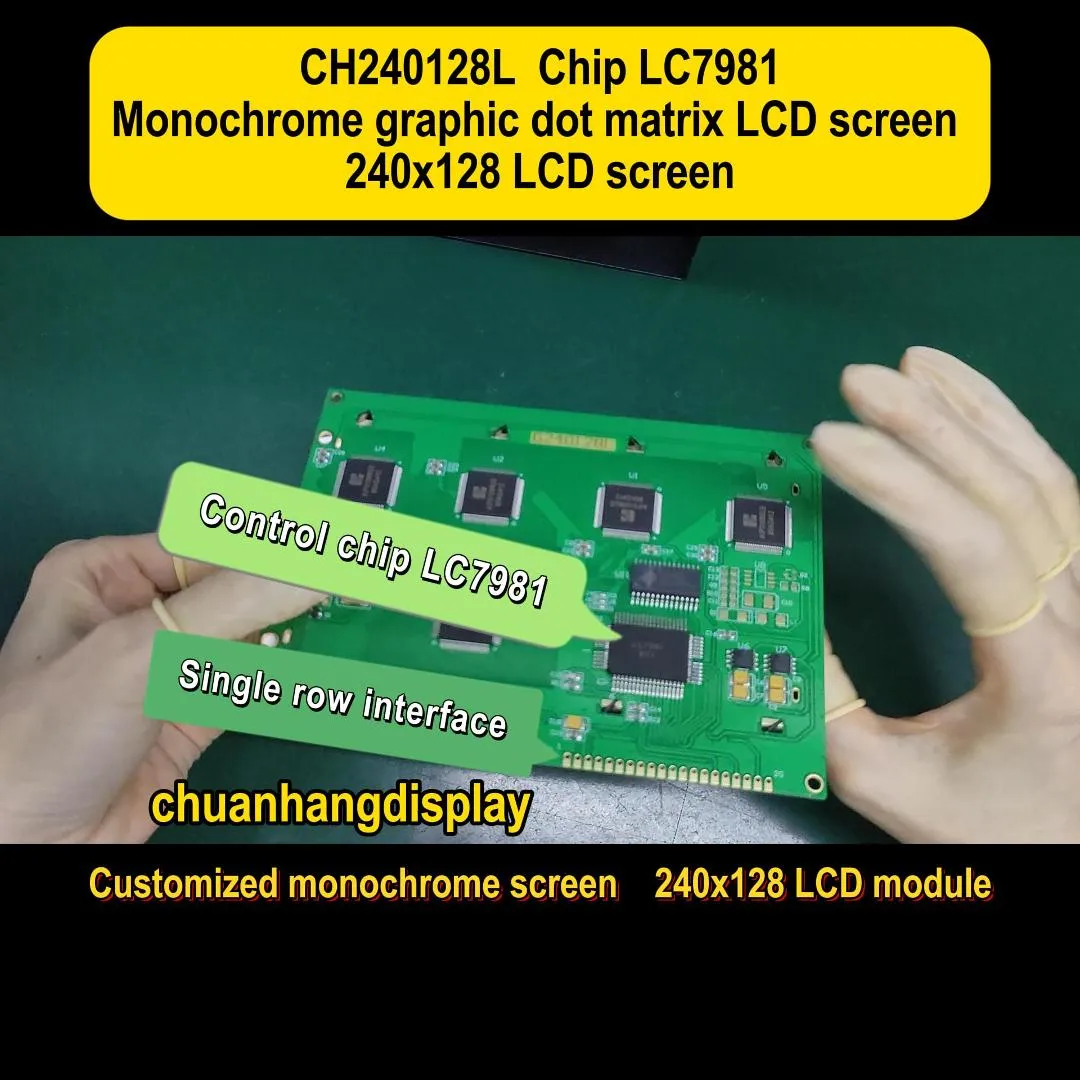
With a dedicated R&D team and automated assembly lines, Chuanhang Display ensures consistent quality. Every dot matrix lcd display module undergoes rigorous optical and electrical testing. They provide:
STN, FSTN, and VA (Vertical Alignment) technologies.
Wide temperature options (-30°C to +80°C).
Custom COB (Chip-on-Board) and COG (Chip-on-Glass) designs.
Fast prototyping (2–3 weeks for samples).
Their engineers help integrate the dot matrix lcd display module into your hardware, reducing development risk.
To maximize the life of your dot matrix lcd display module, follow these guidelines:
Avoid prolonged exposure to direct sunlight (UV can degrade polarizers).
Clean with isopropyl alcohol and a soft cloth – never abrasive cleaners.
Ensure the supply voltage stays within specified limits (±5%) to prevent contrast drift.
If the display shows flickering, check the backlight driver and contrast adjustment circuit.
Proper handling ensures the dot matrix lcd display module operates reliably for years.
In summary, the dot matrix lcd display module continues to be a smart choice for applications requiring simple, durable, and power‑efficient visual output. By evaluating specifications, supplier capabilities, and environmental needs, you can select the right module for your project. For expert guidance and quality products, Chuanhang Display offers a comprehensive range backed by strong technical support.
Q1: What is the difference between a character dot matrix LCD module and a graphic dot matrix LCD module?
A1: A character dot matrix lcd display module is designed to display pre‑defined characters (usually 5×8 or 5×11 dots) and is controlled with an ASCII‑like interface. A graphic module allows you to control each pixel individually, enabling custom shapes, bar graphs, and simple images.
Q2: Can I use a dot matrix LCD module outdoors?
A2: Yes, if you select a transflective polarizer version. Transflective dot matrix lcd display modules use ambient light to improve readability in sunlight. Adding an LED backlight helps in low‑light conditions.
Q3: How do I determine the correct supply voltage for the module?
A3: Most modules operate at 5V or 3.3V logic. Check the datasheet’s “Absolute Maximum Ratings” section. Some dot matrix lcd display modules include an onboard voltage converter for the LCD drive (typically 8–12V).
Q4: What is the typical lifespan of an LED backlight in a dot matrix LCD module?
A4: LED backlights generally last 50,000 to 100,000 hours, depending on drive current and ambient temperature. Running the LED at the recommended current (often 20–40 mA) ensures maximum life of your dot matrix lcd display module.
Q5: Does Chuanhang Display offer custom dot matrix LCD modules?
A5: Absolutely. Chuanhang Display provides custom glass, COB, and COG solutions. You can specify resolution, viewing angle, backlight color, and even embedded fonts. Their engineering team assists with the entire development process.
Q6: Why does my module show faint characters or uneven contrast?
A6: This often indicates an incorrect contrast voltage (Vo). Adjust the potentiometer or the PWM signal feeding the Vo pin. Also verify that the temperature compensation circuit is suitable for your environment. A high‑quality dot matrix lcd display module should have uniform contrast across the entire display area.
Q7: Can I daisy‑chain multiple dot matrix LCD modules?
A7: Some graphic modules with an SPI interface allow daisy‑chaining via chip‑select lines. Character modules can be connected in parallel if you manage the Enable and Register Select signals separately. Consult the controller datasheet of your specific dot matrix lcd display module.
For detailed specifications and pricing, visit Chuanhang Display’s official website and explore their extensive portfolio of dot matrix lcd display modules.