For original equipment manufacturers (OEMs) and system integrators, the choice of an LCD display supplier directly impacts product yield, field failure rates, and development timelines. A single batch of displays with inconsistent backlight brightness or missing controller compatibility can halt production lines for weeks. Yet many procurement teams focus solely on unit price and minimum order quantity (MOQ), ignoring technical audits that separate reliable suppliers from distributors of reclaimed or substandard panels.
This guide provides a structured framework for evaluating an LCD display supplier – from module types (TN, STN, FSTN, TFT) to quality management systems and long-term supply agreements. We also reference how Chuanhang Display approaches custom LCD projects with documented traceability and pre-shipment validation.

A component distributor may stock generic 16x2 character displays, but a true LCD display supplier offers engineering support, glass selection guidance, and supply chain continuity. The differences become visible when you request modifications – a different backlight color, a pin-out change, or extended temperature range.
Not all LCD display suppliers specialize in the same technologies. The four main categories are:
A qualified LCD display supplier will clearly state which technologies they manufacture in-house versus outsource. Many suppliers claim to offer TFT modules but simply rebrand generic panels without any quality control.
Volume buyers often need non-standard features. Ask your LCD display supplier about:
Chuanhang Display, as a mid-volume LCD display supplier, maintains separate production lines for custom PCB tooling, allowing customers to modify mechanical drawings without large NRE charges.
When evaluating a potential LCD display supplier, request the following data before signing a contract. Each item correlates directly with field reliability.
The industry follows ISO 13406-2 (now superseded by ISO 9241-302) for pixel defect classes. A Class II display allows up to 4 bright dots and 4 dark dots per million pixels. Many low-cost LCD display suppliers ship Class III (up to 12 defects) without disclosure. Ask specifically for:
Reliable LCD display suppliers perform routine tests on sample lots. Request reports for:
A supplier that cannot provide these test results is likely selling consumer-grade displays as industrial-rated.
B2B buyers working with an inexperienced LCD display supplier frequently encounter three recurring problems.
1. Inconsistent viewing angle from batch to batch
Cause: Fluctuations in rubbing cloth pressure during alignment layer application. Mitigation: Request a “golden sample” from first article inspection (FAI) and compare each new batch against it with a goniometer measurement.
2. Premature polarizer peeling
Cause: Low-quality adhesive or improper curing temperature. Mitigation: Ask for a peel strength test (≥ 0.5 N/cm per ASTM D903). A serious LCD display supplier will have this data.
3. Long lead times for reorders
Cause: Supplier uses a shared production line and prioritizes larger customers. Mitigation: Negotiate a rolling forecast commitment (e.g., 12-week rolling demand) and safety stock agreement.
A transparent LCD display supplier breaks down cost into four components:
Lowest quote does not mean lowest total cost. For example, a cheaper LCD display supplier might use 0.5mm glass instead of 0.7mm, leading to higher breakage in your assembly line (2-3% vs 0.2%). Calculating true landed cost includes rework labor and production downtime.
Typical MOQ from a direct LCD display supplier ranges from 500 to 2,000 pieces for standard modules, and 2,000 to 5,000 for custom glass shapes. Below these quantities, you pay a prototype fee that doubles the per-unit price. For projects under 1,000 units annually, consider working with a supplier that offers pooled production (combining multiple small orders into one glass master).
Chuanhang Display operates a low-MOU program for engineering samples (10–50 pieces) at 2x standard pricing, with the excess refunded against a production order of 1,000+ units.
A professional LCD display supplier must provide documented compliance for the regions you ship to:
Additionally, ISO 9001:2015 (quality management) and ISO 14001:2015 (environmental) are baseline. For automotive applications, require IATF 16949 – a certification many general-purpose LCD display suppliers do not hold.
Use this list during your initial qualification call with any LCD display supplier:
A supplier unable to answer these questions without referring to a manager is likely a trading company, not a manufacturer.
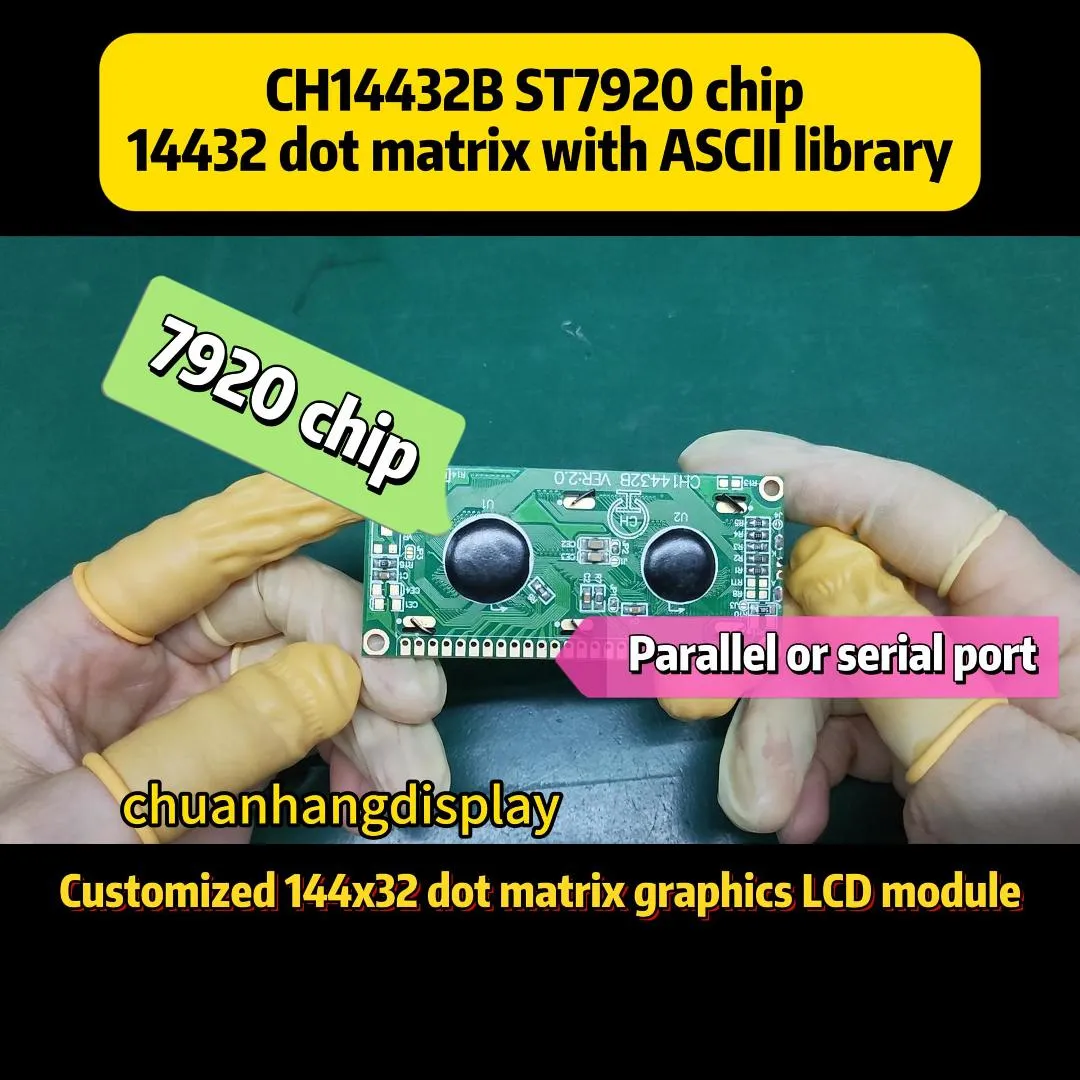
Switching an LCD display supplier mid-project carries risks: different controller initialization sequences, changed connector pinouts, or altered mechanical drawings. For products with expected lifespans of 5+ years, the selected supplier must commit to:
Chuanhang Display structures supply agreements with a 24-month LTB clause and maintains a cross-reference database for pin-compatible replacements.
Q1: How do I verify if an LCD display supplier actually manufactures the panels or just rebrands them?
A1: Request a factory tour (physical or video) showing cleanroom conditions, COG bonding equipment, and optical inspection stations. Ask to see the glass cassette loading area – rebranders cannot show this. Also check their ISO certificate scope: “Design and manufacturing of LCD modules” is the correct wording.
Q2: What is the typical cost difference between TN and TFT modules from the same LCD display supplier?
A2: For a 3.5-inch diagonal, a TN monochrome module costs $2.50–$4.00 in volume. A TFT with the same size and resistive touch starts at $8.00–$12.00. The gap narrows for larger sizes (7-inch TFT can be $15, while a comparable STN monochrome is rare above 5 inches).
Q3: Can one LCD display supplier provide both character LCDs and TFTs with consistent quality?
A3: Some can, but many specialize. Character LCDs use different process steps (rubbing alignment, fluid injection) versus TFT (array process, color filter). Verify their production lines are separate or that they have documented process controls for each type. Chuanhang Display maintains separate teams for passive (character/graphic) and active (TFT) modules.
Q4: How long does it take to get custom LCD glass from a supplier after design approval?
A4: Tooling for photomasks takes 2-3 weeks. Glass processing (deposition, etching, rubbing) requires 4-6 weeks. Assembly, backlight attachment, and testing add 2-3 weeks. Total typical lead time: 8-12 weeks for first articles. A responsive LCD display supplier will offer 5-day engineering samples for existing glass sizes (no new tooling).
Q5: What happens if a module fails after 18 months in the field? How does the supplier handle returns?
A5: Warranty terms vary. Professional LCD display suppliers provide failure analysis (FA) at no cost for the first 3 failures per batch. They should issue a corrective action report (8D format) within 10 working days. Replacement modules or credit is typically pro-rated after the warranty period (12 months). Always negotiate this before ordering.
Choosing the right LCD display supplier requires technical due diligence, not just comparing price sheets. Document your module requirements (viewing angle, brightness, operating temperature, connector type) and send them to at least three candidates. Compare their responses on quality data, lead time commitments, and engineering support.
For buyers needing a partner with custom glass capabilities, documented testing, and volume flexibility, Chuanhang Display provides initial consultation, datasheet review, and sample approval within 10 working days.
Contact Chuanhang Display today with your LCD specifications – include target annual volume, preferred module type (TN/STN/TFT), and any required certifications. A technical sales engineer will respond with a detailed quotation and quality plan within 48 hours.