The 12864 LCD remains a staple in industrial human-machine interfaces (HMIs) decades after its introduction. Its 128×64 pixel resolution offers a sweet spot – enough graphical capability for menus, icons, and small fonts, yet low power and cost-effective. For B2B buyers, selecting the right 12864 LCD module involves understanding not just resolution, but also LCD type (STN, FSTN, VATN), interface protocols, on-board controllers, mechanical integration, and supply chain reliability.
This article provides a deep-dive technical analysis of 12864 LCD modules, addresses real-world industry pain points, explains material choices like COG versus COB, and guides you through pricing benchmarks and supplier evaluation. We will reference Chuanhang Display’s engineering approach where relevant to illustrate best practices.
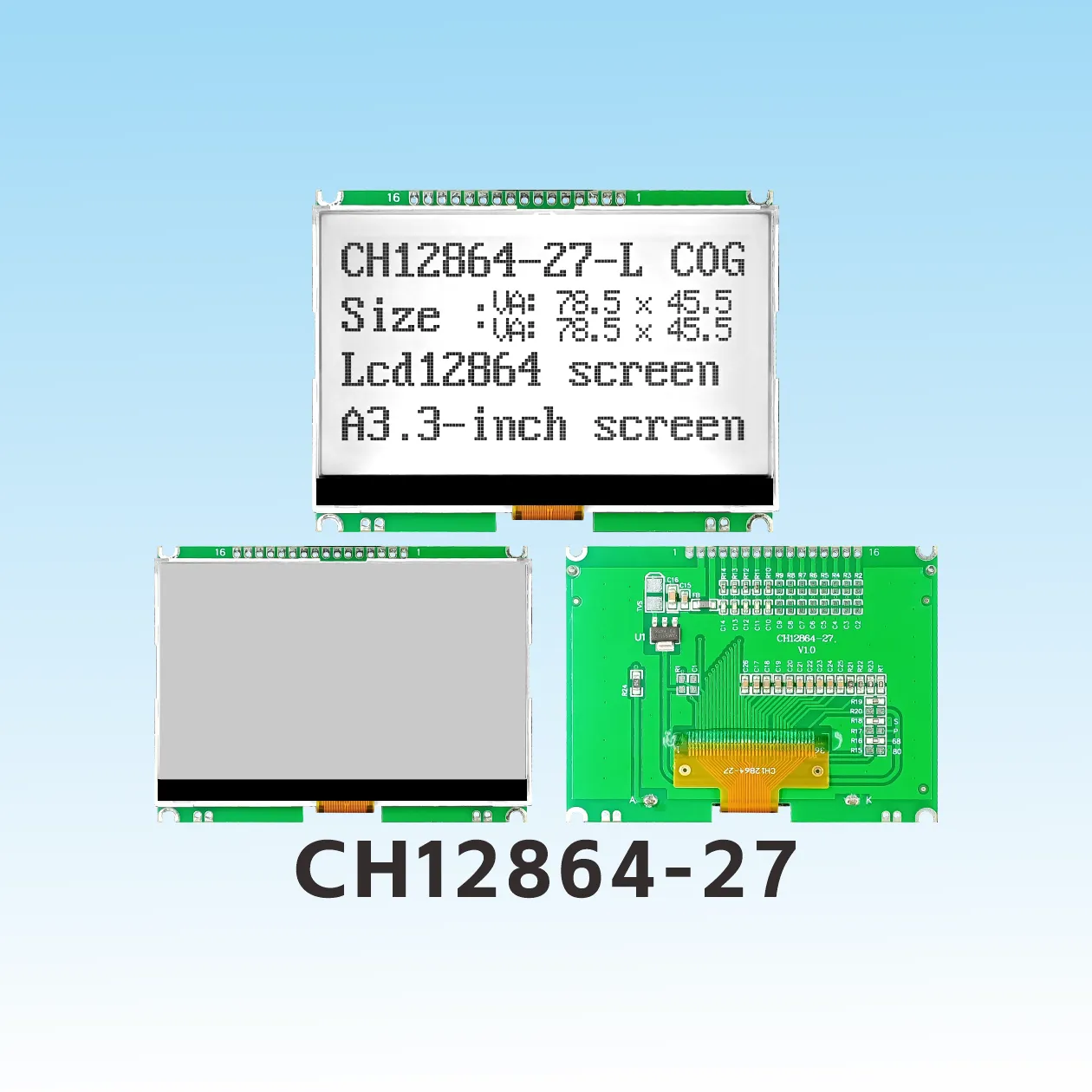
A 12864 LCD contains a matrix of 128 columns and 64 rows. Each pixel is controlled by row and column drivers. The core technical specifications that distinguish quality modules from mediocre ones include:
Most 12864 LCD modules incorporate a built-in controller, such as:
Interface selection impacts your microcontroller choice and PCB layout:
Engineers at Chuanhang Display note that many field failures trace to voltage mismatch or logic level incompatibility. Always verify the operating voltage (typically 3.3V or 5V) and ensure level shifting for mixed-voltage systems.
Not all 12864 LCD modules look the same. The liquid crystal mode determines contrast, viewing angle, and operating temperature:
| Type | Contrast | Viewing Angle | Temp Range | Cost | Typical Use |
|---|---|---|---|---|---|
| STN (yellow-green) | Moderate | Narrow (6-12 o’clock) | 0°C~50°C | Low | Indoor consumer |
| FSTN (black/white) | High | Wide (6-12 or 12-6) | -20°C~70°C | Medium | Industrial panels |
| VATN (vertical alignment) | Very high | Ultra-wide (>80°) | -30°C~80°C | High | Medical, outdoor |
For outdoor or high-vibration environments, choose FSTN positive (white background, black characters) with an LED backlight.
Transflective 12864 LCD panels combine a reflective polarizer with a partial backlight – they work in direct sun and in dark rooms. For battery-operated handhelds, a reflective LCD without backlight saves power, but you lose nighttime usability.
Two dominant packaging methods:
If your final product faces shock or vibration (e.g., forklift dashboard), COB with a robust metal frame is safer. For handheld medical devices where thickness matters, COG is preferable.
B2B buyers frequently encounter these issues when sourcing 12864 LCD modules:
One overlooked specification is the operating temperature range. Many low-cost 12864 LCD modules claim “industrial grade” but only guarantee -10°C to 60°C. True industrial applications need -30°C to 80°C with storage at -40°C. Always ask for the test report.
Pricing for 12864 LCD modules varies widely based on volume, LCD type, interface, and customization. Below are benchmark ranges (USD, FOB China, 2026 estimates):
| Volume | COB, STN, parallel | COG, FSTN, SPI | Custom VA (VATN) + touch |
|---|---|---|---|
| 100-499 pcs | $3.80 – $5.20 | $4.50 – $6.00 | $9.00+ |
| 500-1999 pcs | $2.90 – $4.00 | $3.50 – $4.80 | $7.50+ |
| 2000-9999 pcs | $2.20 – $3.10 | $2.70 – $3.80 | $6.00+ |
| 10,000+ pcs | $1.60 – $2.40 | $2.00 – $3.00 | $4.80+ |
Additional cost factors:
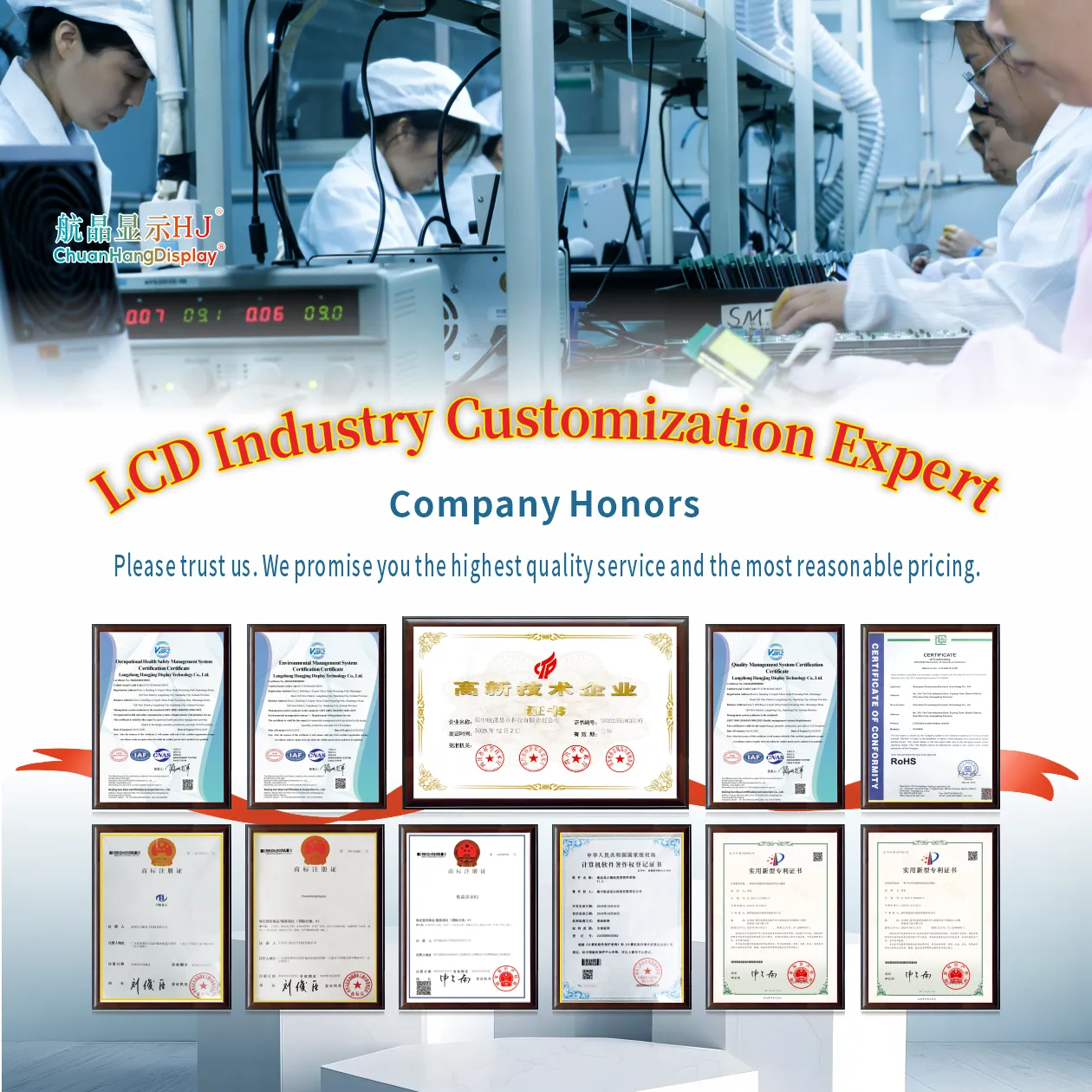
When reliability and technical support matter more than saving $0.20 per unit, Chuanhang Display has built a reputation for consistent quality and engineering collaboration. Their 12864 LCD portfolio includes:
Chuanhang Display provides full electrical and mechanical drawings before sampling, and their failure rate (measured over 2023-2025) stays below 0.3% after 1,000-hour life testing. For buyers integrating a 12864 LCD into medical or automotive prototypes, this level of traceability is non-negotiable.
The 12864 LCD remains a cost-effective, versatile choice for industrial HMIs, medical devices, and instrumentation. Success depends on matching the LCD type (FSTN vs STN), interface (SPI vs parallel), and packaging (COG vs COB) to your specific operating environment and assembly process.
Avoid the common pitfalls of inconsistent backlighting, poor contrast, and long lead times by working with suppliers who provide clear specifications and pre-shipment optical testing. For mission-critical designs, consider Chuanhang Display as a partner that offers both standard and semi-custom 12864 LCD modules with documented quality control.
Q1: What is the difference between a 12864 LCD and a 12864 OLED?
A1: A 12864 LCD uses liquid crystals and a backlight or reflector to modulate light. An OLED (organic light-emitting diode) emits its own light per pixel. OLEDs offer higher contrast and thinner profiles but have shorter lifespan (especially blue pixels) and are more expensive. For outdoor or 24/7 industrial use, an 12864 LCD with FSTN technology is more durable and readable in sunlight.
Q2: Can I run a 12864 LCD directly from a 3.3V microcontroller without level shifters?
A2: It depends on the built-in controller. Many modern 12864 LCD modules (using SSD1306 or SH1106) accept 3.3V logic. However, legacy KS0108-based modules require 5V. Always check the “Vdd” and “Vlcd” specifications. If the module’s maximum input high voltage (VIH) is below 3.5V, 3.3V is safe. Otherwise, use a level shifter or a 5V-tolerant MCU.
Q3: What is the typical lifespan of a backlit 12864 LCD?
A3: With white LED backlights rated at 50,000 hours (continuous operation at 25°C), that equals about 5.7 years. However, high ambient temperatures (above 60°C) reduce LED life by 50% for every 10°C increase. For hot environments, choose a 12864 LCD with overdriven LEDs (higher current de-rated by thermal management) or use a reflective panel without backlight.
Q4: How do I fix a flickering display on my 12864 LCD?
A4: Flickering typically comes from insufficient refresh rate or unstable driving voltage (Vlcd). First, check that your microcontroller’s SPI/parallel timing matches the datasheet (especially the enable pulse width). Second, measure the contrast adjustment voltage (often called V0 or VEE). A poorly regulated charge pump can cause V0 to ripple. Add a 10µF capacitor near the LCD connector. If the issue persists, it may be a defective module.
Q5: What MOQ (minimum order quantity) should I expect for a custom 12864 LCD with FSTN and wide temperature range?
A5: For COB modules with minor changes (e.g., backlight color, pin header orientation), MOQ typically starts at 500-1000 units. For COG modules or full glass changes (e.g., custom active area), MOQ often ranges from 3,000 to 5,000 units. Some suppliers like Chuanhang Display offer low MOQ prototypes (50-100 pieces) for design validation before mass production.
Q6: Is the 12864 LCD compatible with Raspberry Pi or Arduino?
A6: Yes, fully. Both platforms have abundant libraries. For Arduino, the U8g2 library supports most 12864 LCD controllers (KS0108, SSD1306, SH1106) over I2C, SPI, or parallel. For Raspberry Pi, use the Adafruit_CircuitPython_SSD1306 library or the ‘lcd’ kernel module. Note that 5V Arduino boards require level shifters when connecting to 3.3V-only modules.
Q7: Can I get a 12864 LCD with a capacitive touch panel overlay?
A7: Yes, but it is uncommon and expensive. Most touch overlays for graphic LCDs are resistive (4-wire or 5-wire) because the 12864 LCD is typically used in gloved or stylus-friendly industrial environments. Capacitive touch would require a separate sensor glass bonded to the LCD, increasing cost by $5-$10 per unit. If you need touch, resistive remains the practical choice.
Stop wasting weeks evaluating unreliable suppliers. Send your technical requirements (target resolution, interface, temperature range, volume, and any mechanical constraints) to Chuanhang Display for a detailed quotation and sample plan. Their engineering team will recommend the optimal 12864 LCD variant – COB or COG, STN or FSTN, parallel or SPI – and provide 2D drawings within 48 hours.
Request a Quote Now – Include your company name, application, and estimated annual usage for priority response.