For engineers and procurement specialists working with character-based display modules, the JHD162A LCD display remains a widely adopted solution across industrial controls, medical devices, and consumer electronics. This 16x2 alphanumeric module offers a balance of simplicity, readability, and driver compatibility. However, sourcing a reliable JHD162A LCD display involves more than matching pin counts – it requires evaluating controller authenticity, backlight uniformity, temperature range, and supplier consistency.
In this guide, we examine the technical architecture, application fit, common failure modes, and procurement best practices for the JHD162A LCD display. We also highlight how Chuanhang Display supports B2B clients with traceable components and short lead times.

The JHD162A LCD display belongs to the family of character LCDs built around the Hitachi HD44780 controller or its compatible equivalents (such as the Samsung KS0066 or Sitronix ST7066). This controller standard is what gives the JHD162A its cross-platform usability – from 8051 microcontrollers to Raspberry Pi GPIOs.
The module uses a 4-bit or 8-bit parallel interface. In 4-bit mode, it saves four I/O lines, a common choice for embedded designs with limited pins. Key signals include:
The built-in character generator ROM (CGROM) provides 192 standard characters (ASCII plus Japanese, European, and Cyrillic extensions). Additionally, the CGRAM (character generator RAM) allows designers to create up to 8 custom symbols – useful for battery icons, arrows, or unit indicators.
A properly functioning JHD162A LCD display operates at 5V DC (typical tolerance 4.7V to 5.3V). The backlight consumes separate power – usually 4.2V to 5V for LED backlight, with current around 20–30 mA per LED if using the standard yellow-green or blue-white versions.
Contrast adjustment requires a variable resistor (typically 10kΩ) between V0 pin and VSS. Without proper contrast biasing, the JHD162A LCD display will show faint characters or blocky patterns. In mass production, fixed resistor dividers are sometimes used, but a potentiometer is preferred for field tuning across temperature shifts.
Despite newer OLED and graphical LCD technologies, the JHD162A LCD display remains in active production for several reasons: low power in reflective mode, excellent sunlight readability with transflective polarizers, and zero pixel burn-in.
Common B2B applications include:
The 16x2 format (16 characters per line, two lines) provides enough space for simple menus, error codes, or measurement values without overwhelming the operator.
Engineers sourcing the JHD162A LCD display frequently report three recurring issues. Understanding these helps avoid field failures.
1. Inconsistent contrast across temperature
Some clone modules use low-grade LCD fluid that becomes too dark at 50°C or too faint at 0°C. A genuine JHD162A LCD display from a qualified supplier like Chuanhang Display uses wide-temperature fluid (operating range -20°C to +70°C) with stable viscosity.
2. Backlight brightness degradation
LED backlights in cheap modules often use under-rated current or poor thermal management. Over 6–12 months, brightness drops by 30% or more. Quality JHD162A LCD display units employ constant-current drive and aluminum-backed PCBs for heat dissipation.
3. Missing or counterfeit HD44780 controllers
Some suppliers replace the standard controller with a reduced-function ASIC that fails with custom characters or does not support 4-bit mode correctly. Authentic JHD162A LCD display modules use recognized controller IP, verified through register tests.
The physical construction of the JHD162A LCD display directly affects its lifespan in industrial environments. Key material choices include:
The module’s overall dimensions are typically 80.0mm x 36.0mm with an active area of 66.0mm x 16.0mm. Weight is approximately 30g, suitable for handheld devices.
For B2B buyers, the unit price of a JHD162A LCD display ranges from $2.50 to $6.00 depending on quantity, backlight color, temperature grade, and conformity certifications (RoHS, REACH).
When qualifying a vendor for the JHD162A LCD display, request:
Many distributors list the JHD162A LCD display as a generic item, but only a few perform incoming inspection on contrast uniformity and pin alignment. Chuanhang Display provides a 12-month warranty and pre-shipment electrical testing for every batch of 100 units or more.
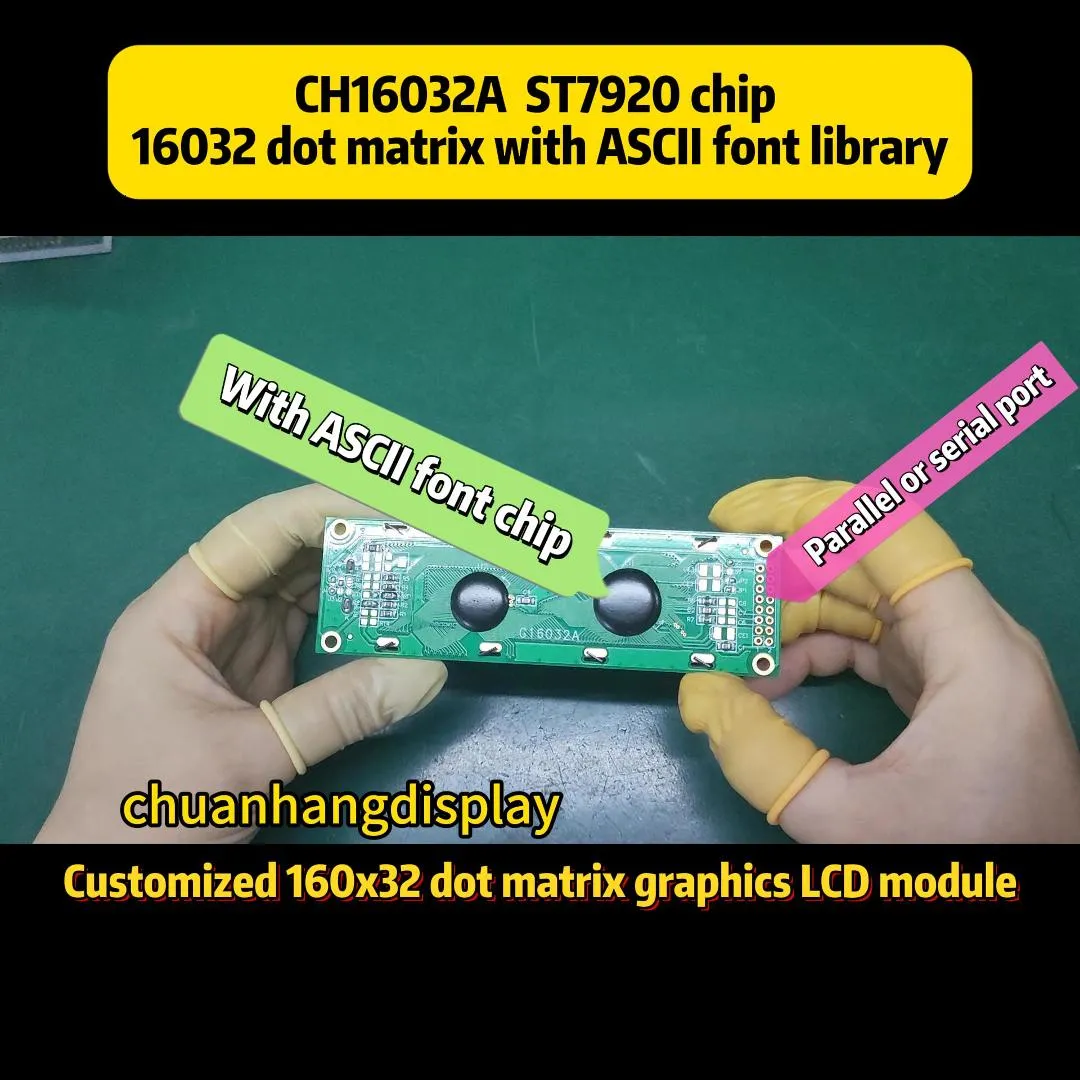
Chuanhang Display has supplied passive LCD modules, including the JHD162A LCD display, to industrial OEMs since 2010. Our process includes:
For projects requiring a JHD162A LCD display with guaranteed HD44780 behavior and consistent backlight color across batches, Chuanhang Display provides engineering samples within 5 working days and production lead times as short as 15 days.
Q1: What is the operating voltage of the JHD162A LCD display?
A1: The logic section requires 5V DC ±5%. The LED backlight typically runs at 4.2V to 5V with a current-limiting resistor. For 3.3V systems, a level shifter or a dedicated 3.3V-compatible variant (with on-board boost converter) is needed.
Q2: Can the JHD162A LCD display show custom symbols like battery icons or logos?
A2: Yes. The HD44770 controller includes 64 bytes of CGRAM, allowing up to 8 custom characters (5x8 pixels each). You define the pixel pattern in software and then display it as a normal character code (0x00 to 0x07).
Q3: How do I distinguish an authentic JHD162A LCD display from a counterfeit?
A3: Run a controller ID test – read the busy flag and try writing a custom character. Fakes often ignore the busy flag or corrupt CGRAM data after power cycling. Also check contrast stability: genuine modules show uniform character darkness across all 32 positions.
Q4: What is the typical lifespan of the LED backlight on this module?
A4: With proper current limiting (20 mA per LED) and ambient temperatures below 50°C, the backlight retains >70% brightness for 50,000 hours (about 5.7 years of continuous operation). High-quality suppliers like Chuanhang Display bin LEDs to ensure this specification.
Q5: Does the JHD162A LCD display require an external driver IC?
A5: No. The HD44780 controller and its driver ICs (such as the HD44100 for segment drive) are integrated onto the module’s PCB. You only need a microcontroller with 6 to 11 GPIO pins (depending on 4-bit or 8-bit mode) and a contrast adjustment potentiometer.
Whether you need a standard JHD162A LCD display for a production run of 5,000 units or a customized version with extended temperature range, Chuanhang Display provides technical datasheets, competitive pricing, and pre-shipment validation. Request a quote or sample kit today – include your target volume, backlight color, and any required certifications.
Contact Chuanhang Display now for specifications, lead times, and volume pricing.
(Email, web form, or direct sales inquiry available – no automated chat bots, only direct engineering support.)