Standard off-the-shelf LCD modules serve many applications, but they impose fixed mechanical outlines, limited temperature ranges, and pre‑defined character or graphic resolutions. When your product demands a unique aspect ratio, non‑standard voltage, integrated touch panel, or extreme durability, engineering a custom solution becomes necessary. A capable custom lcd display manufacturer bridges the gap between your mechanical enclosure constraints and the optical performance required for reliable field operation.
This guide explains the technical decisions involved in custom LCD development, the material trade‑offs that affect long‑term reliability, and the cost structure you should expect. It also outlines qualification steps to separate high‑volume specialists from low‑quality assemblers. Whether you design medical devices, industrial controls, or automotive clusters, the following information helps you specify, source, and validate custom displays efficiently.
Many engineers begin with a standard module, only to discover dimensional, electrical, or environmental mismatches. A custom custom lcd display manufacturer becomes necessary under these conditions:
When you engage a custom lcd display manufacturer, the following parameters become fully negotiable. Understanding each gives you leverage during design review.
Most LCDs use soda‑lime glass (0.55mm, 0.7mm or 1.1mm thickness). For lightweight or flexible products, request thinner glass (0.3mm or 0.4mm). The cell gap (distance between two glass plates) determines response time and contrast. Typical gaps range from 4µm to 8µm. Smaller gaps give faster response but narrower viewing angle. Your manufacturer should simulate the gap based on your LC fluid choice.
Polarizer surface treatments include glare (standard), anti‑glare (matte, reduces reflections), and anti‑reflection (multi‑layer coating, premium).
| Fluid Type | Response Time | Temperature Range | Typical Application |
|---|---|---|---|
| TN (Twisted Nematic) | 10–20 ms | 0°C to +50°C | Low‑cost, narrow viewing angle |
| STN (Super TN) | 80–150 ms | -10°C to +70°C | Wider angle, industrial |
| FSTN (Film STN) | 100–200 ms | -20°C to +80°C | Black/white, high contrast |
| VA (Vertical Alignment) | 10–30 ms | -20°C to +70°C | Deep black, wide viewing |
| HTN (Hyper TN) | 30–60 ms | -10°C to +60°C | Between TN and STN |
For outdoor applications requiring visibility from extreme angles, FSTN or VA fluids are preferred despite slower response. For real‑time graphs (e.g., ECG monitors), TN or VA with overdrive circuitry is better.
Custom backlights use LED light bars on one edge (edge‑lit) or a matrix behind (direct‑lit). Edge‑lit is thinner but less uniform on large areas. Direct‑lit allows zone dimming but adds thickness. Key parameters:
The physical assembly method affects cost, thickness, and reliability. A custom lcd display manufacturer should offer all three, with clear recommendations based on your volume and shock/vibration requirements.
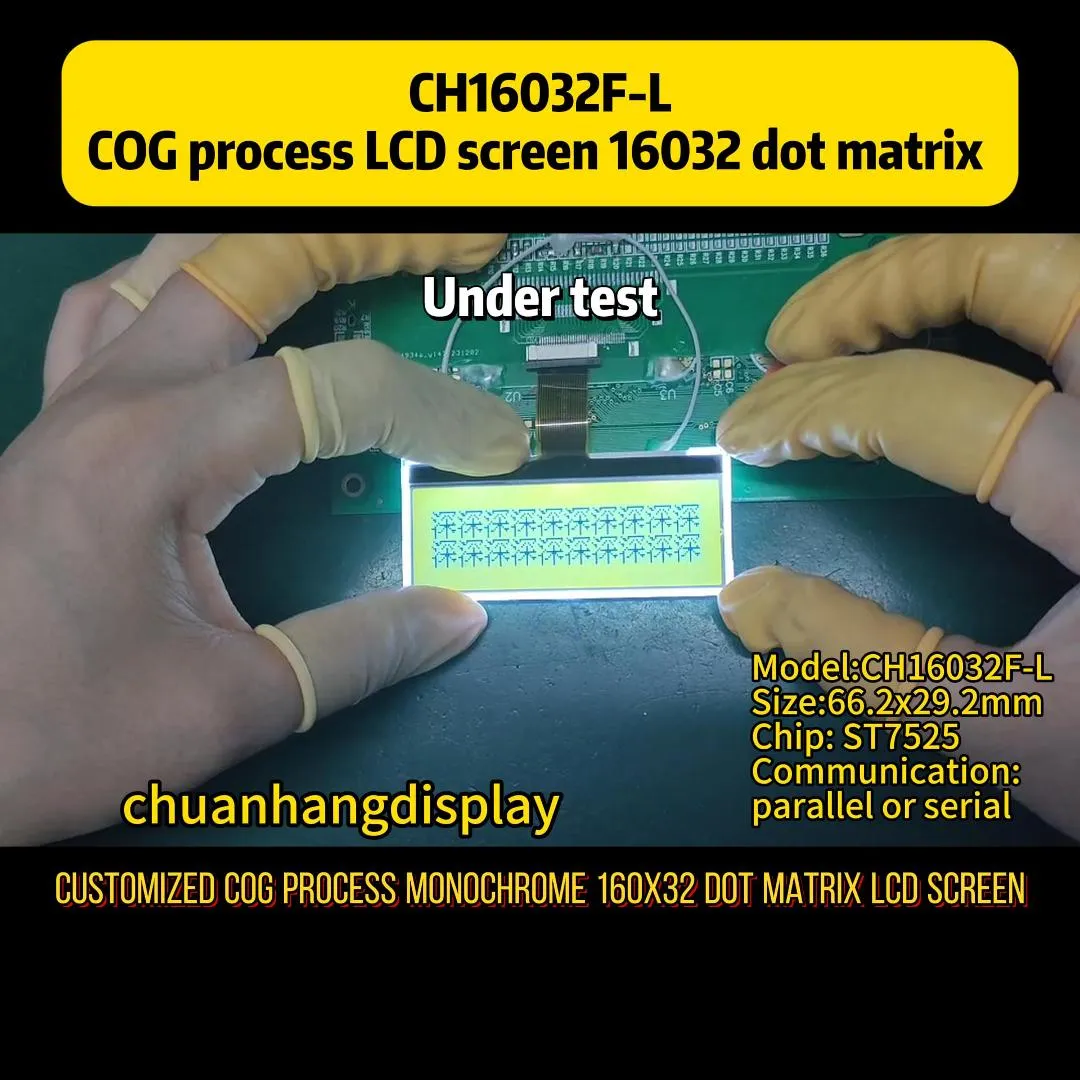
Chuanhang Display routinely designs COG and COB modules, with in‑house ACF bonding lines that maintain alignment tolerances below ±15µm.
Different industries impose unique validation standards. A medical display manufacturer needs ISO 13485; automotive requires IATF 16949 and AEC‑Q100 components. Here is how a specialized custom lcd display manufacturer adapts to each sector.
A reliable custom lcd display manufacturer follows a structured phase‑gate process. Expect these stages:
Before approving a custom lcd display manufacturer, review their test plan. Minimum required tests include:
A manufacturer that cannot provide raw data from these tests is not suitable for mission‑critical products. Chuanhang Display supplies a certificate of analysis (CoA) for every batch, including uniformity measurements and defect counts.

When requesting a quote from any custom lcd display manufacturer, you will see these line items:
| Cost Component | Typical Range | Notes |
|---|---|---|
| Non‑recurring engineering (NRE) | $1,500 – $8,000 | Higher for COG (new IC bonding program) or multiple custom masks. |
| Sample unit price | $8 – $40 per piece | Based on complexity, backlight type, and quantity of samples (typically 10–20 units). |
| Production unit price (10k/year) | $3 – $15 | COB cheaper at low volume; COG cheaper above 100k/year. |
| Tooling amortization | Often included in NRE or spread over first 50k units | Clarify whether NRE refundable after reaching volume commitment. |
| Lead time (engineering samples) | 4 – 8 weeks | Faster for manufacturers with in‑house mask shop and LC filling line. |
| Lead time (mass production) | 3 – 5 weeks after sample approval | Excluding shipping. |
Negotiation levers: reducing the number of custom mask layers (e.g., using a standard character set instead of custom icons), accepting a wider brightness tolerance (±20% vs ±10%), or consolidating multiple display sizes into one glass master.
Not every custom lcd display manufacturer has the same vertical integration. Look for these competencies:
Long lead times for changes – Some suppliers take 12 weeks to revise a glass mask. A vertically integrated maker like Chuanhang Display reduces this to 3‑4 weeks by controlling mask generation and glass etching in‑house.
Poor documentation of timing and contrast – Many low‑cost suppliers provide generic data sheets that do not match the delivered sample. Demand measured values at three temperatures (0°C, 25°C, 50°C) for contrast, response, and viewing angle before approving production.
Inconsistent backlight color – Batch‑to‑batch variation in LED bins produces yellow or blue tint. Your custom lcd display manufacturer should provide a spectral distribution plot and commit to a MacAdam ellipse 4‑step or tighter.
No ESD protection on FPC – Without integrated TVS diodes or shielding, field failures from electrostatic discharge can reach 5‑10%. Request ESD protection components mounted on the FPC stiffener.
Q1: What is the minimum order quantity (MOQ) for a fully custom LCD display?
A1: MOQ varies by complexity. For a simple TN COB module with standard polarizers, MOQ can be as low as 1,000 units. For a COG module with custom FPC and optical bonding, typical MOQ is 5,000–10,000 pieces. Some custom lcd display manufacturers, including Chuanhang Display, accept smaller MOQ (500–1,000) for customers paying a higher NRE fee or using shared tooling.
Q2: How long does a custom LCD design take from specification to first production batch?
A2: With an experienced manufacturer, engineering samples take 5–7 weeks after final specification sign‑off. Pilot production requires another 3–4 weeks for assembly and testing. Mass production typically begins 10–14 weeks from project kick‑off. Factors that extend timeline: multiple iterations of mechanical drawings, custom character mask design, or qualification testing for medical/automotive standards.
Q3: Can a custom LCD display manufacturer add a capacitive touch panel to an existing LCD design?
A3: Yes. The touch sensor can be bonded to the cover glass (on‑cell) or integrated into the LCD stack (in‑cell). On‑cell is easier to qualify with an existing LCD design because it does not change the liquid crystal cell. In‑cell reduces thickness by one layer but requires re‑engineering the cell gap. Discuss your mechanical stack‑up early; the manufacturer will recommend the approach based on your thickness and optical requirements.
Q4: What causes uneven brightness on a custom backlit LCD, and how is it prevented?
A4: Uneven brightness (mura) comes from inconsistent LED spacing, poor diffuser sheet quality, or warped light guide plates. A high‑quality custom lcd display manufacturer uses simulation software (LightTools or TracePro) to model LED positioning and adds micro‑optical patterns on the light guide. They also measure nine‑point luminance uniformity (typically >80%) on every batch using a photometer.
Q5: Are there cost savings in combining multiple display sizes into one custom glass master?
A5: Yes. If you require two different module sizes (e.g., 2.4‑inch and 3.5‑inch), a single large glass master can be scribed and broken into both sizes. This reduces mask tooling NRE by 30–50% and lowers unit cost because glass utilization improves. However, the two displays must share the same cell gap and LC fluid. Your manufacturer can advise on glass panel layout optimization.
Q6: How do I verify that a custom LCD display manufacturer can supply parts for 7‑10 years without sudden obsolescence?
A6: Request a component obsolescence management plan. Reliable manufacturers stockpile enough driver ICs for three years of forecasted production and negotiate last‑time‑buy (LTB) windows from their IC suppliers. For critical projects, sign a supply guarantee agreement that includes a 12‑month LTB notice and a recommended replacement design. Chuanhang Display provides such agreements for industrial and medical clients.
Selecting a custom lcd display manufacturer is a technical partnership, not a commodity purchase. The right partner brings material science expertise, rigorous quality testing, and flexible volume scaling. Chuanhang Display has delivered custom LCDs for medical monitors, automotive clusters, and outdoor kiosks, with in‑house design and assembly under one roof.
To start: Prepare a brief that includes your target display size (millimeters), interface type (parallel, SPI, I2C), operating temperature range, backlight color, and annual volume estimate. Send it with your mechanical drawing (DXF or STEP). The engineering team will respond with feasibility, NRE cost, and sample lead time within 3 business days.
[Send Your Custom LCD Inquiry to Chuanhang Display]