Selecting an industrial OLED or LCD module is an electro-optical engineering decision that dictates your system's power budget, thermal boundaries, ambient sunlight readability, and multi-year supply chain security. Founded in 2011, Shenzhen Chuanhang Electronic Technology Co., Ltd. (Chuanhang Display) has evolved over 13 years from its roots in Bao’an, Shenzhen, into a national high-tech enterprise operating a modern 5,000-square-meter manufacturing base. Combining fully automated COG, FOG, COB, COPB, and SMT production lines with an elite R&D team, Chuanhang Display provides global OEMs with high-reliability monochrome LCD, color TFT, and custom display module solutions engineered for critical mission environments.
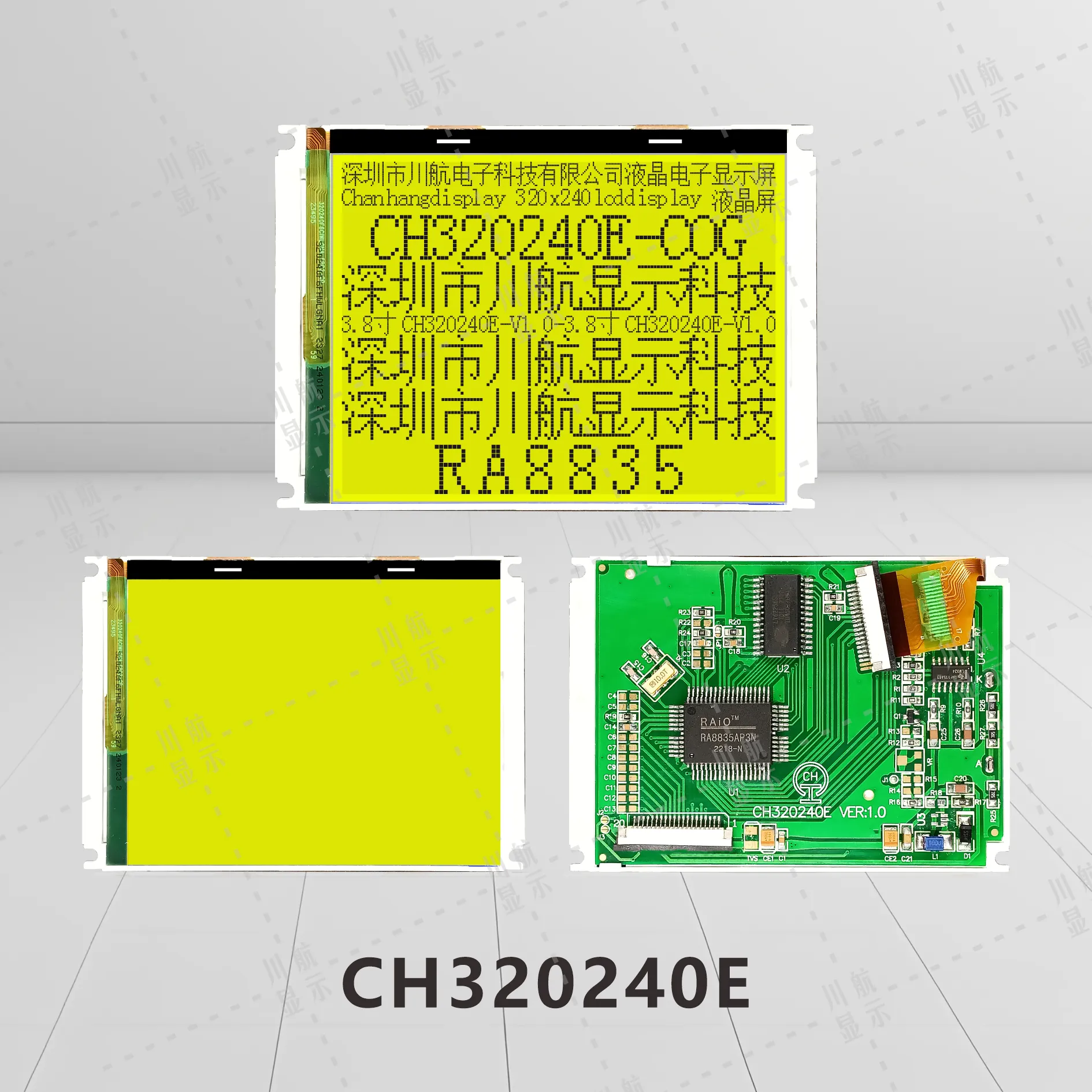
Choose an OLED module for ultra-low power dark-mode UIs, sub-zero instant response (-40°C), and razor-thin packaging in portable medical or diagnostic instruments. Choose an industrial TFT or monochrome LCD module for continuous outdoor sunlight legibility (>1,000 nits), zero risk of static UI burn-in, and 50,000+ hour lifespans in industrial HMIs. Backed by 13+ years of manufacturing experience and in-house COG/FOG/SMT automated lines, Chuanhang Display delivers turnkey OEM/ODM engineering across both display branches to match your exact mechanical and firmware architecture.
13+ Years Industrial Track Record: Established in 2011, scaling from Bao'an Xixiang to a 5,000 m² modern cleanroom production hub.
Full-Cycle Automated Lines: Complete in-house ownership over COG (Chip-on-Glass), FOG (Film-on-Glass), COB (Chip-on-Board), COPB, SMT, and TFT integration lines.
Comprehensive Product Catalog: Specialized production spanning graphic/character monochrome LCDs, high-definition TFTs, COG panels, and custom OLED assemblies.
Engineering & Scale: Over 100 skilled production technicians supported by a dedicated 10+ member R&D, optical, and sales engineering team.
| Parameter | Chuanhang Display Factory Baseline |
|---|---|
| Facility & Capacity | 5,000 m² cleanroom manufacturing base in Shenzhen; 100+ skilled staff, 10+ dedicated R&D specialists. |
| Production Lines | Dedicated COG, FOG, COB, COPB, high-speed SMT, and automated TFT assembly lines. |
| Product Portfolio | Monochrome LCDs (TN, HTN, STN, FSTN), color TFT modules (0.96" to 15.6"+), COG screens, COB modules, custom OLED integration. |
| Packaging & Bonding | Optical bonding (OCA/OCR), custom cover lenses (AG/AR/AF), custom FPC routing, and hot-bar soldering. |
| Quality Governance | Strict ISO-aligned process control across incoming glass, IC eutectic bonding, cleanroom laminar flow, and 100% optical inspection. |
The fundamental difference between OLED and LCD modules lies in their illumination physics. An OLED module utilizes self-emissive organic diodes that light up pixel-by-pixel, whereas a transmissive TFT-LCD module relies on a continuous LED backlight modulated through liquid crystal molecules and dual polarizers.
This fundamental physics gap dictates operational performance in the field. When an LCD displays pure black, residual light always bleeds around the edge of the liquid crystal matrix, limiting static contrast ratios to roughly 1,000:1. In contrast, an OLED module cuts drive current completely to unlit pixels, achieving true-black contrast (>100,000:1) and dramatic power savings on dark user interfaces.
As specified in ISO 9241-307 display ergonomics guidelines, human legibility requires stringent control over specular reflection and luminance decay. Chuanhang Display bridges both technological paths, engineering high-brightness TFTs up to 2,000 nits alongside ultra-contrast micro-OLED assemblies.
| Electro-Optical Metric | OLED Module (PMOLED / AMOLED) | Chuanhang TFT-LCD / Monochrome | Application Impact |
|---|---|---|---|
| Static Contrast Ratio | 10,000:1 – 100,000:1 (True black) | 800:1 – 1,500:1 (Backlight bleed) | OLED provides unmatched crispness for high-density medical graphics |
| Max Sustained Luminance | 300 – 600 cd/m² (Thermally constrained) | 500 – 2,000+ cd/m² (High-nit LED bars) | LCD is the gold standard for outdoor sunlight readability |
| Sub-Zero Response (-30°C) | < 100 µs (Instantaneous transition) | 150 – 400+ ms (Viscous fluid drag) | OLED eliminates the need for embedded ITO glass heaters in cold gear |
| Operational Lifespan | 30,000 – 50,000 hours (Blue subpixel decay) | 50,000 – 70,000+ hours (Field-proven) | LCD provides superior resistance against static UI image burn-in |
Reliability in display module packaging depends entirely on bond-joint integrity. Operating out of its 5,000 m² Shenzhen facility, Chuanhang Display leverages high-precision automated COG, FOG, COB, and SMT production lines to maintain micrometer-level interconnect registration under tight cleanroom parameters.
A major cause of field failure in industrial display modules is mechanical micro-fracturing at the anisotropic conductive film (ACF) interface between the glass substrate and the driver IC or flexible printed circuit (FPC). High-temperature reflow, thermal cycling, and continuous machine vibration quickly cause connection opens if bond pressure and temperature profiles drift.
Through 13 years of specialized manufacturing experience, Chuanhang Display enforces strict quality control across every dedicated line:
| Production Line | Technical Process & Tooling | Engineering Checkpoint | Reliability Advantage |
|---|---|---|---|
| COG Line (Chip-on-Glass) | Automated optical alignment, precision ACF pre-taping, thermocompression bonding | Conductive particle crush burst rate > 5 per bump | Ultra-compact Z-height, immune to line-open bonding failures |
| FOG Line (Film-on-Glass) | Dual-camera CCD vision calibration, high-stability pulsed heat bars | Pitch alignment tolerance within ±0.015 mm | Extreme tensile pull strength (>1.5 kg/cm), high vibration resistance |
| COB / COPB Line | Gold-wire / aluminum-wire ultrasonic bonding and black epoxy glob-top dispensing | Wire loop height consistency and hermetic epoxy encapsulation | Exceptional moisture and corrosion resistance for rugged outdoor meters |
| High-Speed SMT Line | High-precision surface mount placement, multi-zone nitrogen reflow oven | Automated Optical Inspection (AOI) for bridging and dry solder joints | Seamless peripheral component mounting directly onto module carrier boards |
| TFT Assembly Line | Cleanroom laminar-flow backlight stacking and precision bezel crimping | Light-leakage inspection and 9-point luminance uniformity check | Guaranteed uniform backlight distribution (>85% across active area) |
Display module performance relies directly on synchronization between the host processor and the driver IC. Chuanhang Display engineers and customizes FPC routing for 8/16-bit parallel MCU, 4-wire SPI, I2C, RGB TTL, MIPI DSI, and differential LVDS interfaces.
Adhering to electrical and display standards set by the Society for Information Display (SID) and the International Electrotechnical Commission (IEC 61747 / IEC 62341), our 10+ member R&D team fine-tunes clock frequency jitter, slew rates, and ESD suppression networks on every custom FPC tail.
Monochrome LCD Interfaces: Cost-efficient, robust 8080/6800 parallel and I2C/SPI interfaces for segment, character, and graphic displays (TN, STN, FSTN).
High-Speed Differential TFT Interfaces: 1-to-4 lane MIPI DSI and single/dual-link LVDS protocols engineered with dedicated ground shields to suppress EMI emissions in medical and automotive systems.
Chipset Sourcing Continuity: Long-term supply relationships with global driver IC vendors (Sitronix, Ilitek, Solomon Systech, FocalTech) ensuring zero end-of-life (EOL) surprises during multi-year production runs.
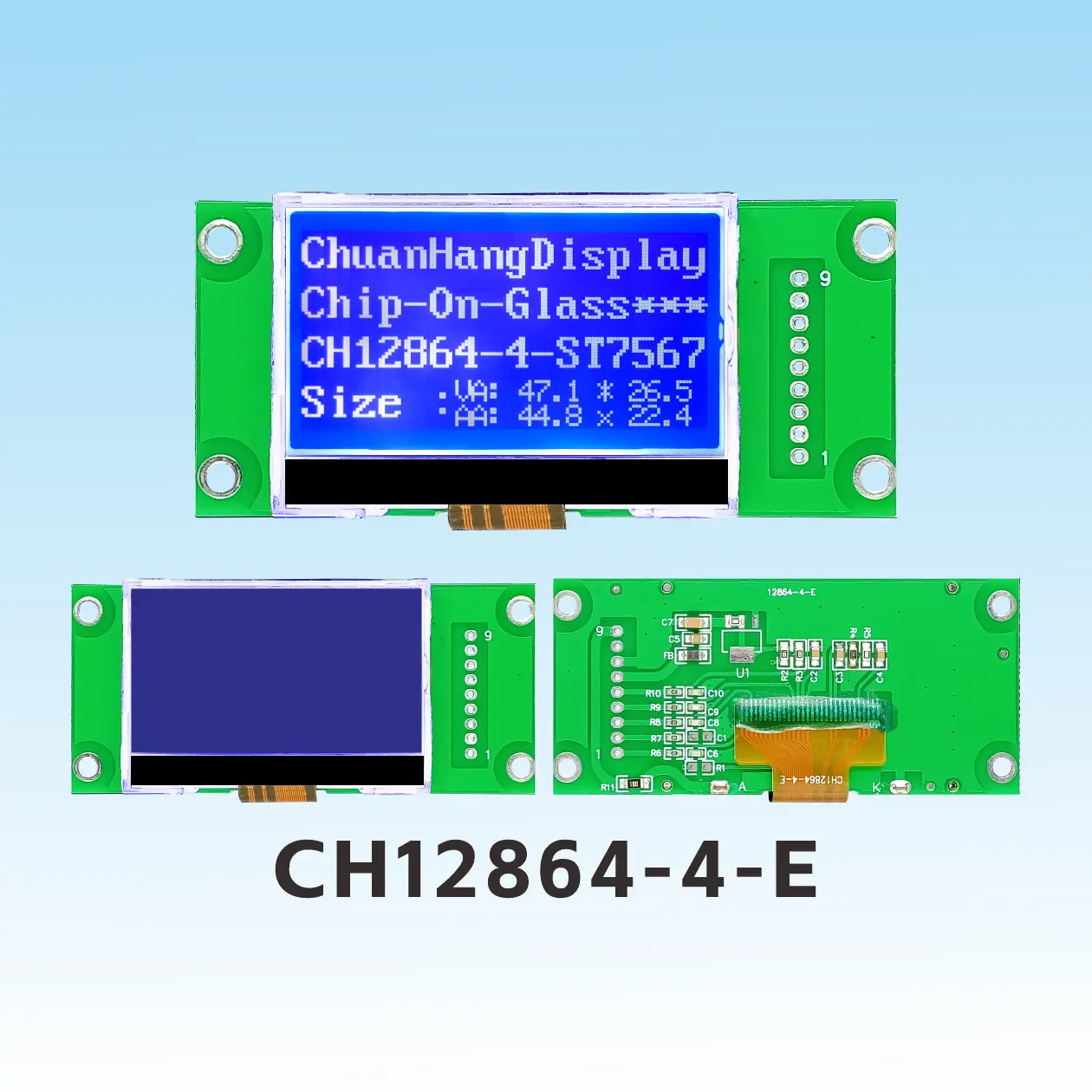
Audit factory-direct line ownership: Ensure your supplier owns dedicated COG/FOG bonding lines rather than outsourcing assembly to secondary workshops.
Demand optical bonding (OCA/OCR) for outdoor gear: Eliminating the air gap cuts surface reflection from 15% to
<0.5% and="" prevents="" internal="" condensation.="">
Verify static image burn-in safeguards: If deploying OLED for 24/7 static HMIs, mandate pixel-shift firmware or opt for Chuanhang's wide-temp IPS panels.
Leverage custom FPC pinouts: Request custom tail geometry from Chuanhang Display to match your legacy motherboard connectors without costly PCB redesigns.
Don't integrate consumer-grade panels into industrial setups: Consumer tablets lack wide operating temp ranges and suffer rapid 6-month EOL cycles.
Don't ignore cold-temperature viscosity shifts: Standard LCD modules smear and drag below -10°C; mandate wide-temp fluid (-30°C to +85°C) or OLED technology.
Don't accept air-gap bonding in high-humidity sites: Unsealed air cavities trap moisture and lead to internal fogging during rapid thermal transitions.
Don't trade with non-manufacturing brokers: Brokers cannot modify FPC timing, rebuild backlight rails, or provide direct cleanroom bonding guarantees.
Operating over 5,000 square meters of modern manufacturing space, Chuanhang Display implements a comprehensive 6-stage qualification loop to guarantee that every monochrome, TFT, and OLED display module achieves zero-defect field reliability.
Raw Glass & Driver IC Screening — 100% incoming electrical and microscopic visual inspection of bare glass cells and silicon wafers to eliminate latent micro-cracks.
Automated Cleanroom COG/FOG Thermocompression — Precise bonding executed under laminar-flow cleanroom conditions with real-time temperature-pressure logging.
Optical Uniformity & Colorimetry Profiling — 9-point luminance calibration (cd/m²), Kelvin color temperature, and chromaticity verification via calibrated spectroradiometers.
Environmental Thermal Damp Heat Soak — Chamber testing across 240+ hours under +60°C / 90% RH humidity alongside rapid thermal shock cycling (-40°C to +85°C).
PCAP Touch Tuning & Noise Immunity Testing — Calibrating touch IC firmware for water-rejection, thick glove operation, and immunity against noisy variable-frequency drives (VFD).
Cover Lens Integration & Clean Vacuum Pack — Autoclave bubble-free optical bonding (OCA/OCR) of chemically strengthened cover glass, followed by antistatic vacuum sealing.
A1: Yes. Backed by 13+ years of monochrome specialization, Chuanhang Display designs and manufactures custom TN, HTN, STN, and FSTN panels. Leveraging our in-house COG, FOG, and COB production lines, we tailor segment patterns, icon layouts, polarizer modes (transflective, transmissive, reflective), and pin/connector layouts to match your exact mechanical dimensions and power specifications.
A2: We engineer for industrial lifecycles. Chuanhang Display partners with Tier-1 glass and driver IC manufacturers that commit to 5 to 7+ years of roadmap continuity. In the event of an unavoidable component obsolescence, our in-house 10+ member R&D team provides pin-compatible drop-in replacements with matching firmware timing, guaranteeing zero mechanical chassis modifications for your end equipment.
A3: For ultra-low power sunlight operation, a transflective monochrome LCD or transflective memory-in-pixel TFT is superior, using ambient sunlight to illuminate the screen with zero backlight power draw. If a rich color graphical UI is required, choose Chuanhang’s optically bonded, high-nit TFT module (>1,000 cd/m²). While OLED excels in low ambient light, direct high-angle sunlight will wash out standard OLED panels unless driven at battery-draining luminance levels.
A4: Operating since 2011, our modern production facility houses over 100 skilled production technicians and houses dedicated automated COG, FOG, COB, COPB, high-speed SMT, and TFT assembly lines. We manage the entire display value chain under one roof—from bare LCD processing and SMT board population to cleanroom optical bonding, environmental testing, and final QA inspection.
A5: Yes. Our engineering team customizes the FPC tail routing, shielding, and touch controller firmware (I2C/USB). We tune mutual-capacitance PCAP sensors to operate flawlessly through up to 6mm vandal-proof tempered glass, heavy multi-layer industrial gloves, and under direct water droplet spray without erratic ghost touches.
A6: Standard catalog display samples ship within 3 to 5 business days. Custom monochrome LCD tooling and FPC modifications take approximately 2 to 3 weeks for first-article working samples. Custom color TFT and optically bonded display assemblies typically deliver within 3 to 5 weeks, supported by full CMM coordinate and optical profiling documentation.
Ready to optimize your next-generation medical, automotive, or industrial HMI display module? Leverage Shenzhen Chuanhang Electronic Technology's 13+ years of manufacturing expertise, 5,000 m² cleanroom infrastructure, and dedicated COG/FOG/SMT production lines today.