n the rapidly evolving world of optoelectronics, few technologies have demonstrated the enduring utility of the 7 segment lcd display. Despite the rise of high-resolution TFT and OLED panels, these monochrome displays remain the gold standard for industrial instrumentation, medical devices, and high-precision metering. Their dominance stems from a unique combination of ultra-low power consumption, high contrast under direct sunlight, and extreme cost-efficiency in mass production.
For procurement managers and hardware engineers, understanding the nuances of these displays—from the underlying liquid crystal chemistry to the complexities of multiplexed driving schemes—is vital for ensuring long-term product reliability.
At its core, a 7 segment lcd display is designed to represent decimal numerals through a standardized arrangement of seven bars (segments), traditionally labeled 'a' through 'g'. By selectively energizing these segments, any digit from 0 to 9 can be formed. Many modules also include an eighth segment for the decimal point (DP) or specialized icons for battery status and units of measurement.
The choice of liquid crystal material dictates the viewing angle, contrast ratio, and cost.
TN (Twisted Nematic): The most common and cost-effective option. It offers a 90-degree twist of liquid crystal molecules. While it has a narrower viewing angle compared to advanced modes, its fast response time and low driving voltage make it ideal for simple handheld devices.HTN (High Twisted Nematic): A middle ground between TN and STN. It offers a wider viewing angle (usually around 110 degrees) and better contrast, making it suitable for automotive dashboards or industrial controllers.STN (Super Twisted Nematic): Utilizing a 180 to 270-degree twist, STN provides significantly higher contrast and much wider viewing angles. This is often the preferred choice for complex displays that require high segment density.
Selecting the right polarizer is a technical decision that depends entirely on the end-use environment.
Reflective: These displays use a mirror-like layer behind the rear polarizer to reflect ambient light. They are perfect for outdoor use but are invisible in the dark without an external light source.Transmissive: These require a permanent backlight. They offer excellent clarity in dark environments but consume more power and wash out under direct sunlight.Transflective: This is the most versatile option for B2B applications. It reflects ambient light while allowing a backlight to shine through from behind, ensuring readability in all lighting conditions.
One of the most frequent points of confusion in the design phase is the drive method. This decision impacts the number of pins required on the MCU and the overall complexity of the PCB layout.
In a static drive configuration, each segment has its own dedicated connection, and there is one common (COM) backplane. This results in the highest possible contrast and the widest viewing angles because each segment is "on" 100% of the time. However, it requires a high pin count. For a 4-digit 7 segment lcd display, you would need 32 pins (28 segments + 4 decimal points) plus one COM pin.
To reduce the pin count, engineers use multiplexing. This involves sharing pins between segments and using multiple COM lines.
Duty: This refers to the fraction of time a segment is energized (e.g., 1/4 duty means the segment is active for a quarter of the cycle).Bias: This refers to the voltage levels used to drive the LCD. Common ratios are 1/2 or 1/3 bias.
While multiplexing saves GPIO pins on the microcontroller, it slightly reduces contrast and restricts the optimal viewing angle. High-quality manufacturers like [Chuanhang Display] utilize advanced glass etching and high-consistency liquid crystal fluids to mitigate these effects, ensuring that even high-duty displays remain crisp.
Connecting the glass panel to the PCB requires a robust mechanical strategy. In B2B sectors where vibration and thermal expansion are factors, the choice of connector is paramount.
The most traditional method involves stainless steel or phosphor bronze pins attached to the glass edges. These pins are then soldered directly into through-holes on the PCB. This provides the most secure mechanical connection and is ideal for high-vibration industrial environments.
These consist of alternating layers of conductive and non-conductive silicone. The strip is sandwiched between the LCD glass and the PCB traces. It requires a mechanical bezel or housing to maintain pressure. The primary advantage is the ease of assembly and the ability to absorb mechanical shocks.
Heat seal connectors are flexible films with conductive carbon or silver traces. One end is bonded to the LCD and the other to the PCB using heat and pressure. This is a space-saving solution often seen in ultra-slim handheld devices.
For many B2B projects, a standard off-the-shelf 7 segment lcd display does not meet the specific branding or functional requirements of the product. Customization allows for the inclusion of company logos, specific icons (e.g., Bluetooth, Low Battery, Alarm), and unique dimensions.
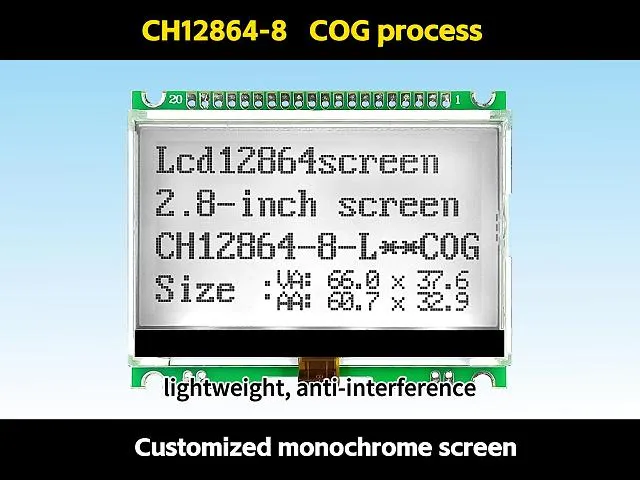
The process typically involves a Non-Recurring Engineering (NRE) fee, which covers the cost of creating the photomasks for the glass and the tooling for the metal pins or backlight. [Chuanhang Display] specializes in this custom design phase, providing technical drawings within 24-48 hours. When designing a custom panel, engineers must define the "Viewing Area" (VA) and "Active Area" (AA) precisely to ensure the housing bezel does not obscure any segments.
Navigating the LCD market involves more than just reading a datasheet. There are several systemic challenges that experienced engineers must account for.
Liquid crystals are temperature-dependent. In extreme cold, the fluid becomes viscous, leading to "ghosting" or slow refresh rates. In extreme heat, the contrast can drop significantly. For outdoor infrastructure, specifying a "Wide Temperature" range (typically -30°C to +80°C) is mandatory. This involves using specialized LC fluids and high-stability polarizers.
Ghosting occurs when segments that should be "off" appear faint. This is often caused by an incorrect Bias voltage or poor synchronization in the multiplexing drive. Ensuring that the LCD controller’s output matches the glass's optimal Vop (Operating Voltage) is the primary solution.
B2B products often have life cycles of 10 to 15 years. Using a standard 7 segment lcd display from a reputable supplier ensures that the form factor remains consistent. Unlike consumer-grade TFTs that go out of production every 24 months, segment glass is remarkably stable, provided the supplier maintains the original master masks.
The price of a 7 segment lcd display is influenced by several variables:
Glass Size: Larger glass panels require more raw material and occupy more space in the production oven.Complexity: The number of COM lines and the density of the traces affect the yield rate.Material Quality: Using Japanese polarizers or high-grade LC fluid increases the cost but ensures a longer lifespan and better UV resistance.Volume: Because the setup time for LCD production lines is significant, unit prices drop drastically as volumes move from 1,000 units to 100,000 units.
[Chuanhang Display] provides transparent pricing models that help OEMs balance upfront NRE costs against long-term unit price savings, ensuring the project remains viable throughout its lifecycle.
For international trade, compliance is non-negotiable. Quality displays must adhere to:
RoHS/REACH: Ensuring the absence of hazardous substances in the glass, polarizers, and pins.ISO 9001: Guaranteeing consistent manufacturing processes.Reliability Testing: High-quality modules undergo "High Temperature/High Humidity" (THB) tests, often at 60°C/90% RH for 500 hours, to ensure the polarizer adhesive doesn't delaminate.
The 7 segment lcd display remains a cornerstone of modern electronics due to its unparalleled efficiency and clarity. Whether you are designing a smart water meter or a complex medical ventilator, selecting the right combination of liquid crystal mode, drive scheme, and connection method is the difference between a mediocre product and an industry-leading one.
By partnering with an authority like [Chuanhang Display], engineers gain access to decades of manufacturing expertise and the ability to customize every aspect of the display to fit their specific application needs.
For detailed technical specifications, custom design inquiries, or to request samples for your next project, please contact our engineering team. We are ready to help you optimize your display solution for performance and cost-effectiveness.
Q1: What is the main difference between TN and VA mode for a 7 segment lcd display?
A1: TN (Twisted Nematic) is the standard technology, offering a light background with dark segments. VA (Vertical Alignment) provides a true black background with very high contrast and superior viewing angles, though it usually requires a backlight to be readable.
Q2: Can I drive a 7 segment lcd display directly with DC voltage?
A2: No. LCDs must be driven with an AC signal. Applying a constant DC voltage will cause a chemical reaction called electrolysis, which will permanently damage the liquid crystal fluid and destroy the display within a short period.
Q3: How do I determine the best viewing angle (6 o'clock vs. 12 o'clock)?
A3: This refers to the direction from which the display is most legible. If the device is typically held below eye level (like a handheld meter), a 6 o'clock viewing angle is best. If it is mounted high on a wall or machine, a 12 o'clock angle is preferred.
Q4: What is the typical lead time for a custom segment LCD?
A4: Generally, the design and counter-drawing take 2-3 days. The production of samples (tooling phase) takes about 15-20 days, and mass production typically follows in 4-6 weeks depending on the order volume.
Q5: Is it possible to have multiple colors on a 7 segment lcd display?
A5: While the liquid crystal itself is monochrome, colors can be achieved by using a multi-colored backlight or by applying a silk-screened color filter to specific areas of the display.
Q6: What causes the segments to look "washed out" at certain angles?
A6: This is usually due to the inherent physics of the liquid crystal twist. Choosing an STN or FSTN material, or optimizing the drive voltage (Vop), can significantly improve the contrast and reduce the "wash out" effect at wide angles.
Contact us today for a professional inquiry and let our experts guide your next display integration.