A custom segment display (static or multiplexed segment LCD) remains the ultimate engineering solution for battery-powered instruments, industrial smart meters, medical diagnostic devices, and automotive clusters—delivering multi-year operation on a single coin cell, instantaneous sub-zero response, and uncompromised outdoor sunlight legibility. Sourcing custom glass requires balancing custom photomask tooling costs, multiplex driving ratios (static up to 1/8 duty), optical polarizer chemistry (TN, HTN, STN, or ultra-black VA/EBTN), and mechanical interconnects (metal pins, elastomeric zebra strips, heat-seal cables, or COG/FPC). Founded in 2011, Shenzhen Chuanhang Electronic Technology Co., Ltd. (Chuanhang Display) operates a modern 5,000-square-meter facility with over 100 skilled technicians and 10+ R&D specialists. We provide turnkey custom segment LCD engineering from initial CAD layout to mass production across automated COG, FOG, COB, and SMT lines, backed by low NRE tooling costs and guaranteed 5-to-7+ year component availability.
Developing a custom segment display module requires defining five physical specifications: segment and icon layout via custom CAD photomask tooling, liquid crystal mode (cost-efficient TN, wide-angle STN, or high-contrast negative VA/EBTN), multiplex drive conditions (static 1:1 or 1/2 to 1/8 duty with matching bias), mechanical interconnection (thru-hole metal pins, zebra elastomer strips, or COG), and operating temperature ranges (-20°C to +70°C or wide-temp -30°C to +80°C). Chuanhang Display delivers rapid 10-to-15-day sample turnaround times on custom glass tooling with low NRE fees, complete temperature compensation circuitry, and direct factory pricing.
Custom 7-segment digits, 14-segment alphanumeric characters, bar graphs, and proprietary brand icons designed to your CAD specs.
Consumes microamps of operating current in reflective mode, enabling continuous 5-to-10-year device operation on a single 3V lithium battery.
Low NRE photomask tooling costs with rapid first-article prototype working samples delivered within two weeks.
Guaranteed 5-to-7+ year availability on custom glass tooling and controller ICs, eliminating forced host PCB redesigns.
Selecting the correct mechanical interconnect for a custom segment display directly dictates assembly labor, shock resistance, and long-term contact reliability. The four primary connection methods are through-hole metal pins, elastomeric zebra strips, flexible heat-seal connectors (HSC), and Chip-on-Glass (COG) with FPC tails.
For high-vibration applications or simple wave-soldered PCBs, through-hole metal pins (typically 2.54mm or 1.8mm pitch) clip directly onto the glass ITO contact pads, providing rigid structural support without additional bezels. Conversely, for ultra-low-profile enclosures or high pin-count segment displays, elastomeric zebra strips compress between the glass and gold-plated PCB pads beneath a stamped metal frame, eliminating soldering entirely.
Complying with display engineering guidelines established by the Society for Information Display (SID) and physical reliability standards under IEC 61747 liquid crystal specifications, Chuanhang Display supports all four connection paradigms in-house:
Clips bonded directly to the glass substrate. Supports 1.8mm, 2.0mm, or standard 2.54mm pitch. Solderable straight into PCB through-holes; no mechanical clamping bezel required.
Conductive rubber strip alternating conductive carbon and insulative silicone layers. Eliminates solder joints entirely; requires mechanical bezel compression (15–20% squeeze ratio).
Conductive carbon/graphite tracks printed on flexible polyester film. Hot-bar bonded to the glass and PCB pads, enabling offset mounting and irregular enclosure packaging.
Driver IC bonded directly to the LCD glass ledge, outputting standard SPI/I2C over a slim flexible FPC. Reduces host MCU pin count from 40+ pins down to just 3 or 4 bus lines.
In custom segment display design, the driving duty ratio defines the number of common (COM) backplane lines. Static driving connects each segment directly to its own pin (1:1), yielding maximum contrast and widest viewing angles, while multiplex driving (1/2, 1/3, 1/4 up to 1/8 duty) shares segment pins to drastically reduce the total pin count of the custom glass.
As the multiplex rate rises, the discrimination ratio between the on-state root-mean-square voltage ($V_{on}$) and off-state voltage ($V_{off}$) narrows significantly, defined by the classic Iron's Law of multiplexing:
V_on / V_off = sqrt( (sqrt(N) + 1) / (sqrt(N) - 1) ) // Where N = Number of Duty Cycles
In high-ambient outdoor environments or wide-temperature extremes (-30°C to +80°C), static or 1/4 duty displays maintain robust contrast margins. For complex layouts with hundreds of segments (such as multi-tariff electricity meters), Chuanhang Display’s engineering team pre-calculates internal bias resistor networks (e.g., 1/3 bias for 1/4 duty) and integrates negative temperature coefficient (NTC) thermistors to prevent crosstalk ghosting.
Unlike trading brokers that outsource glass cutting and liquid crystal filling to third-party sub-contractors, Chuanhang Display directly controls the full segment manufacturing cycle inside our 5,000 m² Shenzhen manufacturing plant. This includes ITO glass precision cutting, photo-resist exposure, chemical etching, polyimide alignment rubbing, and cleanroom vacuum LC filling.
Adhering to optical metrology standards defined by ISO 9241-307 visual display guidelines and cleanroom protocols under ISO 14644-1 cleanroom standards, our production facility delivers unmatched custom glass tooling advantages:
Drawing upon 13 years of specialized display manufacturing, Chuanhang Display executes a structured 6-stage qualification loop on every custom segment display order, transitioning your design from initial 2D CAD layout to certified mass-production release.
A1: Custom segment LCD tooling is exceptionally cost-effective. At Chuanhang Display, photomask NRE tooling fees typically range from $300 to $1,500, depending on glass dimensions, multiplex complexity, and connection type (metal pins vs. COG). Unlike color TFT displays that require tens of thousands of dollars in tooling, custom segment LCDs allow even modest hardware startups to achieve custom icon branding affordably.
A2: Once the customer approves our detailed 2D engineering counter-drawings (typically finalized within 24 to 48 hours), first-article working glass prototypes are fabricated, filled, pinned, and dispatched within 10 to 15 business days. Mass production ramps quickly within 3 to 4 weeks following prototype qualification.
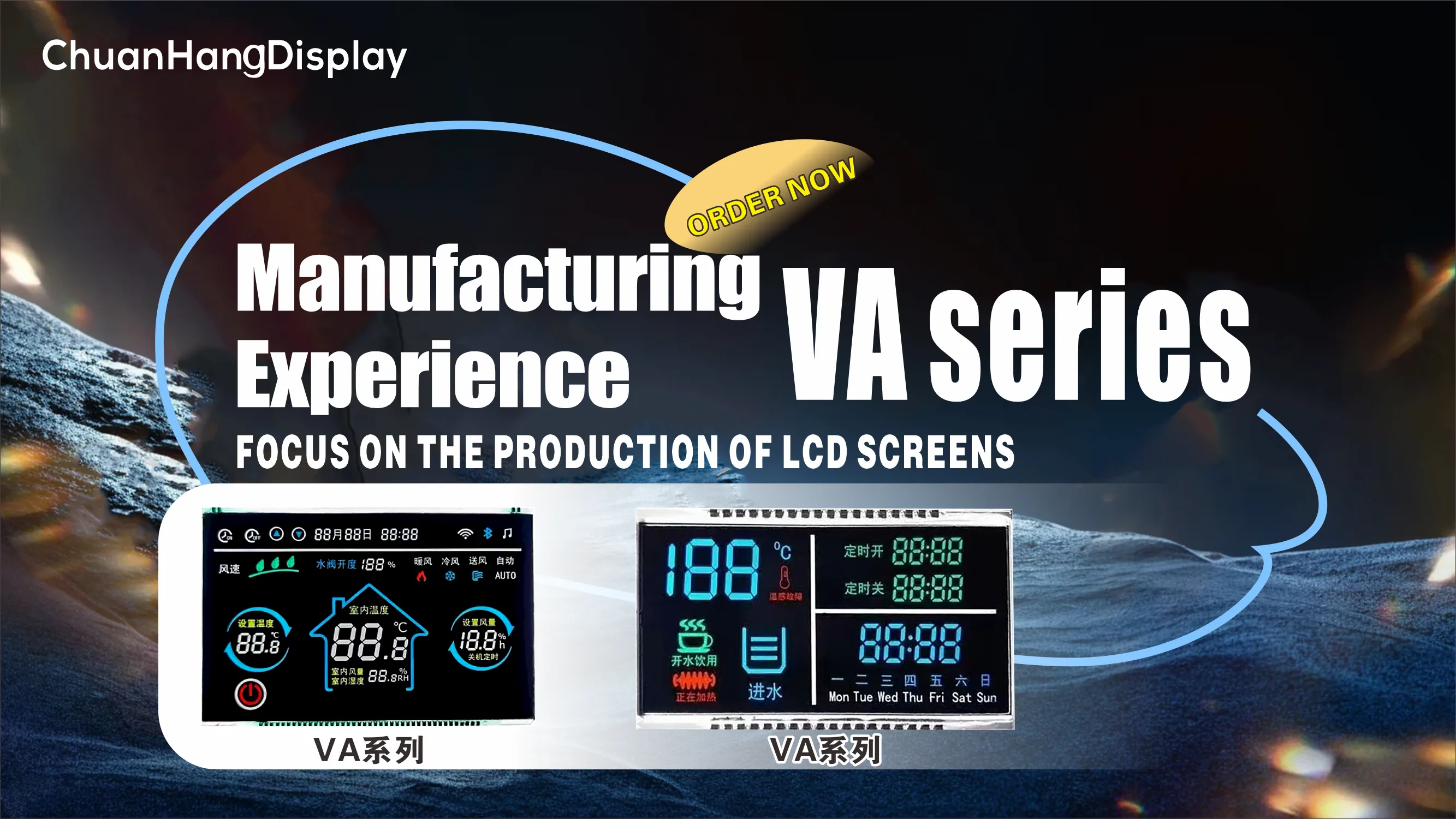
A3: While standard TN displays have a gray background with modest 4:1 contrast, VA (Vertical Alignment / EBTN) displays orient liquid crystal molecules vertically to the glass substrates, blocking backlight bleed completely. This delivers an ultra-deep, pitch-black background with contrast ratios exceeding 300:1 and nearly 180° symmetrical viewing angles. Silk-screening colored inks onto the display creates vibrant, multi-colored static indicators popular in automotive and high-end consumer appliances.
A4: Because custom segment glass masks are fully owned physical assets preserved inside our 5,000 m² Shenzhen facility, Chuanhang Display maintains custom tooling indefinitely. We guarantee 5, 10, or 15+ years of production continuity. If an onboard driver IC reaches end-of-life, our 10+ member R&D team provides pin-compatible replacement PCB assemblies, guaranteeing zero mechanical chassis or host code redesigns for your product.
A5: To receive a formal engineering proposal within 24 hours, provide: (1) A sketch or 2D CAD drawing of your required segment, digit, and icon layout, (2) Target outer glass dimensions (OD), (3) Operating voltage (e.g., 3.0V or 5.0V), (4) Preferred connection method (metal pins, zebra strip, or COG/FPC), and (5) Operating temperature envelope (commercial vs. wide-temp).
A6: After prototype sign-off (delivered in batches of 5 to 10 sample units), our mass production MOQs remain highly accommodating. For custom pinned or zebra segment glass, standard production orders typically start from 1,000 to 2,000 units, supported by multi-tier volume discounts for high-volume annual utility metering contracts.
Bypass trading brokers and engineer your bespoke segment display directly with Chuanhang Display. We provide 24-hour CAD counter-drawings, low NRE tooling costs, and working prototype delivery within 10 to 15 business days.