Selecting the right display supplier determines whether your product launch succeeds or stalls in costly redesigns. If you are developing handheld instruments, smart meters, or medical monitors, securing a high-yield, durable COG LCD module is essential. Send an inquiry to our engineering team today to review your display specifications or request a custom prototype.
Chip-on-Glass (COG) packaging has redefined display architecture. By mounting the display driver IC directly onto the extended glass substrate of the liquid crystal cell, COG eliminates the bulky printed circuit boards required by older surface-mount designs. The result is a profile that measures only a few millimeters thick, consumes minimal battery power, and withstands harsh operating vibrations.
Yet finding a dependable display manufacturer remains a challenge. The market contains hundreds of brokers, trading companies, and small assembly shops that lack cleanroom discipline. Partnering with the wrong vendor brings uneven contrast ratios, high bonding failure rates, delayed shipments, and sudden component obsolescence. Leading original equipment manufacturers (OEMs) rely on proven partners like Chuanhang Display to mitigate these supply chain risks.
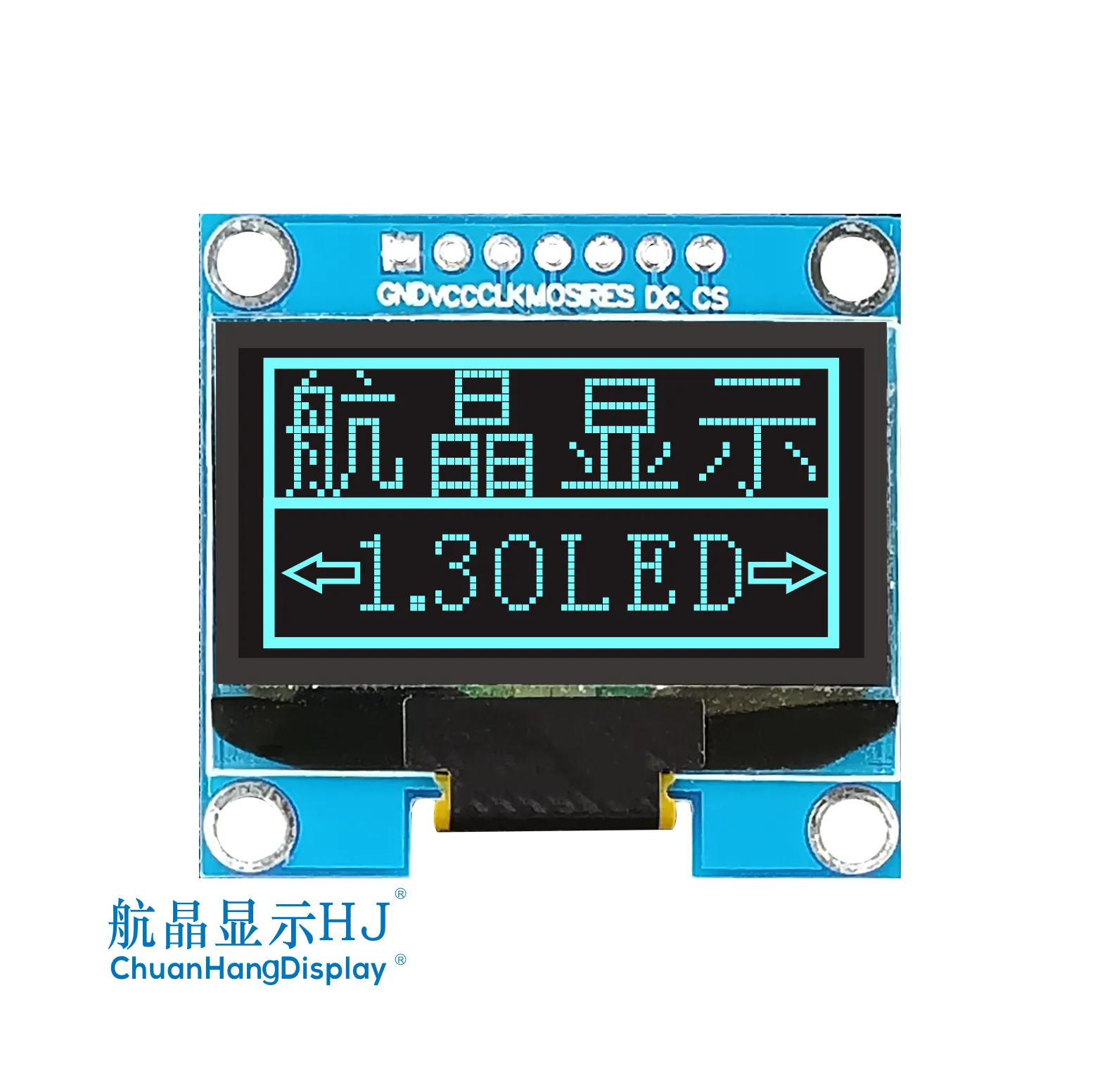
Every millimeter inside an enclosure counts. Traditional surface-mount assemblies, such as Chip-on-Board (COB), require an external PCB host to support the driver IC. This layout increases structural thickness and adds failure points across multiple solder joints.
A precision-built COG LCD module solves these mechanical constraints through direct IC integration. Using Anisotropic Conductive Film (ACF) and microscopic conductive gold bumps, automated bonding heads attach the silicon die directly to the transparent Indium Tin Oxide (ITO) traces on the display glass. This design yields distinct technical advantages:
Procuring displays for commercial or industrial deployment requires strict factory qualification. Sourcing managers and hardware engineers should evaluate candidate factories against five core criteria before placing volume purchase orders.
Reliable suppliers do not outsource critical assembly steps. A qualified manufacturer must maintain fully automated COG bonding lines inside cleanroom environments rated to ISO Class 6 (Class 1,000) or Class 7 (Class 10,000). Ambient airborne dust causes open circuits or pinhole shorts across microscopic ITO pitches.
Check if the supplier also owns complementary production lines. Top-tier factories operate integrated SMT (Surface Mount Technology), FOG (Film-on-Glass), and COPB (Chip-on-Print-Board) lines under the same roof. This internal infrastructure lets you source complete sub-assemblies—including custom backlights, touch sensors, and integrated flex cables (FPC)—from a single vendor.
Scale correlates directly with delivery reliability. Small workshops with one or two manual bonding stations cannot scale when your demand surges from 2,000 units to 50,000 units per month. They also struggle to secure steady allocations of raw glass and silicon drivers during industry-wide component shortages.
Look for established facilities with at least 3,000 to 5,000 square meters of floor space and an experienced workforce. Scaled manufacturing ensures automated optical inspection (AOI), fast batch cycle times, and the capacity to absorb unexpected volume spikes without missing client ship dates.
Display defects usually appear after integration, during temperature cycling, or in high-humidity field use. A premier COG LCD module vendor implements quality control protocols across every stage of fabrication:
Standard off-the-shelf displays rarely fit bespoke industrial enclosures. Your chosen partner must provide direct access to an internal R&D engineering team. Can they alter the display view angle from 6:00 to 12:00? Can they tailor the FPC pinout to match your microcontroller's native SPI or I2C bus?
Choose an agile supplier who accommodates mechanical customizations, including:
Industrial product lifecycles often span seven to ten years. Consumer-grade display vendors frequently drop components after twelve months, forcing unexpected PCB revisions and costly recertifications. Proven display suppliers guarantee form-fit-function product longevity for five to ten years, protecting your development investments.
When measuring suppliers against these five benchmarks, Chuanhang Display stands out as an experienced display manufacturer for industrial, medical, and utility markets.
Established in 2011 in Bao'an Xixiang, Shenzhen, Chuanhang Display has expanded into a modern, 5,000-square-meter advanced manufacturing facility. Over more than 13 years of continuous engineering iteration, the company has built an integrated production system capable of handling complex display configurations.
The company maintains a comprehensive equipment matrix, running dedicated lines for:
A workforce of over 100 skilled production technicians supports this manufacturing infrastructure. A dedicated team of more than 10 senior R&D engineers and overseas technical account managers handles design-in support for global clients. Whether you need standard monochrome panels or fully customized graphic displays, Chuanhang Display pairs large-scale production with custom engineering support.
Hardware engineers often weigh whether to specify a COG LCD module or a traditional COB (Chip-on-Board) display. While both architectures drive monochrome STN, FSTN, or TN panels, their physical builds serve different project constraints.
A COB module mounts the driver IC onto an oversized PCB, securing it with an epoxy potting compound ("black glob"). This construction makes COB panels thicker (typically 8.0 mm to 12.0 mm) and heavier. However, they are simple to mount using standard through-hole standoffs and connect easily via 0.1-inch pin headers.
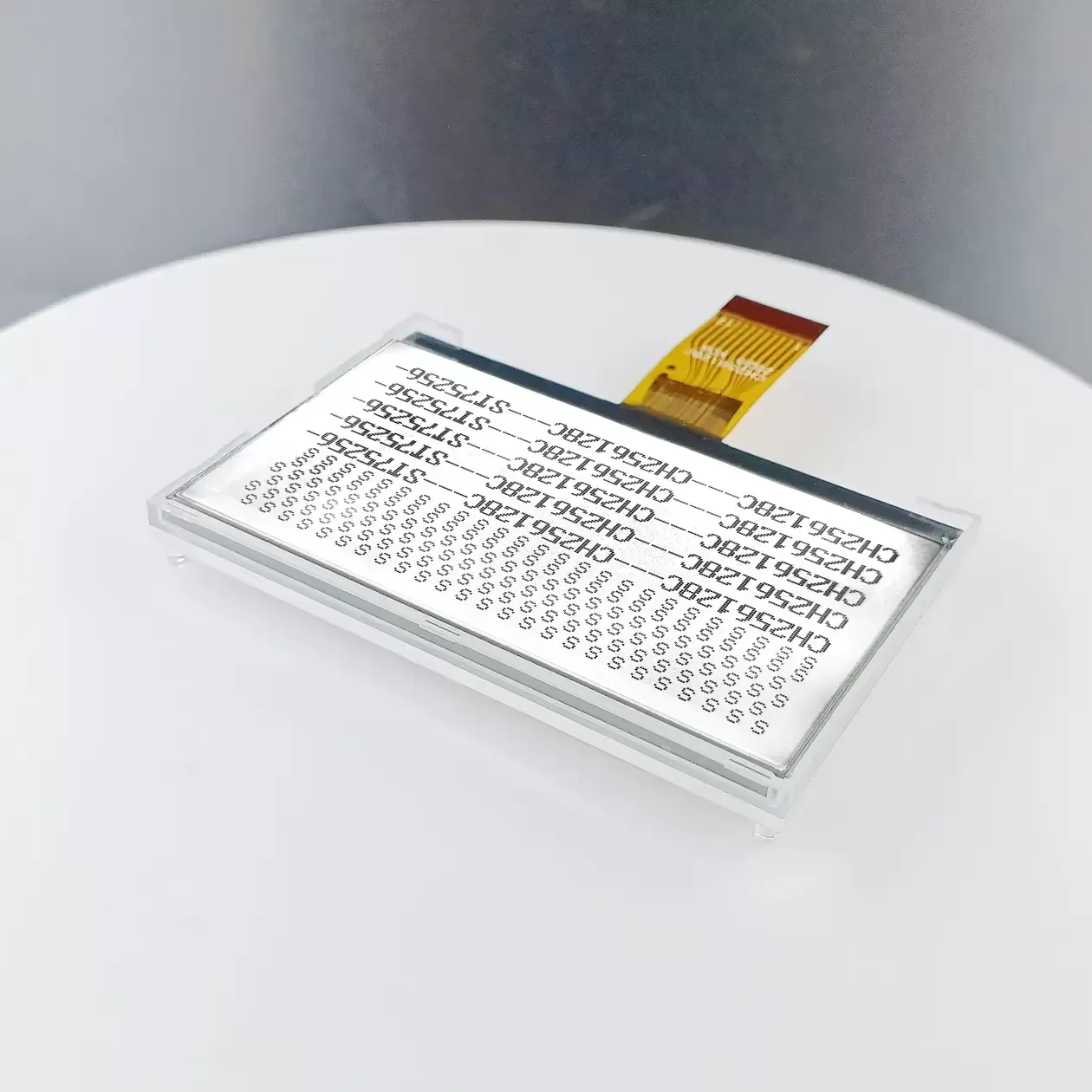
In contrast, a COG LCD module features a thickness under 3.0 mm, saves up to 60% of board footprint, and weighs a fraction of a COB panel. The driver chip mounts directly on the glass, while an ultra-thin FPC cable plugs straight into a zero-insertion-force (ZIF) connector on your main board. For modern handheld devices, wearable tools, and compact panel meters, COG has become the industry standard.
The physical resilience and thin profile of the COG format suit demanding commercial and industrial deployments.
Utility meters run outdoors or inside basement utility vaults for over a decade without battery replacements. These systems demand static or low-multiplex displays that operate reliably from -30°C to +80°C. Transflective FSTN COG displays provide sharp, sunlight-readable digits during the day while drawing microamp-level sleep currents.
Field equipment must survive drops onto concrete, tool bag vibration, and broad temperature swings. Graphic COG modules keep mobile terminals slim and lightweight, reducing operator fatigue. Their low-mass bonding structure resists high-impact shocks that often dislodge heavier surface-mount parts.
Portable blood glucose meters, infusion pumps, and pulse oximeters require high contrast ratios, wide viewing angles, and instant boot-up times. Vertical Alignment (VA) and negative FSTN COG displays deliver crisp white-on-black iconography, giving medical staff clear readings under bright clinical lighting.
Thermostats, HVAC controllers, and security panels demand sleek wall-mounted profiles. A customized COG display with integrated capacitive touch buttons lets designers build thin, modern user interfaces that blend directly into architectural walls.
Preparing clear engineering requirements speeds up the quoting process and helps your supplier quote accurate tooling fees and piece-part costs. Provide the following technical parameters when sending your inquiry:
Q1: What is the minimum order quantity (MOQ) for a custom COG LCD
module?
A1: Tooling a fully customized glass pattern and FPC
generally requires an MOQ between 1,000 and 5,000 units, depending on the glass
dimension. Standard off-the-shelf catalog models from established manufacturers
often feature lower MOQ thresholds for evaluation and pilot runs.
Q2: How long does it take to develop a custom COG display from design
to initial samples?
A2: Standard lead times run two to three weeks
for engineering drawing approval and photomask tooling. Working prototypes and
samples usually ship within three to four weeks after tooling approval. Mass
production lead times typically range from five to seven weeks.
Q3: Can a COG LCD module operate in freezing outdoor
environments?
A3: Yes. By specifying wide-temperature liquid crystal
formulations, a COG panel operates reliably from -30°C to +80°C. For sub-zero
installations, selecting a dynamic driver IC with built-in temperature
compensation ensures rapid display refresh rates without segment ghosting.
Q4: How does vibration affect the driver IC bonded to a COG
panel?
A4: Because the silicon die is cured directly to the rigid
glass substrate with thermal-compression ACF, it possesses negligible physical
mass. COG modules generally endure higher shock and vibration loads than heavier
board-mounted display assemblies.
Q5: Can I integrate a capacitive touch panel directly onto a COG
display?
A5: Yes. Display manufacturers can laminate a projected
capacitive (PCAP) or resistive touch screen directly over the front polarizer of
the COG glass using optical clear adhesive (OCA), delivering a single
plug-and-play assembly.
A dependable display partner helps you launch stable products on schedule and within budget. Whether you need a standard monochrome graphic panel, custom segment iconography, or a sunlight-readable outdoor display, partner with an established factory with deep technical roots.
Contact Chuanhang Display today to discuss your project specifications. Our engineering team will review your application requirements, deliver custom 2D/3D interface drawings, and provide functional samples to keep your production timeline on schedule.