Walk through an electronics trade show in 2026, and you will see vivid micro-OLED viewfinders, curved automotive displays, and razor-thin color panels. High-resolution screens dominate consumer gadgets. Because of this, hardware engineers often ask a fair question: has the standard Character LCD Module reached the end of its life?
The short answer is no. While smartphone displays chase pixel density and billion-color gamuts, industrial devices demand something entirely different. They need raw reliability, predictable power consumption, and production runs that last a decade without redesigns.
At Chuanhang Display, we manufacture millions of alphanumeric panels each year. Far from fading away, the humble character display is experiencing steady demand across utility meters, charging stations, and mission-critical controls. It has evolved from a basic read-out component into an optimized, modern industrial asset.
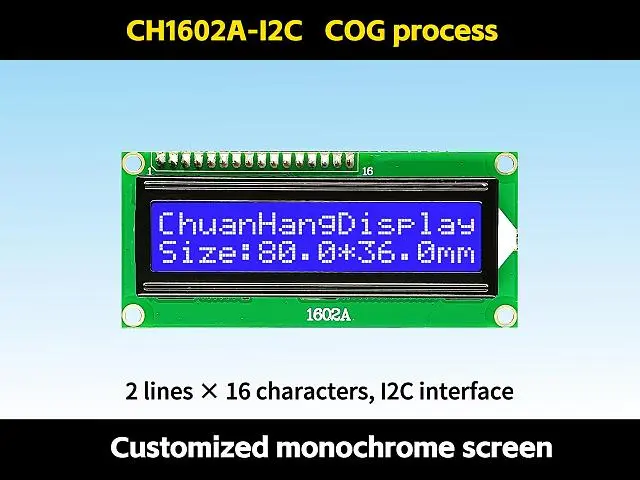
Design teams do not pick an alphanumeric display out of nostalgia. They pick it because the physics and economics of monochrome liquid crystal technology solve specific system-level headaches that modern color screens often worsen.
Battery-powered field equipment cannot waste energy driving millions of sub-pixels. A full-color TFT display requires an active matrix of thin-film transistors, a graphic frame buffer, and a powerful backlight. That setup regularly draws anywhere from 100 milliwatts to several watts.
By comparison, a transflective 16x2 Character LCD can run in direct sunlight using natural ambient light with its backlight turned off entirely. In static display mode, the liquid crystal fluid draws a fraction of a microamp per segment.
Reflective and transflective polarizers allow daytime readability at zero backlight power.
Total module power consumption often drops below 10 milliwatts during active reads.
Deep sleep modes pull practically zero current from standby battery banks.
For an IoT water meter designed to operate underground for 15 years on a single lithium thionyl chloride cell, nothing beats a monochrome character display.
A full-color graphical user interface demands a capable microcontroller or microchip. You need megabytes of flash memory, dedicated RAM for display frame buffers, and complex graphics libraries like LVGL or TouchGFX. That complexity inflates your bill of materials (BOM).
A standard Character LCD Module handles fonts directly inside its onboard controller chip (such as the industry-standard HD44780 or modern equivalents like the ST7066U and AIP31066). Your firmware only needs to push single-byte ASCII codes over a 4-bit or 8-bit bus.
You can run an alphanumeric screen using the most basic 8-bit MCU. That saves expensive board space, cuts software debugging time, and eliminates the need for expensive external memory chips.
Industrial machinery operates in harsh conditions. Factory floors experience voltage spikes, heavy electromagnetic interference (EMI), and broad temperature swings.
Consumer-grade display modules often fail when exposed to freezing cold or baking heat. In contrast, modern industrial character displays offer:
Operating temperature ranges from -30°C to +80°C with wide-temp liquid crystal fluid.
High electrostatic discharge (ESD) immunity that prevents system lockups during factory operation.
Immunity to burn-in, which degrades OLED panels displaying static menus over months of use.
Consumer display glass changes rapidly. Smartphone and tablet display glass lines switch every 18 to 24 months. When a glass foundry stops running a specific consumer cut, an embedded device maker faces an expensive board redesign and recertification cycle.
Medical, utility, and avionics devices require steady supply guarantees. An engineer can source a classic 20x4 LCD display today and be confident that identical drop-in replacements will exist ten years from now. Chuanhang Display continues to support long-term production runs, protecting our customers from sudden obsolescence.
The character screen is not static technology frozen in the 1980s. Material science and manufacturing advances have systematically solved the historical weaknesses of monochrome LCDs.
Traditional displays relied on Chip-on-Board (COB) assembly. In this design, the controller chip sits on a bulky printed circuit board behind the glass. This construction makes the module thick and heavy.
Today, Chip-on-Glass (COG) architecture is widely used in high-volume character applications. By bonding the IC bare die directly onto the glass substrate extension, manufacturers gain significant benefits:
Overall module thickness drops by up to 60%.
Weight drops significantly, making the display ideal for handheld testing meters.
Fewer interconnects lead to better vibration resistance inside motorized industrial tools.
Old yellow-green STN screens suffered from narrow viewing angles and low contrast. Modern character modules frequently use Film-compensated Super Twisted Nematic (FFSTN) and Vertical Alignment (VA) technology.
VA character displays provide true, deep blacks with contrast ratios exceeding 300:1. When combined with pure white LED backlights, characters stand out sharply even when viewed from extreme off-axis angles. Furthermore, multi-color LED backlights can now switch the background from soft white to vibrant red when an alarm condition triggers.
Routing 14 to 16 parallel signal traces across a cramped circuit board wastes precious MCU routing pins. Contemporary character LCD modules now feature integrated bridge controllers supporting native I2C and SPI protocols.
An engineer can drive a complete 20x4 screen using just two I2C lines (SDA and SCL) alongside power and ground. This frees up microcontroller I/O for sensors, communication modems, and motor drivers.
You can find these modules operating quietly behind critical services where user errors or display dropouts are not an option.
Smart electrical grids, residential gas meters, and municipal water monitors need continuous operation in unconditioned outdoor cabinets. A transflective 16x2 character LCD delivers immediate readings under direct midday sun while pulling virtually no power during midnight operations.
Infusion pumps, laboratory centrifuges, commercial autoclaves, and diagnostic blood analyzers prioritize deterministic operation. The user needs simple, legible data: flow rate, remaining minutes, chamber pressure, and error codes. A character display delivers clear figures without graphical bugs or operating system delays.
Variable frequency drives (VFDs), uninterruptible power supplies (UPS), and solar grid inverters generate severe electrical noise. A high-voltage spike can crash complex graphic controllers. Rugged monochrome character displays absorb high levels of EMI and continue updating system diagnostics reliably.
Commercial espresso machines, combi-ovens, and industrial dishwashers produce steam, grease, and heat. Touch-sensitive glass screens often misread inputs when covered in water droplets or grease. A sturdy character display behind an IP65-sealed front panel provides reliable performance through hot, busy kitchen shifts.
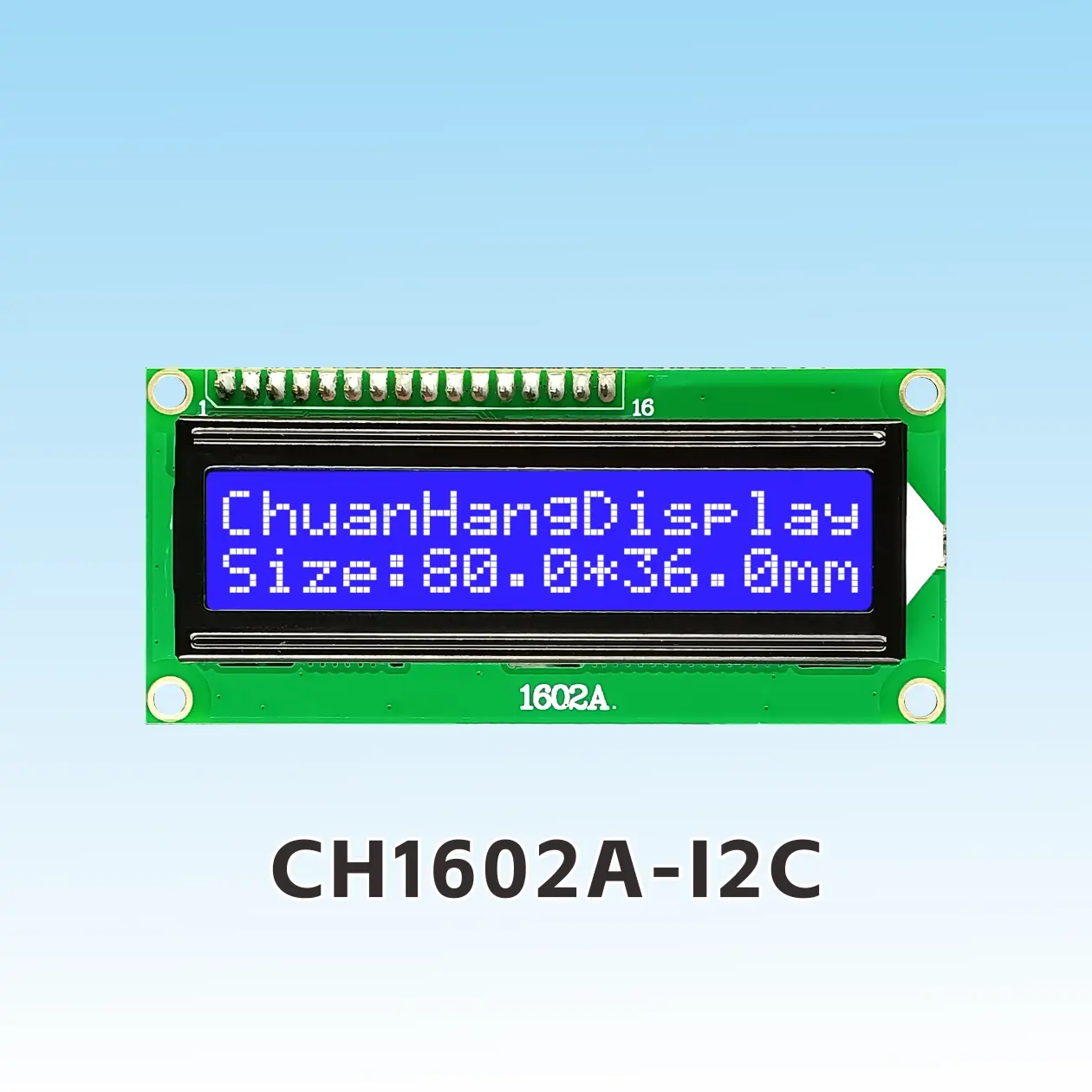
High-reliability display sourcing requires an experienced manufacturing partner. Founded in 2011, Chuanhang Display began in Bao'an, Shenzhen, and has grown into a modern 5,000-square-meter manufacturing facility.
Over the past decade and a half, we have seen component trends come and go. Through it all, our commitment to industrial display manufacturing has never wavered. Today, our facility houses:
Over 100 skilled production technicians dedicated to precision assembly.
An engineering R&D and QA team managing optical and environmental verification.
Dedicated production lines for COPB, SMT, FOG, COG, and specialized TFT integration.
We do not treat the Character LCD Module as a legacy side project. We treat it as an active, precision-engineered industrial component. From cutting the mother glass to SMT pick-and-place, automated wire bonding, and 100% optical inspection, our quality control ensures that our screens run maintenance-free for decades.
Whether you require standard 16x2 drop-in modules for ongoing legacy production or a custom-designed COG panel featuring wide temperature ranges, Chuanhang Display delivers guaranteed long-term stability.
Q1: What is the main structural difference between COB and COG character LCD modules?
A1: In a COB (Chip-on-Board) module, the driver IC is mounted directly on a secondary PCB located behind the display glass, secured by black epoxy potting. In a COG (Chip-on-Glass) module, the driver IC is bonded directly onto the glass substrate extension using anisotropic conductive film (ACF). COG designs are thinner, lighter, and more resistant to mechanical shock, while COB designs offer simple mounting holes and easy mechanical drop-in replacement for older chassis.
Q2: Can a standard character LCD module run directly on a 3.3V power supply?
A2: Classic character LCDs were designed around 5V logic and driving voltages. However, most modern character displays, including those from Chuanhang Display, can be ordered with integrated charge pumps or 3.3V driver ICs. This allows direct connection to modern 3.3V microcontrollers without requiring external logic level shifters or separate boost circuits.
Q3: Why choose an alphanumeric display instead of a cheap color TFT screen?
A3: While small TFTs have become affordable, their total cost of ownership is often higher in industrial products. Color TFTs require more code, larger frame buffers, complex firmware, and constant backlight power. They also suffer from shorter product production cycles and poorer sunlight readability. A monochrome character LCD simplifies hardware and software design, lasts longer in field deployment, and consumes far less energy.
Q4: How do sub-zero temperatures affect character LCD response times?
A4: Liquid crystals are viscous fluids. At very low temperatures (such as -20°C or -30°C), the fluid thickens, which slows down the response time and causes segment transitions to look sluggish. To counter this, Chuanhang Display builds wide-temperature modules using specialized low-viscosity liquid crystal mixtures, maintaining readable response speeds even in freezing environments.
Q5: Can Chuanhang Display customize backlights, pinouts, and cable lengths for legacy equipment?
A5: Yes. We regularly support retrofit programs. We can match legacy pin headers, alter display polarization (positive or negative), adjust LED backlight color (white, blue, yellow-green, amber, or RGB), and fabricate custom FPC ribbons to ensure backward compatibility with your existing mechanical enclosures.
Engineering success is not about picking the screen with the highest pixel count. It is about matching your display directly to your operating environment, power budget, and product lifecycle. The Character LCD Module remains one of the most cost-effective, durable, and reliable interface tools in modern electronics.
If you are building an industrial controller, smart meter, or medical device that demands absolute reliability, work with an experienced manufacturer who understands your long-term requirements.
Contact the engineering team at Chuanhang Display today to discuss your project specifications, request mechanical drawings, or order evaluation samples for standard 16x2 and 20x4 panels.
Email: info@scjhdlcd.com
Website: www.scjhdlcd.com
Factory Address: Chuanhang Display Industrial Park, Bao'an District, Shenzhen, China