In the highly specialized sector of optoelectronics, engineers and procurement specialists frequently require visual interface solutions that prioritize absolute reliability, deterministic operation, and operational longevity. While high-resolution, full-color active-matrix panels command the consumer electronics market, the lcd character display remains an indispensable architectural component in industrial automation, medical instrumentation, and robust telecommunication hardware.
Rather than relying on resource-intensive graphics rendering, these modules excel in environments where precise data readout, extremely low power consumption, and mechanical durability are paramount. This article provides a thorough examination of the core engineering mechanisms, fluid material specifications, and strategic B2B sourcing protocols necessary for integrating these alphanumeric modules into modern, mission-critical hardware architectures.

At the silicon level, the standard alphanumeric screen relies on mature, highly deterministic controller architectures. The foundation of this technology lies in the integrated circuit (IC) driving the liquid crystal matrix.
The industry benchmark remains the HD44780 controller, originally engineered by Hitachi, alongside modern equivalents such as the ST7066 or KS0066. These driver ICs feature a built-in Character Generator ROM (CGROM) that hardcodes standard ASCII and extended regional character sets into the hardware. Characters are typically rendered in a 5x8 or 5x11 dot matrix format, providing clean, legible typography without requiring external font libraries.
Engineers can interface the host Microcontroller Unit (MCU) with the module using straightforward 4-bit or 8-bit parallel data buses. In modern PCB layouts where pin real estate is limited, I2C and SPI serial interfaces are frequently adopted via secondary expansion ICs. By offloading the pixel-mapping process to the display’s onboard controller, the host MCU reduces its computational overhead, preserving processing cycles for vital system logic and sensor polling. Furthermore, the inclusion of Character Generator RAM (CGRAM) allows engineers to program custom glyphs, offering functional flexibility for specific regional languages, diagnostic symbols, or specialized UI icons.
Driving a liquid crystal matrix requires precise alternating current (AC) waveforms to prevent direct current (DC) from degrading the fluid through electrolysis. To reduce the sheer volume of pin connections between the driver IC and the glass ITO (Indium Tin Oxide) traces, these modules utilize multiplexing.
A standard 16x2 module, for example, operates on a 1/16 duty cycle and a 1/5 bias voltage. While multiplexing reduces the physical pin count, it also decreases the Root Mean Square (RMS) voltage difference between activated (ON) and deactivated (OFF) pixels. This constraint necessitates the use of specific liquid crystal fluids with steep electro-optical threshold curves to prevent "ghosting" or cross-talk between adjacent pixels.
Selecting the appropriate liquid crystal fluid and polarizer orientation strictly dictates the optical performance, contrast ratio, and viewing cone of the module.
Twisted Nematic (TN): The baseline technology features a 90-degree molecular twist. While TN panels are highly cost-effective and offer rapid response times at room temperature, they possess relatively narrow viewing angles and lower contrast ratios when multiplexed. They are primarily deployed in low-cost, straight-on viewing applications.Super Twisted Nematic (STN): For industrial requirements, STN is the industry standard. STN fluids utilize a twist angle between 180 and 270 degrees, significantly steepening the response curve. This allows for the higher multiplexing rates required to drive complex formats like a 20x4 or 40x2 lcd character display without severe contrast degradation. However, natural birefringence causes STN panels to exhibit chromatic dispersion—typically yielding a yellow-green or dark blue background.Film-Compensated STN (FSTN): To neutralize the chromatic dispersion inherent to STN, FSTN technology adds a specialized polymer retardation film to the polarizer stack. This film compensates for the phase shift of light passing through the fluid, resulting in a crisp, high-contrast black-and-white presentation. For premium applications requiring high legibility across varied ambient lighting, FSTN is heavily specified.
The optical mode dictates how the panel manages light transmission.
Reflective modules rely entirely on ambient light, utilizing a rear mirror reflector. They offer exceptional outdoor visibility under direct sunlight and draw mere microamps of current, ideal for battery-powered remote sensors.Transmissive modules require a continuous LED backlight to push light through the cell, making them suitable for entirely dark environments but demanding higher power consumption.Transflective modules offer the optimal industrial compromise. They utilize a partially reflective rear polarizer, allowing the panel to reflect ambient light during the day while permitting an LED backlight to illuminate the matrix during low-light conditions.
Industrial hardware must endure rigorous physical conditions. The mechanical packaging of the module is just as critical as its optical components.
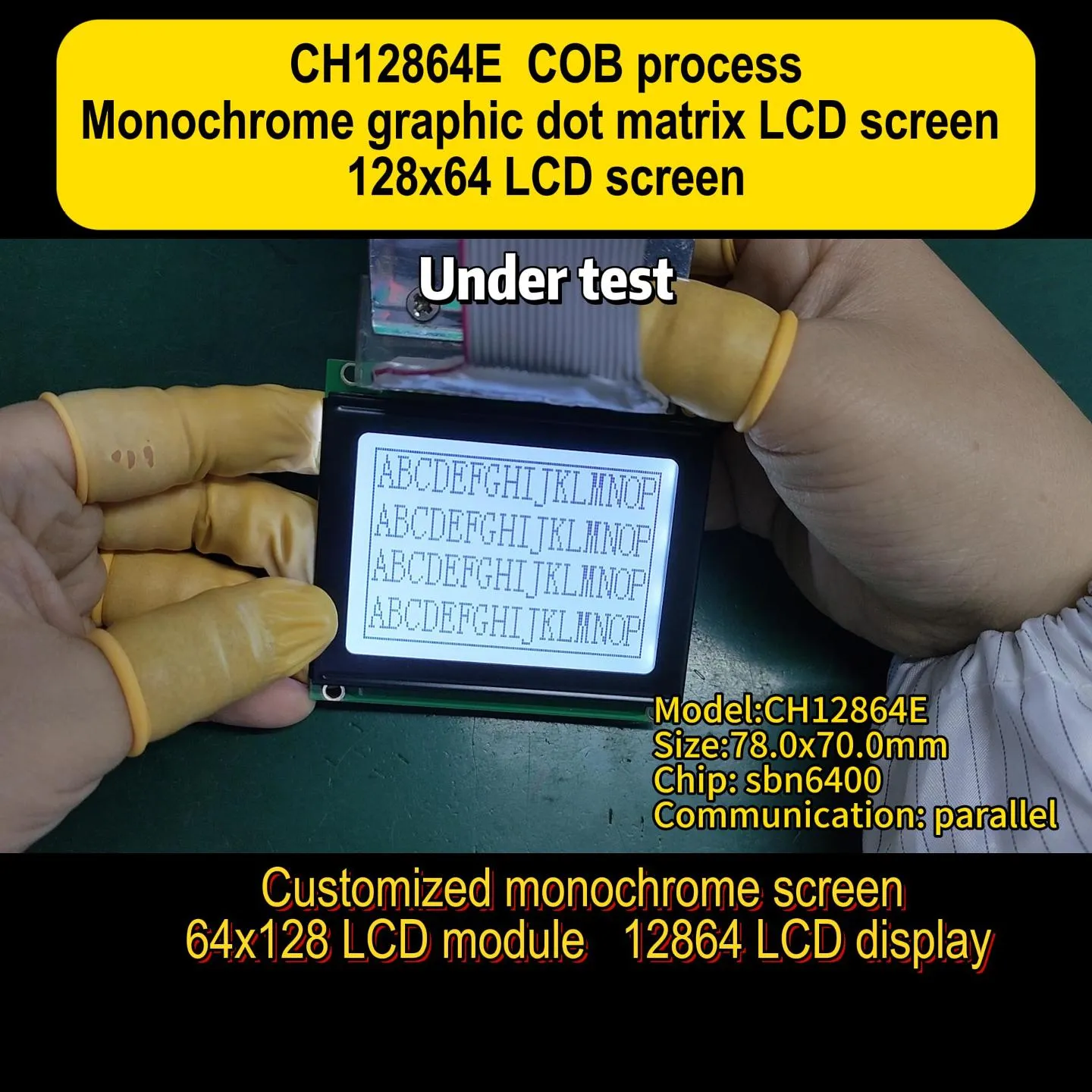
Most traditional character modules utilize Chip-on-Board (COB) construction. In this format, the bare controller silicon is wire-bonded directly to a rigid FR4 printed circuit board and encapsulated in black epoxy. The liquid crystal glass is then connected to the PCB via elastomeric "zebra" connectors and secured by a stamped metal bezel. COB provides immense mechanical rigidity and ease of mounting.
Alternatively, Chip-on-Glass (COG) architecture bonds the IC directly to the ITO traces on the glass ledge using Anisotropic Conductive Film (ACF). COG vastly reduces the physical footprint and weight of the lcd character display, making it ideal for compact handheld instrumentation, though it requires more delicate handling during final assembly.
In sectors such as petrochemical metering, heavy machinery, and defense, optoelectronic components must pass severe reliability testing. Standard consumer displays fail rapidly under thermal shock or high humidity. Industrial-grade modules undergo High Temperature Operating Life (HTOL) tests, often running at 85°C with 85% Relative Humidity for 500 hours to ensure the polarizers do not delaminate and the fluid does not boil into an isotropic state.
Hardware manufacturers face distinct supply chain and integration challenges when procuring optoelectronics. Addressing these pain points proactively is critical for long-term product viability.
A primary challenge is managing extreme temperature fluctuations. Standard commercial liquid crystal fluids become sluggish or freeze below 0°C, and lose their nematic state above +50°C. For industrial deployments, procurement teams must specifically request wide-temperature fluids. These specialized chemical mixtures expand the operational threshold from -20°C to +70°C, with ultra-wide variants capable of functioning flawlessly between -30°C and +80°C. Incorporating onboard temperature compensation circuits for the driving voltage (VOP) ensures the contrast ratio remains consistent across this entire thermal spectrum.
Industrial product life cycles routinely span ten to fifteen years. Modifying plastic injection tooling or rewriting low-level firmware due to unexpected component obsolescence incurs massive engineering delays and financial costs. Counterfeit controller ICs and unstable glass fabrication lines present significant risks. Securing a manufacturing partner that guarantees strict End-of-Life (EOL) management, long-term availability of specific ICs, and strict adherence to geometric tolerances is an absolute necessity for B2B buyers.
Evaluating supply chain partners requires looking beyond baseline unit costs. Professional procurement teams analyze manufacturers based on their cleanroom ISO certifications, automated bonding precision, and rigorous burn-in testing protocols.
Partnering with an established manufacturer like Chuanhang Display ensures consistent access to premium raw materials, from Japanese polarizers to high-purity liquid crystal fluids. Facilities operating at the level of Chuanhang Display implement stringent quality assurance checks, including Electrostatic Discharge (ESD) susceptibility testing and automated optical inspection (AOI), guaranteeing high Mean Time Between Failures (MTBF) for every batch shipped. Engaging such a supplier during the initial hardware design phase allows engineers to negotiate mechanical constraints, custom FPC (Flexible Printed Circuit) pinouts, and custom bezel dimensions, ultimately reducing overall assembly bottlenecks.
Pricing for an lcd character display is dictated by economies of scale and custom engineering requirements.
Standard Formats: Configurations such as 16x2 (16 characters across 2 lines) or 20x4 benefit from massive global production volumes, resulting in highly aggressive unit costs and zero Non-Recurring Engineering (NRE) tooling fees.Custom Formats: If a specific hardware chassis requires custom glass dimensions, bespoke silk-screening on the viewing area, or a unique LED backlight array (e.g., RGB color-changing backlights for status alerts), NRE costs will apply. A transparent and competent manufacturing partner will provide a detailed Bill of Materials (BOM) analysis, empowering buyers to calculate the return on investment for customized tooling versus utilizing an off-the-shelf standard.
Integrating an lcd character display into a product requires a highly analytical approach to fluid chemistry, electrical driving methods, and mechanical packaging. By accurately assessing the technical requirements of STN or FSTN materials, wide-temperature parameters, and precise multiplexing logic, engineering teams can deploy user interfaces that offer uncompromised reliability in the harshest environments. Furthermore, aligning with reputable, technically proficient B2B suppliers ensures stable pricing dynamics, transparent BOM structures, and the long-term supply chain security required to sustain industrial hardware lines for years to come.
Q1: What is the difference between a graphic dot matrix and an lcd character display?
A1: A graphic dot matrix panel allows for the individual control of every single pixel on the screen, requiring continuous rendering of graphics and fonts by the host processor. Conversely, an lcd character display uses a built-in controller (like the HD44780) with pre-programmed ASCII characters in fixed blocks (e.g., 5x8 pixels per character). This dramatically simplifies the programming logic and reduces the processing burden on the host micro-controller.
Q2: Can these alphanumeric modules operate reliably in outdoor, sub-zero environments?
A2: Yes, provided they are specified correctly. Standard modules operate between 0°C and +50°C. For outdoor or sub-zero environments, you must procure modules manufactured with wide-temperature liquid crystal fluids and specialized polarizers, which are rated for -20°C to +70°C, or even -30°C to +80°C. Additionally, implementing temperature compensation circuitry helps maintain optimal contrast as temperatures drop.
Q3: What does the term "viewing direction" mean in the technical specifications, and why does it matter?
A3: Due to the physical twist of the liquid crystal molecules, maximum contrast is achieved from a specific angle. A "6 o'clock" viewing direction means the display is best read from slightly below the center-line (ideal for devices mounted high on a wall or sitting flat on a desk). A "12 o'clock" viewing direction is best read from above (ideal for equipment mounted below eye level). Selecting the wrong viewing direction will result in "ghosting" or washed-out text.
Q4: How do I choose between Reflective, Transmissive, and Transflective optical modes for my project?
A4: Your choice depends on ambient lighting and power constraints. If your device is battery-powered and used exclusively outdoors, a Reflective mode draws the least power and uses the sun for illumination. If the device is always in a dark room, Transmissive mode with an active LED backlight provides bold, high-contrast text. For a device used in both indoor and outdoor environments, a Transflective lcd character display offers the best versatility, reflecting ambient light while allowing backlight transmission in the dark.
Q5: Why should industrial procurement teams consider sourcing from specialized manufacturers like Chuanhang Display?
A5: Industrial life cycles require long-term component availability, strict adherence to quality tolerances, and expert engineering support. Specialized manufacturers like Chuanhang Display provide extensive EOL (End-of-Life) management, access to wide-temperature fluid formulations, and custom tooling capabilities. This prevents costly hardware redesigns and ensures your final product maintains a high MTBF (Mean Time Between Failures) in the field.