As a specialist in liquid crystal display technologies with extensive B2B experience, I have observed that the lcd 16x4 module remains a cornerstone for applications where concise, reliable alphanumeric output is required. Its 16-character by 4-line format provides twice the vertical information density of a 16x2 display, making it ideal for presenting multi‑parameter data without switching screens. This article offers a technical deep dive into the lcd 16x4, explores its diverse application landscape, addresses common engineering hurdles, and provides a professional framework for module selection — all informed by the expertise of Chuanhang Display, a trusted manufacturer in the LCD industry.
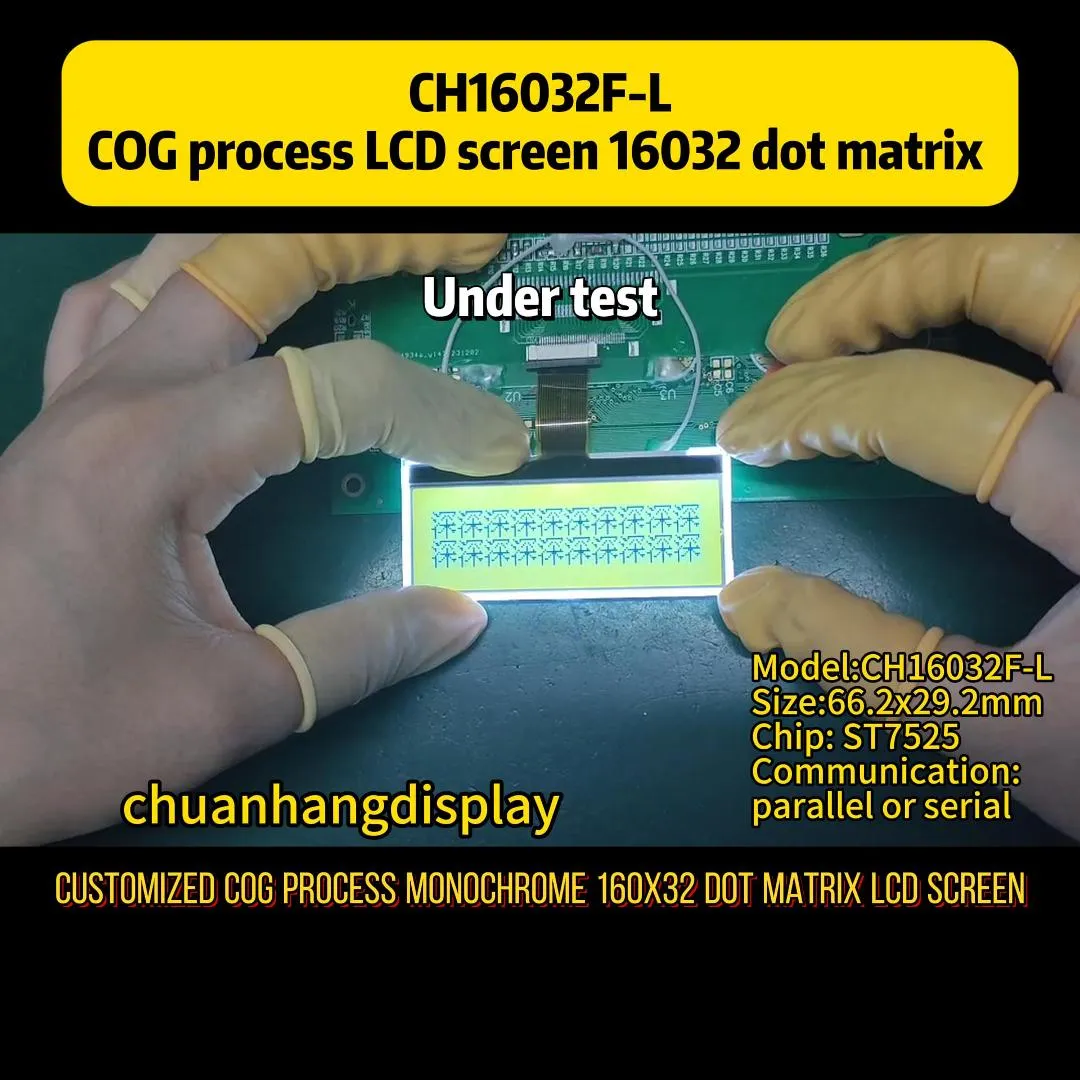
A lcd 16x4 module belongs to the character‑oriented family, typically employing a 5×8 dot‑matrix pattern per character. The "16x4" designation indicates the ability to present sixteen characters on each of four rows, resulting in a total capacity of 64 characters. This format is particularly valuable in control panels and medical devices where space is limited but the need for simultaneous data fields is high.
Almost all 16x4 character LCDs are built around an HD44780‑compatible controller (or equivalents like the Sitronix ST7066, Novatek NT7605). The controller includes:
The four lines are not physically separate; the DDRAM addresses are mapped so that the first line occupies addresses 0x00–0x0F, the second line 0x40–0x4F, the third line 0x10–0x1F, and the fourth line 0x50–0x5F. This mapping requires careful initialisation to ensure correct line wrapping — a nuance that firmware engineers must handle.
The standard interface is a parallel bus (4‑bit or 8‑bit) with RS, R/W, and E control lines. Key electrical parameters include:
For space‑constrained designs, many manufacturers — including Chuanhang Display — offer modules with pre‑installed I2C or SPI adapter boards, reducing wiring to four lines and simplifying PCB layout.
Selecting the correct variant of a lcd 16x4 involves evaluating:
The lcd 16x4 is widely deployed across industries where multi‑line readouts are required without the cost and complexity of graphical displays. Primary sectors include:
Despite the maturity of 16x4 LCD technology, system designers frequently encounter challenges that can be mitigated through careful specification and supplier collaboration.
Industrial and outdoor deployments expose displays to humidity, condensation, and temperature extremes. Standard displays may suffer from contrast degradation, fluid freezing, or polariser delamination. Solutions include:
In a 16x4 format, the backlight must illuminate four lines evenly. Poorly designed edge‑lit guides can create dark spots, especially at the corners. Chuanhang Display addresses this by:
Migrating from 5 V to 3.3 V logic domains can cause communication errors if the module lacks level shifters. Additionally, initialising the four‑line display correctly requires sending specific commands to set the two‑line mode (even though four lines are present). Many engineers overlook the need to enable the second and third lines via the extended function set. Reputable suppliers like Chuanhang Display provide comprehensive application notes and code examples to eliminate this guesswork.

Choosing the optimal lcd 16x4 requires a systematic evaluation of both technical specifications and supply‑chain factors. Use the following checklist during vendor assessment:
With the rise of small OLED and TFT displays, some might question the continued use of character LCDs. However, data from industrial design wins indicates that the lcd 16x4 retains distinct advantages:
We foresee continued adoption in industrial, medical, and infrastructure segments for at least another decade, with incremental improvements in backlight efficiency and operating temperature ranges.
Q1: What is the difference between a 16x2 and a 16x4 LCD display?
A1: A 16x2 LCD shows two lines of 16 characters each (32 characters total), while a lcd 16x4 shows four lines of 16 characters each (64 characters total). The 16x4 format is preferred when more information needs to be displayed simultaneously without scrolling.
Q2: Can I use a standard HD44780 library to control a 16x4 LCD?
A2: Yes, most HD44780 libraries support 16x4 displays. However, you must ensure the library maps the DDRAM addresses correctly (line 1: 0x00, line 2: 0x40, line 3: 0x10, line 4: 0x50). Some libraries require manual address setting for the third and fourth lines.
Q3: What is the typical operating voltage for a 16x4 LCD module?
A3: Most 16x4 character LCDs operate at 5.0 V. However, 3.3 V versions are available for low‑power applications. If you are using a 3.3 V microcontroller with a 5 V LCD, you will need level shifters or an I2C/SPI interface board.
Q4: How do I define and display custom characters on a 16x4 LCD?
A4: Custom characters are stored in CGRAM. You write the 5x8 pixel patterns into CGRAM addresses 0x00–0x07 (for eight characters). Then, you can display them by sending the corresponding CGRAM code (0x00 to 0x07) as data to DDRAM. Chuanhang Display provides sample code for this process.
Q5: Are 16x4 LCD displays suitable for outdoor use?
A5: Yes, provided you choose a transflective polariser and a high‑brightness LED backlight. FSTN positive mode with wide‑temperature fluid is recommended for direct sunlight exposure. Chuanhang Display offers outdoor‑optimised 16x4 modules with enhanced contrast and UV‑resistant polarisers.
Q6: What causes uneven brightness on a 16x4 LCD backlight?
A6: Uneven brightness often results from poor light‑guide plate design or inconsistent LED placement. High‑quality modules from reputable manufacturers use precision light guides and multiple LEDs to ensure uniformity. If you encounter this issue, consider upgrading to a module with better optical design.
Q7: Can I use a 16x4 LCD without a backlight?
A7: Yes, if you select a reflective or transflective polariser, the display can be read in ambient light without a backlight. This is common in battery‑powered devices where power saving is critical.
In summary, the lcd 16x4 remains a technically sound and economically attractive choice for a vast array of industrial and commercial products. By understanding its underlying technology and engaging with experienced manufacturers like Chuanhang Display, engineers can ensure robust performance, long‑term availability, and seamless integration into their designs.