While the display market often focuses on high-resolution OLED or TFT panels, the specialized industrial and medical sectors continue to rely on the reliability and efficiency of segment-based technology. A custom segment display offers unparalleled advantages in power consumption, sunlight readability, and cost-efficiency for specific data visualization needs. This article provides a deep analysis of the engineering considerations, material sciences, and procurement strategies necessary for successful display integration.

A custom segment display operates on the principle of twisted nematic (TN) or super-twisted nematic (STN) liquid crystals. Unlike dot-matrix displays that control every pixel in a grid, a segmented display utilizes pre-defined electrode shapes—often in the form of seven-segment digits, icons, or specific functional symbols.
The hardware stack consists of several layers:
Top and Bottom Polarizers: These determine the display mode (positive or negative).Glass Substrates: Usually soda-lime glass with a thickness of 0.7mm or 1.1mm, coated with Indium Tin Oxide (ITO).Liquid Crystal Layer: The fluid that reacts to electrical charges to manipulate light.Alignment Layers (PI): Polymer films that orient the liquid crystal molecules in a specific direction.
For engineers, selecting the right glass thickness and ITO resistivity is a primary step in ensuring signal integrity across the display surface.
Choosing the correct liquid crystal (LC) mode dictates the visual performance and environmental resilience of the final product. Chuanhang Display specializes in tailoring these modes to meet specific application requirements.
TN remains the most common choice due to its low cost and low operating voltage (typically 3V to 5V). It offers a standard viewing angle and is ideal for battery-operated devices like thermostats and handheld meters.
HTN offers a wider viewing angle than TN and better contrast. It is a middle-ground solution for designers who need improved aesthetics without the higher cost of STN technology.
STN uses a higher twist angle (typically 180° to 270°), which significantly improves contrast and viewing angles. However, STN inherently has a yellow-green or blue-gray background. FSTN adds a compensation film to neutralize this color, resulting in a sharp black-on-white appearance.
VA displays offer the highest contrast ratios. By aligning liquid crystals vertically in the off-state, they block light effectively, creating a true black background with vibrant, multi-colored segments when combined with LED backlighting.
Developing a custom segment display requires a specialized manufacturing process involving Non-Recurring Engineering (NRE) costs. This phase is where the specific artwork, icons, and pinout configurations are defined.
Artwork Design: The designer creates a CAD layout defining every segment, icon, and decimal point. This layout determines the photomask for the ITO etching process.Driving Method (Static vs. Multiplex):Static Drive: Each segment has a dedicated driver pin. This results in the best contrast but requires more pins on the controller.Multiplex (Mux) Drive: Segments share pins through a "Common" (COM) and "Segment" (SEG) matrix. This reduces pin count but can slightly reduce contrast if the duty cycle is too high (e.g., 1/8 or 1/16 duty).Connection Types:Metal Pins: Traditional through-hole mounting for PCBs.Zebra Strips (Elastomeric Connectors): Ideal for thin profiles and high-vibration environments.Heat Seal (HSC): Flexible graphite-based connectors for space-constrained designs.
Industrial environments demand displays that function in extreme conditions. A standard custom segment display typically supports an operating temperature range of -10°C to +60°C. However, for outdoor or automotive applications, wide-temperature fluids are required.
Liquid crystal viscosity increases as temperatures drop, leading to slower response times (ghosting). High-quality panels from Chuanhang Display utilize wide-temp fluids that maintain performance from -40°C to +85°C. In some cases, transparent heaters are integrated into the glass stack to ensure functionality in arctic environments.
The choice between "Standard" and "Harsh Environment" polarizers is fundamental. For outdoor applications, UV-resistant polarizers are mandatory to prevent bubbling, peeling, or fading (browning) caused by prolonged exposure to direct sunlight.
The visibility of a custom segment display is heavily influenced by the backlight unit (BLU) and the reflective properties of the rear polarizer.
Reflective: No backlight; relies on ambient light. Lowest power consumption.Transflective: Works with or without a backlight. The best choice for devices used both indoors and outdoors.Transmissive: Requires a backlight to be visible. Common for VA displays to achieve high contrast.
LED binning is a factor that procurement teams often overlook. To ensure uniform brightness and color consistency across multiple production lots, manufacturers must adhere to strict LED chromaticity coordinates.
When searching for a supplier for a custom segment display, price is only one metric. Technical support during the prototyping phase and long-term availability are more significant.
A reputable manufacturer like Chuanhang Display provides comprehensive design support, including simulation of the viewing cone and power consumption calculations. Key metrics to evaluate include:
ISO Certification: Ensuring consistent quality management.RoHS and REACH Compliance: Mandatory for global market entry.Facility Capacity: Does the factory have cleanroom standards (Class 1000 or better) to prevent dust contamination between the glass layers?
The price of a custom segment display is influenced by the glass size, the number of pins, the type of polarizer, and the complexity of the backlight. While the initial NRE fee might seem like a barrier, it typically ranges from $500 to $2,000, which is quickly offset by the low unit price in volume production.
Even with a well-defined specification, integration challenges can arise. Common issues include:
Ghosting: Often caused by a mismatch between the LCD operating voltage and the driver IC output. Adjusting the contrast voltage (Vlc) usually resolves this.Viewing Angle Misalignment: If the display is mounted at an angle (e.g., in a gas pump or a ceiling-mounted device), the "6 o'clock" or "12 o'clock" viewing direction must be specified during the design phase.Flicker: Usually a result of an incorrect frame frequency. For most segment displays, a frequency between 32Hz and 128Hz is optimal.
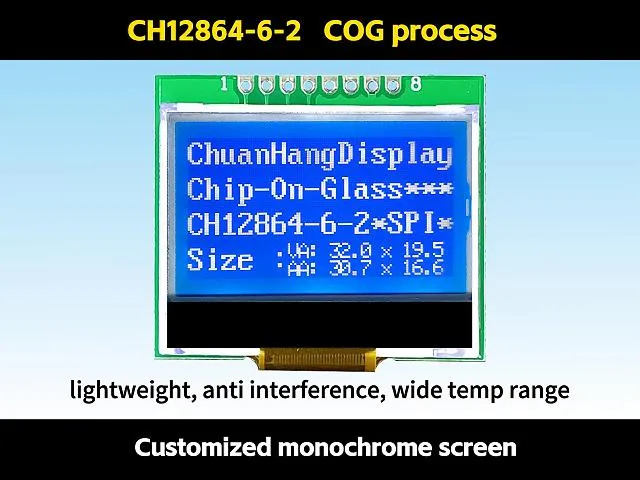
Despite the rise of high-definition screens, the custom segment display is not obsolete. It is evolving. We see innovations in "Segment-on-Glass" (COG) technology, where the driver IC is mounted directly onto the LCD glass, reducing the complexity of the PCB and the number of physical connections.
Furthermore, the integration of touch-sensitive segments is becoming more common. This allows manufacturers to create a seamless interface where the display itself acts as the input device, simplifying the mechanical assembly of the final product.
In conclusion, a custom segment display remains a superior choice for applications where power efficiency, cost, and specialized iconography are paramount. By understanding the chemical and mechanical nuances of LCD technology, engineers can ensure their products remain functional and legible for decades. Partnering with an expert like Chuanhang Display ensures that these technical variables are managed with precision, leading to a robust and reliable user interface.
Q1: What is the typical lead time for a custom segment display prototype?
A1: The process generally takes 2 to 3 weeks for the counter-drawing and layout approval. Once the drawing is finalized, the actual tooling and sample production take approximately 4 to 6 weeks. Mass production usually follows 4 to 8 weeks after sample approval.
Q2: Can I include multi-colored icons in a segmented display?
A2: Yes. This is achieved through two main methods. The first is using different colored LEDs in the backlight for specific areas. The second is "Silk-screen printing" on the front or rear polarizer, where colored inks are applied to icons to give them a permanent color regardless of the backlight.
Q3: How do I determine if I need a TN or an FSTN mode for my project?
A3: If your device is a low-cost, indoor product with simple digits (like a kitchen timer), TN is sufficient. If your product is used outdoors, requires a high-end look, or has complex icons that need a wide viewing angle, FSTN is the preferred choice due to its superior contrast and stability.
Q4: What information is required to provide a quote for a custom segment display?
A4: To provide an accurate quote, manufacturers need the external dimensions of the glass, the viewing area size, the display mode (TN/STN/etc.), the operating voltage, the connection type (pins/zebra), the operating temperature range, and a rough sketch of the segments and icons.
Q5: Is it possible to make a custom segment display with a curved glass surface?
A5: Standard liquid crystal displays are manufactured on flat glass sheets. While curved glass is possible in the OLED industry, it is not commercially viable for segment LCDs due to the difficulty of maintaining a consistent cell gap (the tiny space between the two glass layers where the liquid crystal sits). Instead, designers usually use a curved plastic overlay to create the visual illusion of a curved display.
Q6: What is the minimum order quantity (MOQ) for a custom project?
A6: MOQs vary by manufacturer, but typically for a custom segment display, the MOQ ranges from 500 to 1,000 pieces per production run, depending on the glass size and complexity. Smaller batches may be possible but often incur a setup surcharge.