The evolution of display technology has consistently moved toward miniaturization and higher integration. For engineers and hardware designers, the COG LCD Module represents the pinnacle of monochrome display efficiency. Unlike traditional Chip-on-Board (COB) designs that require a secondary PCB for the driver IC, COG (Chip-on-Glass) technology bonds the driver integrated circuit directly onto the glass substrate. This approach significantly reduces the footprint, weight, and complexity of the final assembly.
As electronic devices in the medical, industrial, and automotive sectors become increasingly compact, understanding the technical nuances of the COG LCD Module is mandatory for successful product lifecycle management. This analysis examines the material science, mechanical considerations, and procurement strategies necessary for professional-grade integration.
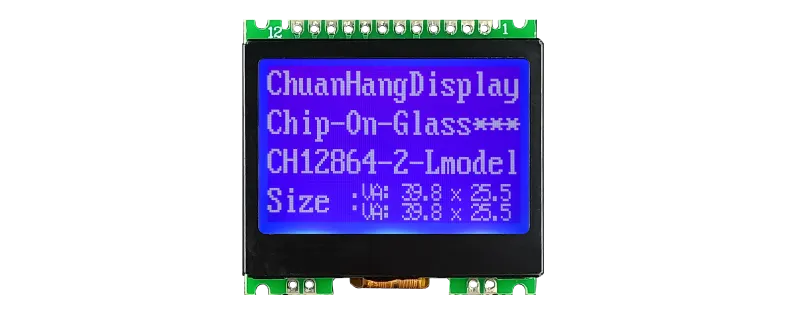
At the heart of a COG LCD Module is the elimination of the traditional wire-bonding or "blob" packaging found on PCBs. Instead, the driver IC—often a Sitronix, Solomon Systech, or similar controller—is flipped and bonded to the Indium Tin Oxide (ITO) traces on the glass.
The connection between the IC's gold bumps and the ITO tracks is facilitated by ACF. This material consists of an adhesive resin embedded with microscopic conductive particles (often gold-plated plastic or nickel). During the bonding process, heat and pressure are applied precisely. The resin hardens while the conductive particles are trapped between the IC and the glass, creating a vertical electrical path while maintaining horizontal insulation.
Because the driver is on the glass, the layout of the ITO tracks must be exceptionally precise. High-resolution displays require fine-pitch traces. If the traces are too thin, the resistance increases, leading to "ghosting" or poor contrast due to voltage drops across the panel. Expert manufacturers like Chuanhang Display optimize these trace widths to ensure uniform pixel activation across the entire viewing area.
The optical performance of a COG LCD Module is not dictated by the driver alone but by the chemical composition of the fluid and the quality of the polarizing films.
STN (Super-Twisted Nematic): Offers a higher twist angle (typically 240 degrees) than standard TN, providing better contrast and wider viewing angles. It is a staple for industrial meters.FSTN (Film-compensated STN): Incorporates a retarder film to eliminate the yellow-green or blue tint of STN, resulting in a crisp black-and-white output. This is the preferred choice for high-end laboratory equipment where clarity is a priority.VA (Vertical Alignment): Provides a true black background with exceptionally high contrast ratios. While more expensive, VA COG modules are increasingly used in automotive dashboards and premium home automation interfaces.
The choice of polarizer—Reflective, Transmissive, or Transflective—must align with the intended lighting environment. For battery-powered outdoor devices, a transflective polarizer allows the display to remain readable in direct sunlight without consuming backlight power.
One of the primary industry pain points with COG technology is its relative fragility compared to COB. Since the driver IC is exposed on the glass, it is more susceptible to mechanical stress and environmental contaminants.
The connection to the main system board is usually handled by a Flexible Printed Circuit (FPC). A common failure point in a COG LCD Module is the transition between the FPC and the glass. Engineers must ensure that the enclosure design provides adequate strain relief so that vibration or external impact does not peel the FPC away from the glass substrate.
Glass, silicon, and plastic housings have different coefficients of thermal expansion (CTE). In environments with wide temperature fluctuations (e.g., -30°C to +85°C), these materials expand and contract at different rates. Professional integration involves using silicone-based gaskets or specialized mounting frames that allow for microscopic movement without putting pressure on the bonded driver IC.
The COG LCD Module is not a universal solution; its implementation must be tailored to specific sector requirements.
Medical Diagnostic Devices: Reliability is the primary metric here. Displays must resist EMI (Electromagnetic Interference) from other hospital equipment. The compact nature of COG allows for more ergonomic handheld designs.Industrial Automation: In this field, longevity is the biggest concern. A display must remain operational for 10 to 15 years. This requires sourcing from suppliers that provide long-term EOL (End-of-Life) notifications and consistent BOM (Bill of Materials) control.Smart Meters: Power consumption is a limiting factor. COG modules, by eliminating the need for a secondary PCB and reducing the number of interconnects, naturally lower the parasitic capacitance of the system, extending battery life in remote gas or water meters.
Because the COG architecture often involves long FPC cables and high-speed serial interfaces (like SPI or I2C), signal integrity can become an issue.
The high-impedance nature of ITO traces makes them sensitive to external noise. Designers should prioritize I2C interfaces with pull-up resistors tuned for the specific bus capacitance. Furthermore, adding a grounding plane to the FPC or using shielded connectors can prevent the display from acting as an antenna, which is a frequent hurdle in FCC or CE certification testing. Chuanhang Display offers customized FPC designs that incorporate shielding layers specifically to address these interference concerns in complex electronic environments.
When procuring a COG LCD Module, the B2B buyer must navigate a different financial landscape than with standard character displays.
NRE (Non-Recurring Engineering): Custom COG modules require unique glass masks and FPC tooling. While this involves an upfront cost, the unit price for high-volume runs is significantly lower than COB equivalents because of the reduced component count.Lead Times: Because COG glass is often "made to order" rather than stocked as a generic commodity, lead times can range from 6 to 10 weeks. Planning for "buffer stock" is a common strategy for mitigating supply chain disruptions.Factory Audits: A reputable supplier must possess Class 1000 cleanroom facilities for the ACF bonding process. Dust contamination during the bonding phase is the leading cause of "line defects" (missing rows or columns) in the field.
A significant trend in the industry is the shift from 5V logic to 1.8V and 3.3V systems. Modern COG LCD Module controllers are designed to operate at these lower voltages, which is fundamental for compatibility with the latest ARM Cortex microcontrollers and ultra-low-power FPGA sets.
When selecting a module, verify the "Internal Booster" capabilities of the driver IC. A quality COG controller can take a 3.3V input and internally boost it to the 10V or 15V required to drive the liquid crystal pixels, simplifying the power supply circuit on the main PCB.

The COG LCD Module continues to be the backbone of professional hardware because it balances high-density information display with a slim, modern profile. While the initial engineering hurdles regarding mechanical protection and FPC handling are higher than legacy technologies, the benefits of reduced weight, lower power consumption, and streamlined assembly are undeniable.
By partnering with an authority like Chuanhang Display, hardware teams can navigate the complexities of ACF bonding, fluid chemistry, and signal integrity to produce products that withstand the rigors of the industrial market. As we move toward more integrated "smart" environments, the reliability of the monochrome COG interface remains a steady anchor in a sea of increasingly complex visual solutions.
Q1: What is the main advantage of a COG LCD Module over a COB LCD Module?
A1: The primary advantage is size and thickness. Since the driver IC is bonded directly onto the glass, there is no need for a bulky PCB behind the display, allowing for much thinner device profiles and reduced weight.
Q2: Can I use a COG display in outdoor environments with high vibration?
A2: Yes, but it requires specific mounting. Since the glass is the structural base, you must use shock-absorbing gaskets and ensure the FPC has adequate strain relief to prevent the bond from breaking under mechanical stress.
Q3: Why does my COG display lose contrast when the temperature drops?
A3: Liquid crystals become more viscous at low temperatures, and the threshold voltage changes. To fix this, you may need to adjust the "Vop" (Operating Voltage) via software or ensure your module has a built-in temperature compensation circuit.
Q4: Is it possible to get a custom FPC length for a COG LCD Module?
A4: Absolutely. One of the strengths of COG technology is that the FPC is a separate component bonded to the glass. Manufacturers can customize the length, pinout, and even the connector type (ZIF or soldered) to fit your specific enclosure.
Q5: How do I handle the I2C address if I want to use multiple COG modules on the same bus?
A5: Many COG driver ICs have a hardware pin (such as SA0 or ADDR) that can be tied high or low to change the I2C address. If the module does not expose this pin, you may need to use an I2C multiplexer or separate bit-banged GPIO pins for communication.