Many product engineers assume that OLED or TFT modules have completely replaced monochrome graphic LCDs. In reality, the 128x64 graphic LCD display continues to ship in millions of units annually for industrial controllers, medical hand-held devices, and laboratory equipment. The reasons are straightforward: ultra-low power consumption (1–2 mW with reflective technology), direct sunlight readability, and a cost structure that remains competitive. A 128x64 pixel resolution offers sufficient area to present custom icons, small system menus, waveform plots, or multilingual character sets without requiring a full-frame buffer or high-end microcontroller.
This article walks through the electrical, optical, and mechanical specifications that B2B buyers must verify before placing volume orders. It also covers panel material selection (COB vs. COG, FSTN vs. STN), controller compatibility, and a practical method for benchmarking suppliers. The goal is to help you specify a 128x64 graphic LCD display that survives extended temperature ranges, electromagnetic interference, and decades of intermittent operation.
Chuanhang Display has supplied over 200 custom monochrome LCD variants to the European automation sector, and the following insights are based on actual failure analysis and design reviews from those projects.
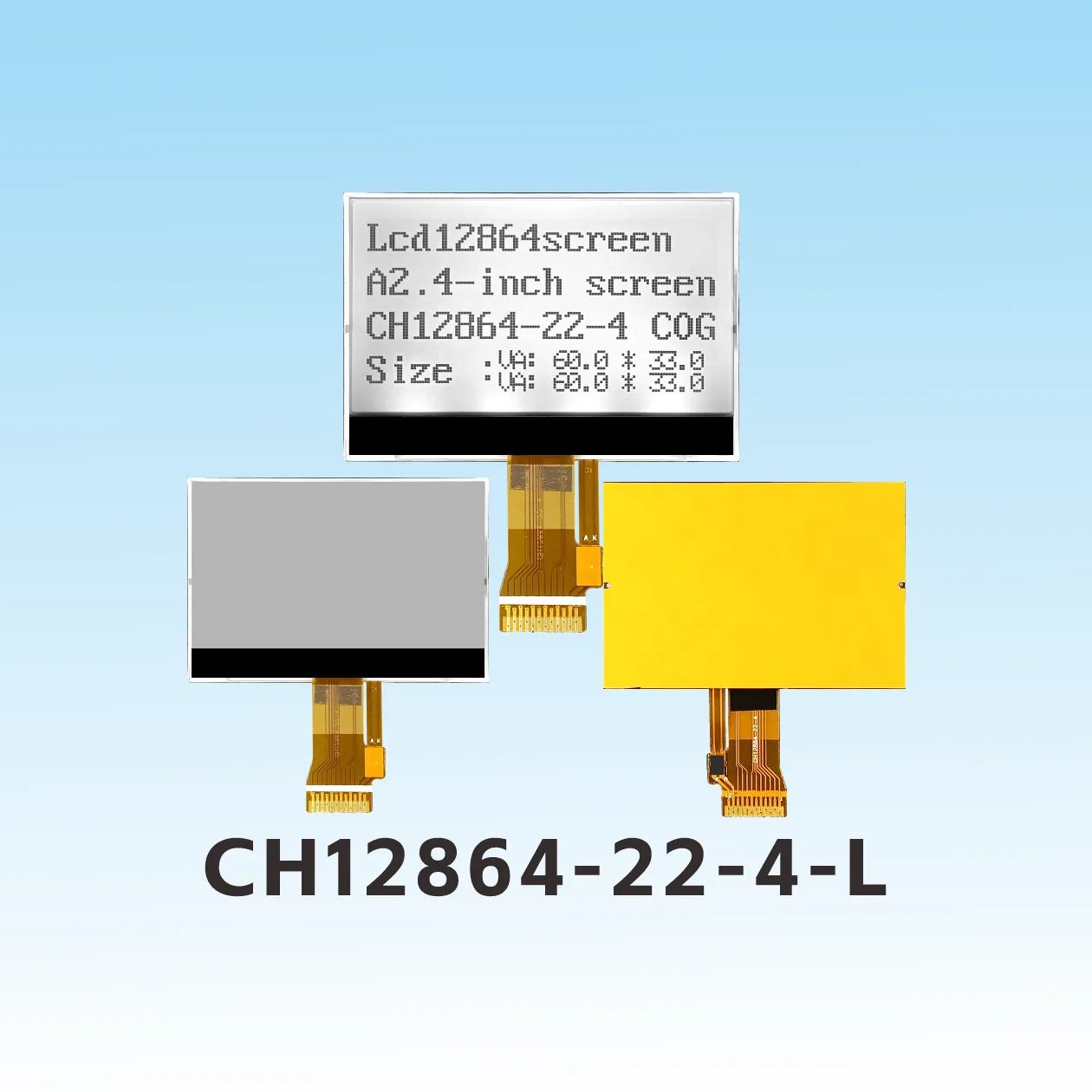
A standard 128x64 graphic LCD display arranges pixels in 128 columns and 64 rows, yielding 8,192 individually addressable dots. The active area typically measures between 62 mm × 44 mm (for medium-size modules) and 54 mm × 36 mm (compact variants). Dot size, dot pitch, and gap determine sharpness. For high-contrast applications, look for dot pitch below 0.48 mm and gap below 0.04 mm.
Three controller families dominate this segment:
When selecting a 128x64 graphic LCD display, confirm the controller’s supply voltage (3.3 V or 5 V) and the logic level shift circuitry if your MCU operates at a different voltage. Mismatched levels cause ghosting or permanent damage to the input protection diodes.
Backlight options: white LED (most common), amber (for night-vision compatibility), or no backlight (reflective polarizer) for lowest power. For industrial controls, choose semi-transmissive FSTN with LED backlight – this provides sunlight readability without backlight and indoor readability with backlight.
Factory automation panels demand a 128x64 graphic LCD display that operates from -20 °C to +70 °C. Beyond temperature range, look for:
Chuanhang Display offers a reinforced series with conformal coating on the PCB, passing 10 G vibration per IEC 60068-2-6.
Patient monitors, infusion pumps, and diagnostic readers require:
In these use cases, a 128x64 graphic LCD display with COG (chip-on-glass) construction reduces PCB footprint and eliminates bond wire loops, which also improves EMC performance.
Retail environments involve frequent power cycling and electrostatic discharge from synthetic clothing. Key considerations:
| Feature | COB (Chip-on-Board) | COG (Chip-on-Glass) |
|---|---|---|
| Controller placement | On PCB, beneath display | Directly on glass edge |
| Thickness | 8–12 mm | 2.8–5 mm |
| Interconnect | Metal pins (2.54 mm pitch) | Elastomeric zebra strip or FPC |
| Suitable for | High vibration, dust protection | Portable devices, tight enclosures |
| Tooling cost | Low (NRE ~$300–500) | Medium (NRE ~$800–1500) |
| Unit price (≥1k pcs) | $3.50–$6.00 | $2.80–$4.50 |
Most 128x64 graphic LCD display modules under $5 are COB with KS0108. For high-volume consumer products, COG reduces assembly time (no pin soldering) and lowers total cost. However, COG connections are more sensitive to mechanical pressure – avoid direct mounting over vibrating motors.
Chuanhang Display maintains separate production lines for COB and COG, offering drop-in replacement designs where both options share the same mechanical mounting holes and FPC connector position.
Pain Point 1: Contrast Disappears in High Temperature
A 128x64 LCD’s drive voltage requires temperature compensation. Many generic modules skip the thermistor or use crude lookup tables. Result: at 60 °C, characters vanish. Solution: request modules with integrated temperature sensor and auto-VOP adjustment (often labeled “TC” or “temp comp”).
Pain Point 2: Missing Pixels After One Year
Caused by zebra strip contamination or insufficient clamping force. For humid environments (greenhouses, laundries), choose COB modules with potted PCB edges. For COG, specify an ACF (anisotropic conductive film) bonding with environmental seal.
Pain Point 3: Poor SPI Timing Margins
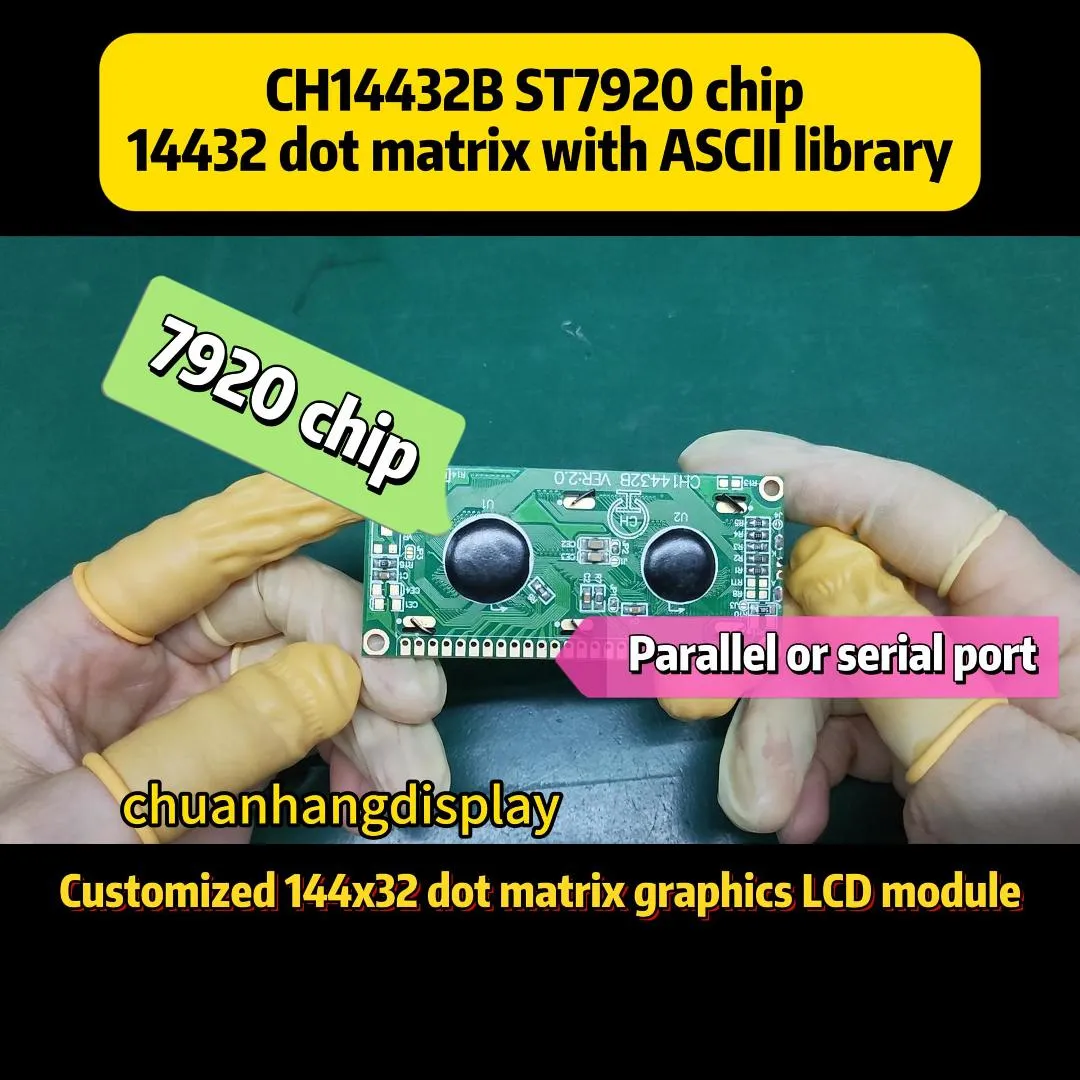
Some ST7920 implementations fail at clock speeds above 2 MHz due to long rise times. Request the supplier’s timing diagram and validate with a 50 pF load on SCK line. Chuanhang Display provides IBIS simulation data for their modules upon NDA.
Pain Point 4: Backlight Bleeding and Uneven Luminance
Edge-lit LED backlights often show bright spots near the LEDs. Specify a light guide plate with laser dot patterning (not screen-printed). Ask for luminance uniformity >80% per five-point measurement.
| Component / Feature | Price impact (per 1k units) |
|---|---|
| Standard STN yellow-green, no backlight | Baseline $2.50 |
| FSTN positive (black/white) | +$1.20 |
| White LED backlight, 4-chip | +$0.80 |
| Wide temperature (-30 °C to +80 °C) | +$1.50 |
| Built-in temperature compensation circuit | +$0.90 |
| COG vs. COB | -$0.70 (COG cheaper) |
| RoHS / REACH declaration pack | +$100 (one-time) |
For a 128x64 graphic LCD display with FSTN positive, white LED backlight, and wide temperature range, expect $4.00–$5.00 per unit at 5k quantity. Custom graphics (your own icon segments) add about $800–$1,500 NRE (non-recurring engineering).
Chuanhang Display provides an online cost estimator for 128x64 modules based on STN/FSTN, temperature range, and interface type. Request login credentials via their B2B portal.
Q1: Can I run a 128x64 graphic LCD display directly from a 3.3 V microcontroller?
A1: Yes, but check the controller’s minimum Vdd. KS0108 needs at least 4.5 V for reliable operation (some clones work at 3.3 V but with reduced contrast). ST7920 and SSD1305 are designed for 3.3 V logic. If you must use a 5 V-only controller, add a level shifter for data lines. A simpler approach: select a 128x64 graphic LCD display with built-in 3.3 V regulator – Chuanhang Display offers this as a standard option for their COG series.
Q2: What is the typical power consumption with and without backlight?
A2: Without backlight (reflective mode): 1–2 mW (0.3 mA at 5 V). With backlight: white LED adds 60–120 mW depending on brightness (4 LEDs × 15 mA × 3 V ≈ 180 mW). For battery-operated instruments, use a reflective FSTN 128x64 graphic LCD display and backlight only when user pushes a button. Some controllers support display-on/off commands to save additional power.
Q3: How do I create custom graphics and characters?
A3: For KS0108, you write directly to the display’s RAM – each bit represents a pixel. Use a font generator tool (e.g., GLCD Font Creator) to convert your icons into byte arrays. For ST7920, you can store custom patterns in the CGRAM (character-generator RAM) as 16×16 blocks. Most embedded libraries (U8g2, Adafruit GFX) support 128x64 graphic LCD display with standard controllers. For volume production with custom startup logos, Chuanhang Display pre-programs the CGRAM during module assembly.
Q4: What is the typical lifespan of a 128x64 monochrome LCD?
A4: The LCD glass itself (liquid crystal material) lasts 10–15 years under normal conditions (25 °C). The LED backlight degrades faster – to 70% initial brightness after 50,000 hours (≈5.7 years continuous). Polarizers may yellow after 8–10 years, especially with UV exposure. For outdoor or high-temperature applications, request polarizers with UV blocking (specified as “UV-stable”) and derate LED current to 10 mA.
Q5: Can I replace a parallel-interface 128x64 with an SPI version without changing PCB layout?
A5: Not directly. Parallel requires 11 pins (8 data + 3 control); SPI uses 4 pins (CS, SCK, MOSI, DC). However, some ST7920-based modules offer both interfaces on the same FPC – unused pins must be tied to Vdd or GND as per datasheet. You cannot use KS0108 (parallel-only) on an SPI bus. Plan PCB with jumpers to select interface. Chuanhang Display offers pin-compatible adapters for their 128x64 graphic LCD display families, allowing drop-in replacement between parallel and SPI.
Selecting a 128x64 graphic LCD display involves balancing optical performance (FSTN vs. STN), electrical interface (parallel for speed, SPI for pin savings), and mechanical constraints (COG for thinness, COB for ruggedness). Avoid common pitfalls: skipping temperature compensation, ignoring ESD protection on the PCB, and assuming all suppliers follow KS0108 timings strictly.
Chuanhang Display provides full design support including schematics review, firmware driver examples (C, MicroPython, Arduino), and 3D CAD models for mechanical integration. Their quality assurance includes 100% thermal cycling test (-30 °C to +80 °C, 10 cycles) for every production batch of graphic LCD modules.
Contact Chuanhang Display to request:
Submit your inquiry through the official B2B form – include target annual quantity, preferred interface (SPI/I²C/parallel), and operating temperature range. A technical sales engineer will respond within 24 hours with a tailored proposal.
[Click here to send an inquiry to Chuanhang Display]
(Or email directly: sales@chuanhangdisplay.com with subject “128x64 Graphic LCD Inquiry – [Your Company Name]”)