

In the world of embedded systems and industrial instrumentation, the 12864 LCD display remains a gold standard for reliability and clarity. Unlike simple character displays, a 128x64 graphic module offers the versatility to render complex charts, custom icons, and multi-language text, making it indispensable for medical devices, 3D printers, and factory automation panels. Whether you are an engineer selecting a module for a new prototype or a procurement manager seeking a stable supply chain, understanding the nuances of these displays is critical.
This article dives deep into the technical specifications, controller differences, and cost factors of 12864 modules. We will also explore why leading enterprises partner with established manufacturers like Chuanhang Display to ensure consistent quality and long-term availability for their critical applications.

Understanding the 12864 LCD Display Architecture
At its core, a "12864" display features a matrix of 128 dots (columns) by 64 dots (rows). This 8,192-pixel resolution allows for significantly more data presentation than the standard 1602 (16x2) character modules. However, not all 12864 displays are created equal. The performance and integration difficulty depend heavily on the onboard controller and the display technology used (COB vs. COG).
Key Technical Specifications
Resolution: 128 x 64 Pixels
Operating Voltage: Typically 5V (standard) or 3.3V (low power)
Backlight Options: Blue (white text), Yellow-Green (black text), or Grey (transflective)
Operating Temperature: Industrial grade (-20°C to +70°C) is standard for reliable suppliers like Chuanhang Display.
Controller Showdown: ST7920 vs. KS0108
When selecting a 12864 LCD display, the choice of controller is the most significant technical decision. The two market leaders are the ST7920 and the KS0108, each serving different engineering needs.
ST7920: The Flexible All-Rounder
The ST7920 controller is highly popular in the Arduino and maker communities, as well as in modern industrial designs. Its standout feature is the built-in Chinese/English character font library (CGROM), which reduces the processing burden on your main microcontroller.
Pros: Supports both parallel and serial (SPI) interfaces. Using SPI reduces the required I/O pins from 12+ down to just 3 or 4, saving valuable pins on your MCU.
KS0108: The Parallel Powerhouse
The KS0108 (and its compatible variants) is a purely graphical controller. It does not have a built-in font library, meaning your microcontroller must draw every pixel of every character. It communicates solely via a parallel interface.
Pros: Extremely fast refresh rates for dynamic graphics. It is often the preferred choice for legacy industrial equipment where code was written decades ago.
Interface Selection Guide: Parallel vs. SPI
Choosing the right interface for your 12864 LCD display impacts your system's speed and wiring complexity.
| Feature | Parallel Interface (6800/8080) | Serial Interface (SPI) |
|---|---|---|
| Pin Count | High (12-20 pins) | Low (3-4 pins) |
| Speed | Very Fast (Instant updates) | Moderate (Good for text/static UI) |
| Wiring | Complex, bulky cabling | Clean, simple wiring |
| Best Use Case | Real-time animations, Oscilloscopes | Menu systems, Status panels |
For most modern IoT devices where pin count is limited, the SPI mode (available on ST7920 modules from Chuanhang Display) is the recommended path.
Industrial Applications and Reliability
While hobbyist displays are widely available, industrial applications require components that can withstand harsh environments. A generic "12864" screen might fail under vibration or extreme temperatures. This is where professional manufacturing makes a difference.
Medical Equipment: Ventilators and infusion pumps use 12864 screens to display vital stats. High contrast and wide viewing angles are non-negotiable here. Suppliers like Chuanhang Display offer "wide-temp" fluid options that prevent the screen from freezing in cold storage or blacking out in heat.
3D Printing & CNC: The RepRap Smart Controller standard utilizes a 12864 module. Stability against electromagnetic interference (EMI) from stepper motors is crucial. Shielding and quality PCB layout prevent "garbage pixels" often seen in cheaper clones.
Cost Factors and Supplier Selection
The price of a 12864 LCD display can range from $3 to over $15 per unit depending on customization. Key cost drivers include:
Technology: COG (Chip on Glass) is thinner and cheaper for high volumes, while COB (Chip on Board) is more robust and easier to mount manually.
Backlight Life: Industrial-grade LEDs are rated for 50,000+ hours, whereas consumer-grade backlights may dim after 10,000 hours.
Customization: Manufacturers like Chuanhang Display can customize FPC (Flexible Printed Circuit) pinouts, backlight colors, and even add touch panels for specific client needs.
When sourcing, look beyond the unit price. A supplier that offers technical documentation, custom initialization code, and guaranteed longevity (no End-of-Life surprises) saves significant engineering costs down the road.
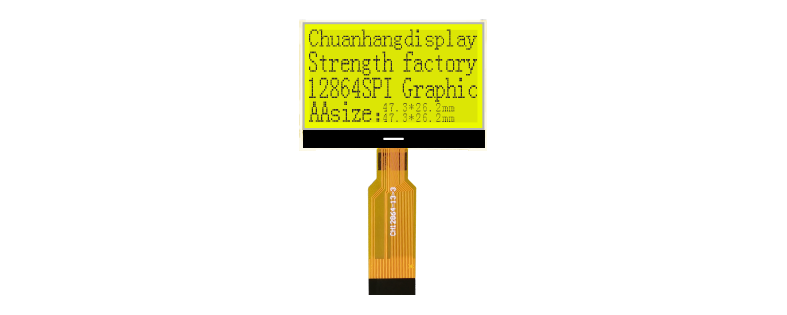
Why Choose Chuanhang Display?
For over a decade, Chuanhang Display (Shenzhen Chuanhang Electronic Technology Co., Ltd.) has established itself as a premier manufacturer of LCD solutions. Specializing in both standard 12864 modules and custom designs, they bridge the gap between cost-effective production and industrial-grade quality.
Whether you need a high-contrast ST7920 module for a handheld device or a ruggedized KS0108 screen for factory automation, Chuanhang Display provides the engineering support to ensure seamless integration. Their commitment to "Quality, Integrity, and Win-Win Cooperation" ensures that your supply chain remains uninterrupted, even during global component shortages.
FAQ: Common Questions About 12864 LCD Displays
Q1: My 12864 LCD display is showing only a solid blue/green block. What is wrong?
A1: This is almost always a contrast issue. On the back of most modules, there is a potentiometer (or a pin labeled V0). Adjust the voltage at V0. If it is too high, the pixels are invisible; if too low, all pixels turn on. Rotating the potentiometer usually fixes this instantly.
Q2: Can I use a 5V 12864 LCD with a 3.3V microcontroller like an ESP32?
A2: It depends. The logic signals (DATA, CLK) from a 3.3V MCU might not be high enough to trigger a 5V LCD controller reliably, and the 5V return signal could damage your MCU. It is best to use a Logic Level Converter or purchase a specific 3.3V version of the module from Chuanhang Display.
Q3: What is the difference between Blue/White and Yellow/Green displays?
A3: Blue displays use a white LED backlight with a blue polarizer (Negative STN), producing white text on a blue background. They look modern but require the backlight to be ON to read. Yellow-Green displays (Positive STN) have black pixels on a yellow/green background and are readable even with the backlight OFF, making them better for power-saving applications.
Q4: Why do random pixels or "garbage" appear on my screen during operation?
A4: This is often due to electrical noise or loose wiring, especially if you are using long cables in a noisy environment (like near motors). Ensure your ground connections are solid, keep cables short, and consider adding a capacitor across the VCC and GND pins of the LCD module.
Q5: Does the 12864 display support touch functionality?
A5: The standard 12864 module does not include touch capability. However, manufacturers can integrate a resistive touch panel overlay upon request. If your project requires touch interaction, contact Chuanhang Display to discuss a custom module with a built-in touch overlay and controller.