For OEM engineers and procurement managers evaluating display solutions for compact instrumentation, the oled display 128x64 represents a established sweet spot between resolution, power draw, and physical footprint. Unlike larger graphical panels that require complex GPU drivers or smaller numeric segments that lack visual flexibility, this resolution class delivers readable graphics, multi-language character support, and crisp iconography within a module footprint typically under 40mm × 35mm.
This guide examines the oled display 128x64 from a systems-engineering perspective: we analyze pixel-driver architectures, compare substrate material options, review real-world reliability data across temperature extremes, and provide actionable criteria for supplier qualification. Whether you are specifying a display for a handheld medical diagnostic tool, an industrial HMI pendant, or a wearable data logger, the technical decisions outlined here directly affect your product's field failure rate, optical performance, and unit cost.
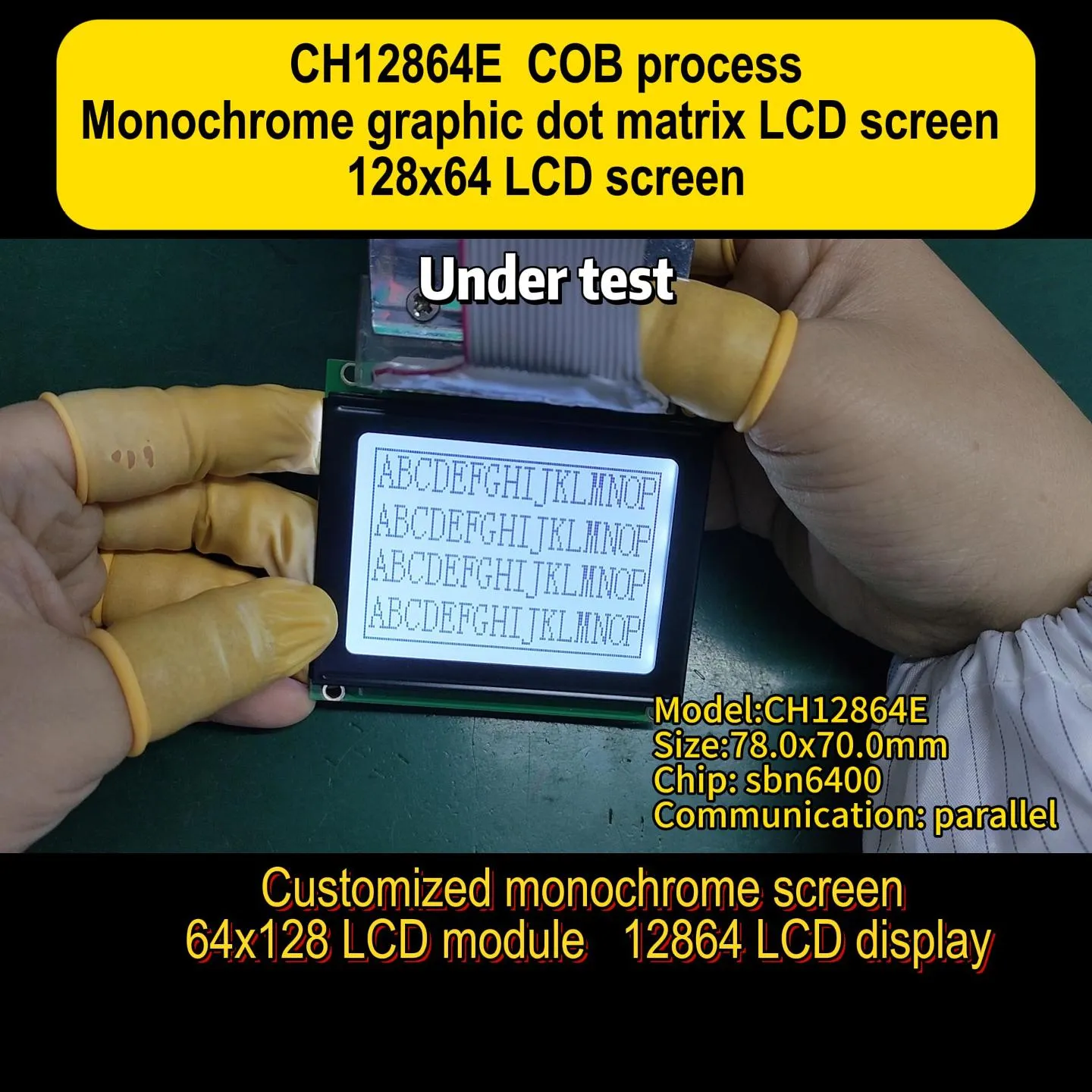
The 128x64 resolution denotes a matrix of 128 columns and 64 rows, totaling 8,192 individually controllable pixels. In a passive-matrix OLED (PMOLED) configuration—which dominates this resolution class—each pixel is addressed via a grid of row and column electrodes. The row driver sequentially activates each row while the column driver supplies current to the desired pixels in that row. This multiplexing approach keeps driver IC costs low but imposes brightness limitations as the duty cycle decreases with higher row counts.
For the oled display 128x64, the typical duty cycle is 1/64, meaning each pixel emits light for only 1/64th of the frame period. To achieve adequate average luminance (typically 80–120 cd/m²), peak pixel currents must be proportionally higher. This trade-off directly influences the choice of OLED stack materials and encapsulation robustness, topics we address in the materials section below.
Active-matrix (AMOLED) variants exist for 128x64 but are exceedingly rare due to cost overhead—a TFT backplane adds at least 2–3 layers of photolithography, tripling panel cost without offering significant visual benefit at this pixel density. Consequently, over 95% of commercially available oled display 128x64 modules use PMOLED driving schemes.
Most oled display 128x64 modules integrate a dedicated driver controller such as the SSD1306, SH1106, or equivalent. These ICs embed SRAM for frame buffering (1 KB suffices for 128×64 monochrome), oscillator circuitry, and voltage generator for the OLED bias supply. The interface options typically include:
When selecting a oled display 128x64 module, verify the driver IC revision and its supported command set—some older SH1106 variants exhibit different page-addressing behavior than SSD1306, which can break existing firmware if not accounted for during component substitution.
The choice of substrate material for the oled display 128x64 impacts not only mechanical flexibility but also thermal stability and optical clarity. Glass substrates (typically 0.3–0.5 mm thick) offer excellent dimensional stability, low moisture permeability, and a well-established manufacturing infrastructure. They remain the default choice for industrial control panels and benchtop instruments where rigidity is advantageous.
Plastic substrates (polyimide or PET) enable thinner modules and limited bendability—some suppliers offer flexible variants with a bending radius down to 10 mm. However, plastic substrates require barrier films to protect the organic emissive layers from oxygen and moisture, adding cost and reducing yield. For most stationary equipment, glass-based oled display 128x64 modules provide superior long-term reliability at a lower unit cost.
The OLED stack comprises a hole-injection layer, hole-transport layer, emissive layer, electron-transport layer, and cathode. For monochrome 128x64 displays (white, blue, yellow, or green), the emissive layer uses small-molecule phosphorescent dopants hosted in a matrix material. The color purity and efficiency are governed by the dopant concentration and the host's triplet energy level.
White OLEDs (WOLED) are particularly popular for oled display 128x64 modules paired with color filters when an RGB output is required, though the color gamut is narrower than direct-emission RGB side-by-side patterns. For monochrome applications, green-emitting OLEDs achieve the highest luminous efficiency (up to 60 cd/A), making them the preferred choice for battery-operated devices. Yellow and blue variants trade efficiency for specific aesthetic or optical requirements—blue OLEDs, for instance, exhibit faster degradation rates, which we discuss in the lifetime section.
OLED materials are intrinsically sensitive to moisture and oxygen—exposure to water vapor levels above 100 ppm can cause dark spot formation within hours. The oled display 128x64 modules employ one of three encapsulation strategies:
For harsh-environment applications (outdoor signage, automotive interiors), prioritize modules with glass-lid encapsulation and an integrated environmental sensor that triggers display shutoff when internal humidity exceeds a threshold.
Handheld blood analyzers, pulse oximeters, and portable ECG monitors frequently use the oled display 128x64 to present numerical readouts, trend graphs, and alarm icons. The high contrast ratio (>10,000:1) and wide viewing angle (±80°) ensure readability in operating theaters with variable ambient lighting. For these applications, Chuanhang Display offers a variant with antimicrobial surface coating and a front polarizer that reduces glare under surgical lamps.
CNC machine controllers, robotics teach pendants, and process calibrators benefit from the oled display 128x64's ability to render multi-language character sets (ASCII, Cyrillic, Chinese simplified) without pixelation. The module's response time (<10 µs) eliminates motion blur when displaying rapidly updating torque or temperature graphs. Industrial users prioritize modules with extended operating temperature ranges (−40°C to +85°C) and reinforced FPC connectors that withstand repeated flexing.
Personal air-quality monitors, dosimeters, and athlete-worn biometric sensors require displays that consume less than 2 mA average current during active updates. The oled display 128x64, when driven with a 1/64 duty cycle and optimized waveform, achieves 100 cd/m² at 1.8–2.2 mA supply current. Combined with a 3.0 V to 5.5 V input range, this allows direct operation from CR2032 coin cells or Li-Po batteries.
Thermostat panels, lighting control keypads, and security system keypads increasingly incorporate graphical displays to replace segmented LCDs. The oled display 128x64 provides sufficient real estate for a 6×8 character grid or a simple animated icon set. For these indoor applications, Chuanhang Display's COG (Chip-on-Glass) variants minimize the module thickness to 2.0 mm, enabling flush-mount designs.
Commercial-grade oled display 128x64 modules are rated for 0°C to +70°C operational and −30°C to +80°C storage. Industrial-grade (often designated with an 'I' suffix) extend this to −40°C to +85°C operational. The key thermal failure mechanisms include:
A typical oled display 128x64 module with 100% pixels illuminated at 100 cd/m² draws 18–25 mA from a 3.3 V supply, translating to 60–83 mW of active power. However, most graphical content has an average pixel on-rate of 15–30% (text and simple icons), reducing real-world consumption to 10–15 mA. For power-sensitive designs, consider the following optimization techniques:
OLED lifetime is typically defined as the time for luminance to decay to 50% of its initial value (L50) at a constant current density. For a green monochrome oled display 128x64, leading suppliers specify L50 > 20,000 hours at 100 cd/m² and room temperature. However, this figure drops to approximately 8,000 hours when operating at 80°C. Degradation is nonlinear—the Arrhenius model with an activation energy of 0.3–0.5 eV predicts a halving of lifetime for every 10°C increase above 25°C.
To maximize display longevity in field deployments, consider oversizing the pixel area (using a slightly higher resolution panel and scaling content) to operate at lower current densities, or implement a pixel-shifting algorithm that redistributes on-time across adjacent pixels for static graphics.
When qualifying a supplier for oled display 128x64 modules, request the following data sets:
Chuanhang Display implements a 100% optical inspection station with a Konica Minolta CS-2000 spectroradiometer on each production line for oled display 128x64 modules, and provides batch-level uniformity reports upon request.
The global OLED materials supply chain is concentrated among a handful of producers (UDC, Merck, Sumitomo Chemical). Lead times for emissive-layer materials can extend to 20–24 weeks during capacity-constrained periods. For oled display 128x64 modules, the glass substrate and driver ICs are typically stocked commodities, but the finished module assembly requires 2–3 weeks for standard configurations and 4–6 weeks for custom FPC layouts or viewing-angle optimizations.
To mitigate supply risks, consider dual-sourcing with approved second-source suppliers. However, be aware that driver IC pinouts and command sets may differ—verify software compatibility before qualifying a backup vendor.
Pricing for a standard monochrome oled display 128x64 module with glass encapsulation and SPI/I²C interface typically falls within the following bands:
| Order Quantity | Unit Price Range (USD) | Typical MOQ |
|---|---|---|
| 500–1,000 pcs | $4.20 – $5.80 | 500 |
| 5,000–10,000 pcs | $3.10 – $4.00 | 2,000 |
| 50,000+ pcs | $2.40 – $2.90 | 10,000 |
These figures assume a white or blue monochrome panel with a standard 30-pin FPC and no custom modifications. Add $0.80–$1.50 per unit for color-filter-based RGB, $1.20–$2.00 for extended temperature range, and $0.50–$1.00 for ZIF connector variations. For volume orders above 100,000 units, Chuanhang Display offers engineering support for custom anode-cathode metallization patterns that reduce module thickness by 0.3 mm.
Chuanhang Display has shipped over 2 million oled display 128x64 modules across medical, industrial, and consumer applications since 2015. Our engineering team provides:
The oled display 128x64 remains a workhorse component for engineers who require a balance of graphical capability, power efficiency, and physical compactness. By understanding the driver IC options, substrate trade-offs, encapsulation strategies, and environmental limitations, procurement teams can specify modules that deliver consistent optical performance over multi-year field deployments. When evaluating suppliers, prioritize manufacturers with documented quality-control procedures, transparent material sourcing, and a willingness to provide detailed reliability data beyond the standard datasheet.
For projects requiring custom dimensions, interface modifications, or extended temperature ranges, Chuanhang Display offers application-engineering support and rapid prototyping for oled display 128x64 modules. Our flexible manufacturing lines accommodate small-batch pilot runs as well as high-volume production, with on-site FAE support available throughout the design-in phase.
Q1: What is the typical power consumption of an oled display 128x64 when displaying static text?
A1: With 25% of pixels active at 100 cd/m² brightness, the module draws approximately 12–14 mA from a 3.3 V supply (40–46 mW). In sleep mode (display off), the current drops to 2–3 µA, making it suitable for intermittent-readout devices.
Q2: Can I drive an oled display 128x64 directly from a 5 V microcontroller without level shifters?
A2: Most modules accept VDD from 2.8 V to 5.5 V, and the logic-level inputs are 5 V tolerant when VDD ≥ 3.3 V. However, the internal charge pump may be disabled at VDD > 4.0 V to prevent overvoltage—consult the specific driver IC datasheet for the recommended VDD range for your brightness target.
Q3: How does the lifetime of a blue oled display 128x64 compare to a green one?
A3: Blue OLEDs use deep-blue emitters with wider bandgaps, which degrade faster due to higher injection voltages and molecular instability. At 100 cd/m², a blue module typically achieves L50 of 8,000–10,000 hours, versus 20,000+ hours for green. For applications requiring blue output, consider oversizing the drive current to operate at 80% of maximum brightness to extend effective lifetime.
Q4: What is the difference between SSD1306 and SH1106 controllers on oled display 128x64 modules?
A4: The SSD1306 uses a 128×64 display RAM organized in 8 pages × 128 columns, with column mapping from 0 to 127. The SH1106 has a 132×64 RAM layout with a 2-column offset, meaning the first two columns are not displayed. While both are interface-compatible, the SH1106 requires an extra command to set the start column to 2 for proper alignment. We recommend the SSD1306 for new designs due to wider community support and consistent addressing.
Q5: Are there any known issues with using oled display 128x64 in high-vibration environments?
A5: Glass-substrate PMOLED modules are inherently robust to vibration because they have no moving parts. However, the FPC connector and solder joints are potential failure points. For industrial equipment subjected to >5 g rms vibration, specify a module with a reinforced ZIF connector (increased latch force) and epoxy-potted FPC termination. Chuanhang Display offers a vibration-hardened variant with an additional adhesive layer under the FPC, which passes MIL-STD-810G vibration profiles.
Q6: What is the maximum viewing angle for a standard oled display 128x64?
A6: PMOLEDs provide a theoretical viewing angle of ±85° in all directions due to the Lambertian emission pattern. In practice, the contrast ratio drops from 10,000:1 at normal to about 500:1 at 80° off-axis. For applications requiring wide-angle readability, request a module with a microlens array film on the front surface, which increases the luminance at high viewing angles by 40% at the cost of a 10% reduction in normal-luminance efficiency.
To discuss your specific oled display 128x64 requirements—including custom FPC pinouts, temperature extensions, or optical treatments—contact our engineering support team. We respond to technical inquiries within 4 business hours and offer free samples for qualified OEM projects. Include your target annual volume, preferred interface (SPI/I²C), and any environmental certification needs in your inquiry for a prioritized evaluation.
Submit your inquiry via the form below or email our display specialists directly. Chuanhang Display provides full documentation sets including 3D step files, electrical characteristics tables, and reliability test reports for all custom oled display 128x64 configurations.