The visual interface remains the primary bridge between human operators and complex machinery. While high-resolution OLEDs and TFTs dominate consumer electronics, the dot matrix lcd display module continues to be the backbone of industrial, medical, and telecommunications infrastructure. This preference is not merely a matter of cost but a result of reliability, power efficiency, and legibility under diverse lighting conditions.
A dot matrix lcd display module operates on the principle of a grid of liquid crystal pixels that can be individually addressed to form both alphanumeric characters and custom graphics. Unlike segmented displays, which are limited to fixed icons and numbers, the dot matrix architecture provides the flexibility required for modern diagnostic tools and control panels.
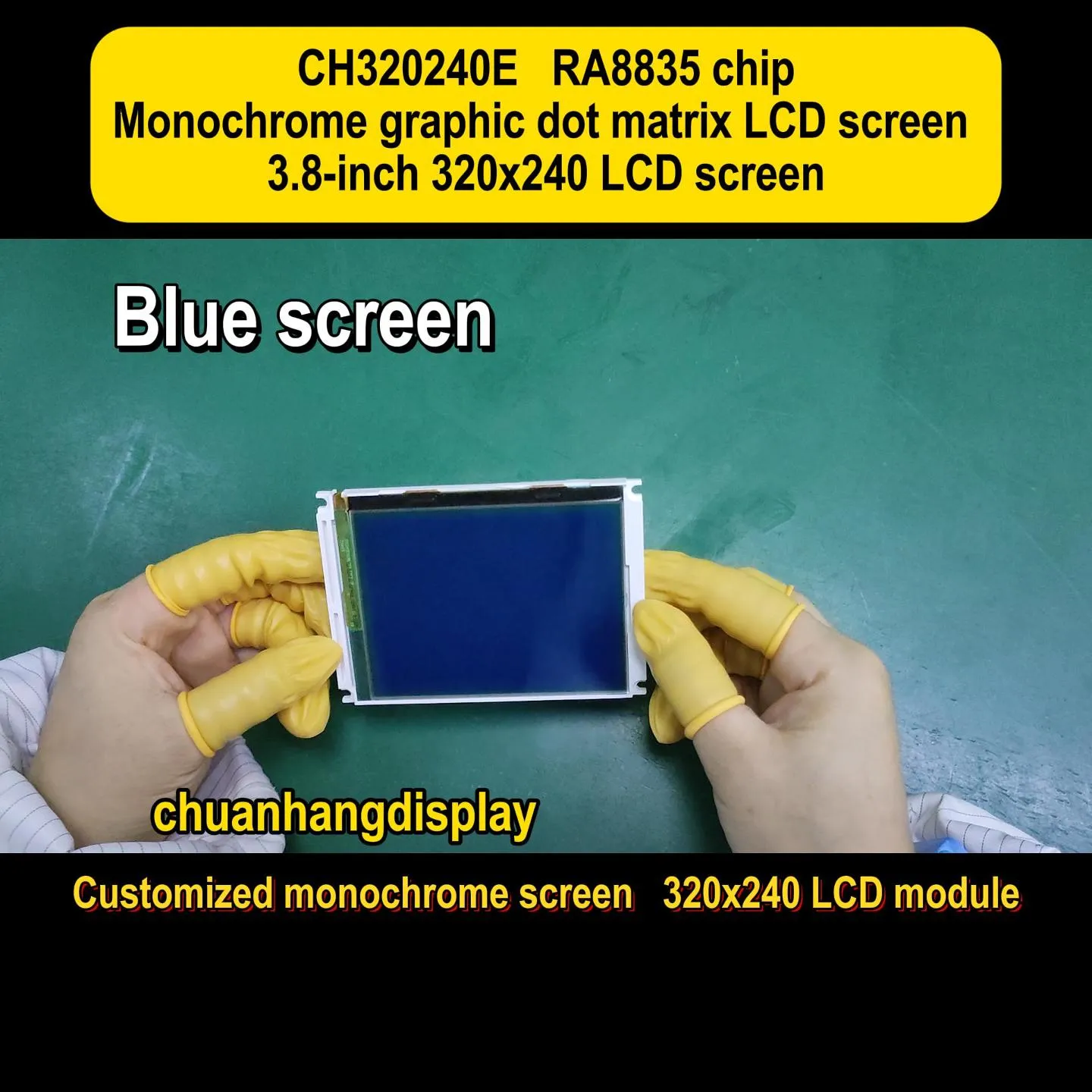
To evaluate a dot matrix lcd display module, one must understand its internal composition. These modules are generally categorized by their resolution—common configurations include 16x2 or 20x4 for character modules, and 128x64 or 240x128 for graphic modules.
The choice of liquid crystal material dictates the visual performance.
TN (Twisted Nematics): The most cost-effective option, offering basic contrast and narrow viewing angles. Suitable for handheld devices with direct viewing requirements.STN (Super-Twisted Nematics): Provides a higher twist angle (typically 180° to 270°), which allows for a higher multiplex drive and better contrast.FSTN (Film-compensated STN): Incorporates a compensation film to eliminate the color tint of STN displays, resulting in a professional black-and-white appearance. Chuanhang Display often utilizes high-grade FSTN materials for medical instrumentation where clarity is a fundamental requirement.
The physical integration of the driver IC (Integrated Circuit) significantly impacts the module's footprint and durability.
Chip on Board (COB): The IC is mounted on a PCB and covered with an epoxy "blob." This is the standard for character displays because it is robust and easy to mount mechanically.Chip on Glass (COG): The driver IC is mounted directly onto the LCD glass. This reduces the thickness and weight of the dot matrix lcd display module, making it ideal for compact, battery-operated devices.
The longevity of a display in a B2B environment depends on the quality of its sub-components. Professional buyers must look beyond the surface specs to understand the Bill of Materials (BOM).
The polarizer is the outermost layer of the display. For outdoor applications, a "transflective" polarizer is necessary. It reflects ambient light to enhance readability in direct sunlight while allowing the backlight to pass through in dark environments. If a project involves high humidity, a "hard-surface" or "anti-glare" treated polarizer is needed to prevent degradation.
Modern modules almost exclusively use LED backlighting. However, the arrangement (Side-lit vs. Bottom-lit) matters. Side-lit modules are thinner, while bottom-lit modules provide superior uniformity for larger graphic displays. The longevity of the LED—measured in half-life hours—should ideally exceed 50,000 hours for industrial-grade applications.
Engineers often face three primary challenges when integrating a dot matrix lcd display module: Electromagnetic Interference (EMI), thermal management, and software compatibility.
In heavy industrial environments, high-voltage machinery can interfere with display signals. High-quality modules feature grounded frames and shielded cables. Professional manufacturers like Chuanhang Display implement rigorous testing to ensure their modules do not emit or succumb to interference, maintaining data integrity on the screen.
Standard displays often fail or lag when temperatures drop below 0°C or exceed 50°C. To solve this, wide-temperature liquid crystal fluids are used, extending the operating range from -20°C to +70°C. For extreme environments, integrated heaters can be laminated onto the glass to ensure the liquid crystals remain fluid and responsive.
The versatility of the dot matrix lcd display module allows it to serve multiple sectors where high-end color screens are impractical or too power-hungry.
Medical Diagnostics: Laboratory equipment requires high-contrast displays to show precise waveforms and numerical data without the risk of "burn-in" associated with emissive technologies.Energy Management: Smart meters and grid monitors rely on the low power consumption of these modules, often running on battery power for over a decade.Industrial Automation: CNC machines and PLC units utilize graphic dot matrix displays to provide real-time feedback in environments where oil, dust, and vibrations are prevalent.Telecommunications: Rack-mounted servers and routers use small character modules for status updates and IP address configuration.
When sourcing a dot matrix lcd display module, the lowest price often masks hidden costs related to failure rates and supply chain instability.
A reliable supplier must provide long-term availability. Industrial projects often have lifecycles of 5 to 10 years. You must ensure the manufacturer has a stable roadmap for their driver ICs. Chuanhang Display has established a reputation for maintaining consistent supply chains, which prevents the need for costly PCB re-designs mid-project.
Resolution: Higher pixel density requires more complex driver ICs and finer ITO (Indium Tin Oxide) etching on the glass.Interface Type: Parallel interfaces (8-bit) are common and fast, but SPI or I2C interfaces reduce the pin count, potentially lowering the cost of the host microcontroller and the connecting cables.Customization: Custom icons, specialized backlights, or pre-attached headers will increase the unit price but significantly reduce assembly labor costs on the factory floor.

Before finalizing a purchase order, B2B procurement teams should verify the following parameters:
Duty and Bias: Ensure the driving circuitry matches the module's requirements (e.g., 1/16 duty, 1/5 bias).Viewing Direction: Specify 6 o'clock (viewed from below) or 12 o'clock (viewed from above) to match the final installation angle of the equipment.Logic Voltage (VDD): Most modules run on 5V or 3.3V. Using the wrong voltage can permanently damage the driver IC.Controller Compatibility: Verify if the module uses industry-standard controllers like the ST7066 or HD44780, which simplifies firmware development.
While it is tempting to view monochrome technology as "legacy," it is actually evolving. We are seeing a move toward higher contrast ratios and thinner profiles. The integration of "Value-Added" services, such as bonded capacitive touch panels over a standard dot matrix lcd display module, is becoming more common. This allows manufacturers to provide a modern user experience with the ruggedness and simplicity of LCD technology.
Selecting the right dot matrix lcd display module requires a balance of electrical engineering knowledge and strategic sourcing. By focusing on material quality, driver architecture, and supplier reliability, companies can ensure their human-machine interfaces remain functional for decades. As demonstrated by industry leaders like Chuanhang Display, the path to a successful product launch involves meticulous attention to these technical nuances.
Q1: What is the main difference between a character and a graphic dot matrix lcd display module?
A1: A character module has pre-defined pixel blocks (e.g., 5x8 dots) separated by small gaps, designed specifically to display letters and numbers. A graphic module has a continuous grid of pixels (e.g., 128x64), allowing for the rendering of images, icons, and fonts of any size.
Q2: Can these modules be used in direct sunlight?
A2: Yes, provided they use a transflective or reflective polarizer. Transflective modules use ambient light to brighten the display, making them perfectly readable in bright outdoor conditions where a standard smartphone screen might wash out.
Q3: Why should I choose an FSTN display over a standard STN display?
A3: FSTN (Film-compensated Super-Twisted Nematics) uses an additional layer to neutralize the natural yellow-green or blue tint of STN. This results in a higher contrast, black-and-white image that is much easier on the eyes and looks more modern for professional equipment.
Q4: How does the interface type (SPI vs. Parallel) affect my project?
A4: A parallel interface (8-bit) allows for faster data transfer, which is helpful for complex graphics. However, it requires many GPIO pins on your controller. An SPI or I2C interface uses only 2 to 4 pins, saving space on the PCB and allowing for smaller, cheaper microcontrollers, though the refresh rate may be slightly slower.
Q5: What is the typical lifespan of a dot matrix lcd display module?
A5: The LCD glass itself can last for decades. The limiting factor is usually the LED backlight, which typically has a lifespan of 50,000 to 70,000 hours of continuous use. High-quality modules allow the backlight to be dimmed or turned off during inactivity to further extend this duration.
Q6: What should I do if my display shows "ghosting" or blurred characters?
A6: Ghosting is often caused by an incorrect contrast voltage (V0). Most modules require a potentiometer or a software-controlled PWM signal to adjust the contrast voltage relative to the operating temperature. Fine-tuning this voltage usually resolves clarity issues.