In the discipline of modern embedded systems and hardware engineering, human-machine interfaces require precision, reliability, and excellent readability under diverse environmental conditions. While consumer electronics have largely migrated to active-matrix full-color panels, B2B industrial, medical, and testing equipment continue to rely heavily on passive-matrix monochrome technology. Specifying a graphic LCD display module provides a fully addressable pixel matrix, allowing engineers to render custom typography, complex bitmaps, trend graphs, and multilingual user interfaces without the massive processing overhead required by TFTs.
For hardware developers, procurement managers, and industrial designers, selecting the correct display involves navigating complex optical properties, interface protocols, and supply chain dynamics. This analysis examines the technical architecture, material sciences, industry-specific operational requirements, and vendor selection strategies required for successful display integration.

The optical performance of a display depends heavily on the underlying fluid technology and polarization layers. Understanding these material science parameters is a primary step in hardware specification.
Liquid crystal technology operates by manipulating the polarization of light through voltage application. The specific fluid formulation and twist angle determine the multiplexing capability and visual output.
TN (Twisted Nematic): This is the most basic configuration, twisting light at 90 degrees. While highly cost-effective, TN panels suffer from limited viewing angles and lower multiplexing capabilities. They are generally suitable only for low-resolution matrices or segment displays.STN (Super-Twisted Nematic): By twisting the liquid crystal molecules between 180 and 270 degrees, STN panels achieve higher contrast at higher multiplex rates, allowing for denser dot-matrices. However, STN inherently produces a color shift—often a yellow-green or blue background—due to the birefringence effect of the fluid.FSTN (Film-Compensated STN): To resolve the optical interference of standard STN, manufacturers apply a polymer retardation film over the polarizer. FSTN delivers a true black-on-white (or white-on-black) appearance, offering superior contrast ratios highly favored in medical infusion pumps and precision testing equipment.FFSTN (Double Film-Compensated STN): Utilizing two compensation films, this advanced material setup maximizes contrast and widens the viewing cone. It approaches the visual clarity of active-matrix displays while retaining the low power consumption characteristics of passive technology.
Choosing the correct optical mode dictates power consumption and environmental suitability. Hardware engineers must evaluate the primary operating environment to select the appropriate rear polarizer:
Reflective: This mode relies entirely on ambient light bouncing off an opaque rear reflector. It consumes negligible power as it requires no backlight, making it ideal for battery-operated handheld instruments, multimeters, and devices used exclusively in well-lit or outdoor environments.Transmissive: This mode requires a continuously illuminated LED backlight to push light through the pixel matrix. The rear polarizer is completely transparent. This mode is standard for indoor environments like server racks, networking switches, or indoor factory floors where ambient light is insufficient.Transflective: A hybrid approach utilizing a semi-transparent reflector. It reflects ambient light under direct sunlight, ensuring excellent outdoor readability, while allowing backlight illumination to pass through in dark environments. Transflective polarizers represent the optimal solution for portable industrial hardware and marine electronics.
Unlike active-matrix TFTs that place a transistor at every pixel, a graphic LCD display module relies on passive-matrix addressing. Intersections of horizontal (COM) and vertical (SEG) transparent Indium Tin Oxide (ITO) electrodes form the pixels.
Driving these intersections requires precise voltage regulation. Hardware engineers must account for the Duty Cycle (the fraction of time a row is driven) and the Bias Ratio (the voltage levels used to prevent adjacent, unselected pixels from turning on). Incorrect bias calculations lead to "crosstalk" or "ghosting," where inactive pixels appear faintly visible, severely degrading UI readability.
Modern modules integrate specialized Controller ICs to manage these complex waveforms. Controllers such as the ST7565, KS0108, UC1609, or T6963 abstract the fluid physics, handling the RAM-to-display mapping internally.
The physical integration of the Controller IC drastically affects the mechanical footprint and the Bill of Materials (BOM) cost:
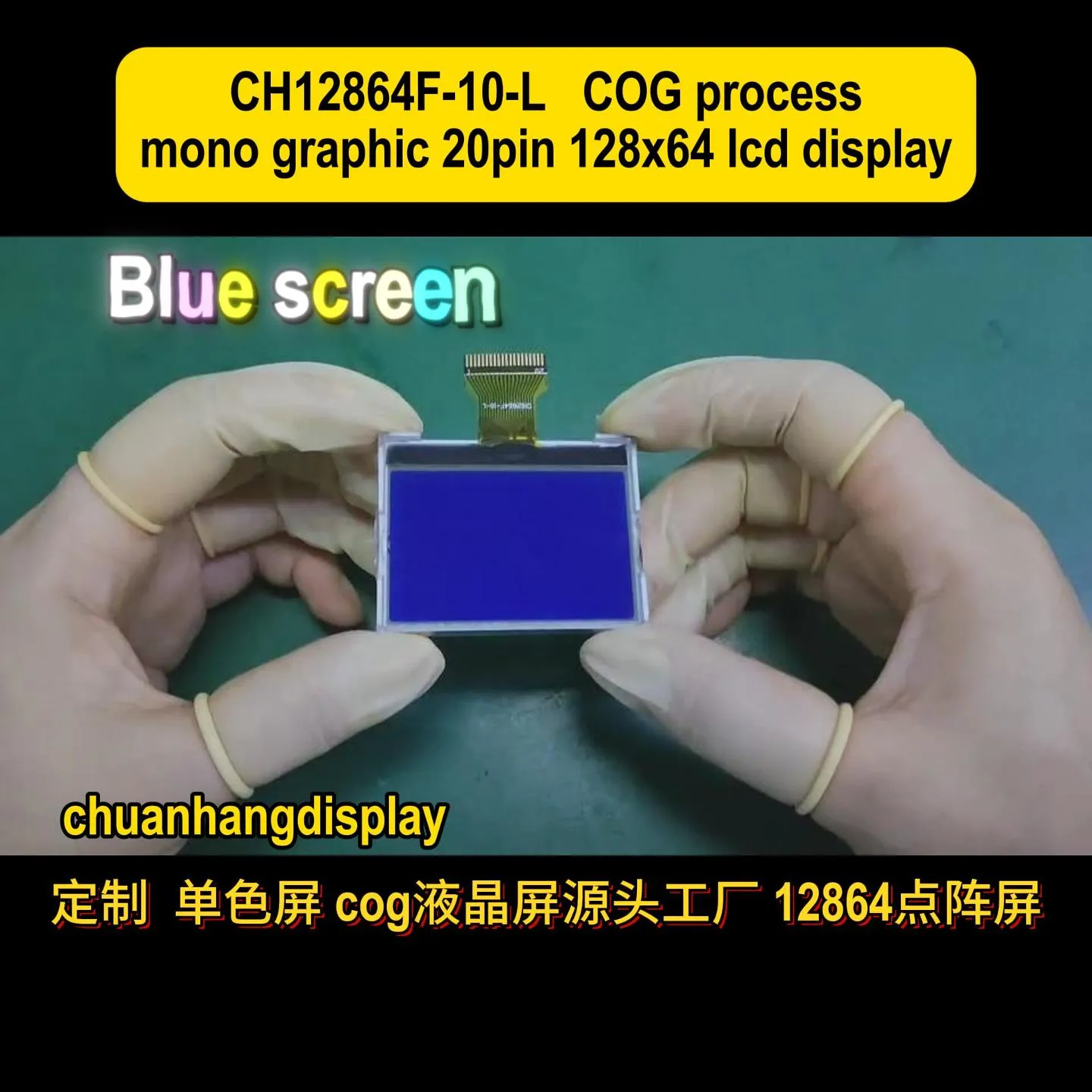
COB (Chip-on-Board): The display controller is wire-bonded directly onto a fiberglass PCB, and the liquid crystal glass is attached via an elastomeric connector (Zebra strip) or metal pins. COB modules are physically thicker but offer robust mounting holes and are easy to prototype with standard header pins.COG (Chip-on-Glass): Advancements in semiconductor packaging allow manufacturers to bond the bare IC directly onto the ITO glass ledge using Anisotropic Conductive Film (ACF). A Flexible Printed Circuit (FPC) tail then routes the signals to the mainboard. COG drastically reduces the physical footprint, thickness, and component cost, making it the preferred choice for compact B2B electronics.
Engineers interface their primary microcontrollers (MCUs) with the display IC using standard protocols. For low pin-count microcontrollers, SPI (Serial Peripheral Interface) or I2C are the preferred protocols, requiring only 2 to 4 data lines. If high-speed screen refresh rates are required—such as displaying fast-moving waveform graphs on an oscilloscope—an 8-bit parallel interface (like the 8080 or 6800 protocol) provides higher bandwidth, provided the MCU has sufficient GPIO pins available.
Despite the proliferation of full-color screens in consumer devices, monochrome passive-matrix displays remain dominant in specific B2B sectors due to their unique ability to solve fundamental hardware engineering pain points.
Liquid crystal fluid viscosity changes with temperature. Standard commercial displays freeze or become sluggish below 0°C, while high temperatures cause the fluid to become isotropic (turning the screen entirely black). Industrial-grade panels utilize wide-temperature fluid formulations, maintaining stable operational parameters from -30°C to +80°C. Additionally, onboard temperature compensation circuits automatically adjust the driving voltage (VLCD) to maintain consistent contrast across the entire thermal range, ensuring reliability in oil and gas monitoring stations or automotive dashboards.
For remote IoT sensors, portable gas detectors, and smart utility meters, battery lifespan is a primary concern. A transmissive TFT requires continuous milliamp-level backlight current to function. In contrast, a reflective pixel-matrix display operates in the micro-ampere range. By utilizing sleep states in the driver IC and relying on ambient light, hardware longevity can be extended from days to several years on a single lithium cell.
In industrial automation, heavy machinery generates significant Electromagnetic Interference (EMI) and Electrostatic Discharge (ESD). High-speed differential signaling used in color displays (like MIPI DSI) is highly susceptible to EMI, which can cause frame drops or total display failure. The parallel or low-speed SPI interfaces of a monochrome graphic LCD display module offer superior noise immunity, ensuring the user interface remains stable on CNC machines, Programmable Logic Controllers (PLCs), and robotic control pendants.
Procuring industrial displays involves more than checking standardized datasheets; it requires strategic supply chain management. B2B buyers must evaluate tooling costs, lead times, and long-term availability guarantees.
The unit pricing of a display module is determined by ITO glass area, dot-matrix resolution, and backlight complexity. While standard off-the-shelf modules are cost-effective for prototyping, production hardware often requires custom form factors. This introduces Non-Recurring Engineering (NRE) fees.
Glass Tooling: Customizing the physical dimensions and resolution of the glass typically involves NRE costs ranging from $1,000 to $3,000. This covers the photolithography masks required for the ITO layout.FPC Tooling: Customizing the length, pinout, or bending radius of the Flexible Printed Circuit usually requires an NRE of $300 to $600 for the copper etching masks.Backlight Tooling: Designing a custom plastic light guide plate (LGP) to ensure uniform brightness requires injection molding tooling, adding another $500 to $1,000 to the initial NRE.
Selecting a manufacturing partner guarantees consistency across production batches. Partnering with a specialized manufacturer like Chuanhang Display allows hardware teams to bypass trading intermediaries and access direct engineering support during the PCB layout phase. When auditing a supplier, procurement managers should verify their cleanroom standards (typically ISO Class 5 or 6 for LCD assembly) and their adherence to stringent quality management systems.
Furthermore, long-term product availability is a major concern for B2B procurement. Consumer-grade screens are often declared End-of-Life (EOL) within 18 to 24 months. Industrial buyers should seek guarantees from suppliers like Chuanhang Display, which commit to 5-to-10-year longevity programs for their industrial display lines. This prevents forced, costly, and time-consuming hardware redesigns midway through a product's lifecycle.
Developing robust human-machine interfaces for industrial, medical, and telecommunications equipment demands rigorous component selection. Implementing the correct graphic LCD display module ensures that equipment remains readable, reliable, and power-efficient under the harshest environmental constraints. By understanding the underlying physics of nematic fluids, matrix addressing methodologies, and supply chain pricing dynamics, engineering teams can confidently source solutions that optimize both unit cost and long-term operational longevity. Working with established manufacturers like Chuanhang Display ensures that technical specifications align perfectly with project requirements, resulting in superior end-product performance.
Q1: What is the primary difference between a character display and a graphic LCD display module?
A1: A character display utilizes a fixed ROM map (such as the standard HD44780 controller) that limits it to displaying pre-defined numbers and letters within specific blocks (e.g., 16 characters by 2 lines). A graphic LCD display module utilizes a fully addressable X-Y pixel matrix. This allows the primary microcontroller to manipulate any individual dot on the screen, enabling the rendering of custom fonts, logos, geometric shapes, and dynamic sensor charts.
Q2: How do I ensure my display module remains readable in direct outdoor sunlight?
A2: For outdoor readability, you must specify a display equipped with a "transflective" or "reflective" polarizer. Transflective polarizers reflect intense ambient light back to the viewer, increasing optical contrast in direct sunlight, while still allowing a built-in LED backlight to illuminate the screen during nighttime operation.
Q3: Can these passive-matrix displays survive freezing temperatures in outdoor environments?
A3: Standard commercial liquid crystal panels generally operate between 0°C and +50°C. However, industrial-grade panels are engineered using specialized wide-temperature liquid crystal fluids. This prevents the fluid from freezing or experiencing isotropic failure, extending the operational and storage temperature range safely from -30°C down to +80°C.
Q4: What are the distinct advantages of COG (Chip-on-Glass) versus COB (Chip-on-Board) manufacturing?
A4: COB mounts the driver IC on a rigid fiberglass PCB, creating a physically thicker module that provides robust mounting holes and easy-to-solder through-hole pins. COG bonds the bare driver IC directly to the ITO glass ledge, significantly reducing the display's thickness, overall physical footprint, and assembly BOM costs. COG is highly recommended for compact, modern handheld instrumentation.
Q5: Which communication protocol should I use to connect the display controller to my microcontroller?
A5: The choice of protocol depends on your MCU's available pins and required screen refresh rate. SPI (Serial Peripheral Interface) and I2C require very few GPIO pins (2 to 4) and are excellent for low-power MCUs. If you need to push data quickly to the screen to display fast-moving animations or real-time graphs, an 8-bit parallel interface (such as the 8080 protocol) offers significantly higher data bandwidth.