In the sophisticated field of industrial visualization, the graphic lcd represents a significant evolution over traditional segment or character-based displays. While character modules are restricted to pre-defined alphanumeric blocks, a monochrome dot-matrix graphic display provides engineers with total control over every individual pixel. This pixel-level addressability is what enables the rendering of complex waveforms, intricate icons, and multi-language support in high-precision environments ranging from medical diagnostics to aerospace instrumentation.
For technical procurement officers and design engineers, selecting the right display is not merely about screen size; it requires a deep understanding of liquid crystal chemistry, driver logic, and mechanical integration. Chuanhang Display has established itself as a leader in this sector, providing the technical expertise required to navigate these complex specifications.
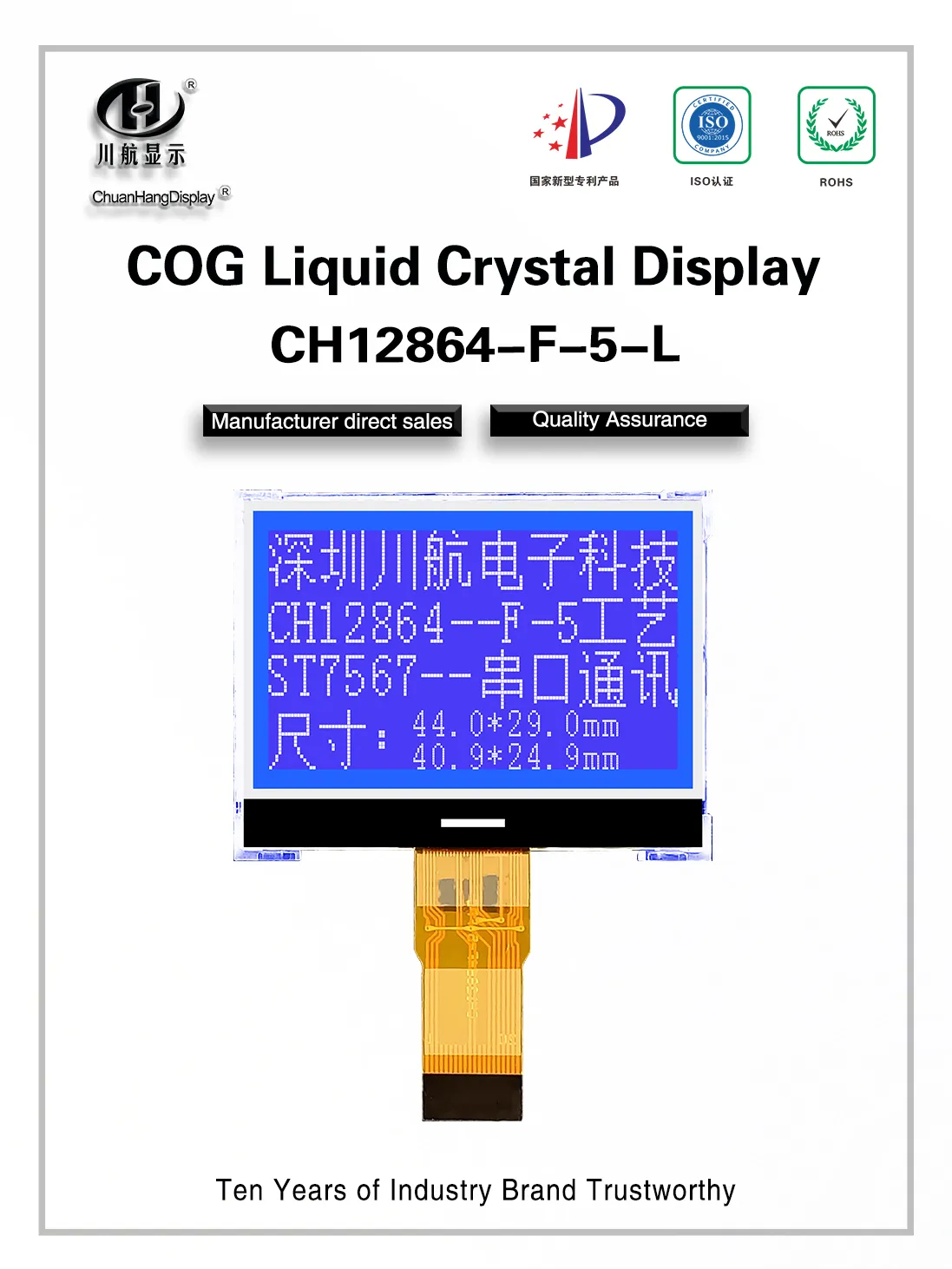
A graphic lcd is defined by its resolution, such as 128x64, 240x128, or 320x240. Unlike active-matrix TFTs, most monochrome graphic displays utilize passive-matrix addressing. This architecture relies on a grid of rows and columns, where the intersection of a specific row and column defines a pixel.
The performance of a passive-matrix display is heavily dictated by its duty cycle (the fraction of time a row is energized) and the bias voltage (the voltage levels used to prevent "ghosting" or cross-talk between pixels). As the resolution increases, the duty cycle becomes shorter (e.g., 1/128 duty), which naturally reduces the contrast ratio. Engineers must counteract this by choosing high-performance liquid crystal fluids and optimizing the VOP (operating voltage) to ensure a sharp distinction between "on" and "off" states.
In industrial settings, the frame frequency must be carefully calibrated. If the frequency is too low, the human eye perceives flicker; if it is too high, the liquid crystal molecules may not have sufficient time to react, leading to blurred images or "ghosting." A professional graphic lcd module will typically operate at a frame rate between 60Hz and 80Hz, balancing power consumption with visual clarity.
The choice of liquid crystal material is the primary factor in determining the optical performance and environmental resilience of the display.
Super-Twisted Nematic (STN): This is the industry standard for most industrial applications. By twisting the liquid crystal molecules by 180 to 270 degrees, STN offers significantly better contrast and viewing angles than basic TN technology. It is available in yellow-green, blue, and gray modes.Film-Compensated STN (FSTN): To solve the inherent color tint of STN, an optical compensation film is added. This results in a high-contrast black-on-white or white-on-black display. FSTN is the preferred choice for medical devices where data precision is mandatory.Double STN (DSTN): By using two layers of STN glass, DSTN eliminates color shifts over a wide temperature range. While more expensive and heavier, it remains a robust choice for specialized outdoor instrumentation.Vertical Alignment (VA/BTN): For applications requiring a "true black" background and ultra-high contrast ratios (exceeding 1000:1), VA technology provides a premium aesthetic that rivals OLED while maintaining the longevity and cost-profile of a traditional LCD.
The integration of a graphic lcd into a host system is managed by the LCD controller and driver ICs. Understanding these protocols is vital for software development and hardware layout.
Most 128x64 modules utilize the ST7565 or UC1601 series, which are known for their low power consumption and integrated power supply circuits. Larger displays, such as 240x128 modules, often employ the RA8835 or T6963C controllers. These chips handle the complex task of refreshing the matrix, allowing the host microcontroller (MCU) to simply send pixel data via command sets.
Parallel Interface (8080/6800): This is the traditional method, offering the highest data throughput. However, it requires 8 to 13 GPIO pins, which may be a constraint for smaller MCUs.Serial Interface (SPI/I2C): Modern industrial designs increasingly favor 3-wire or 4-wire SPI. This reduces the pin count significantly, though it limits the refresh speed for large animations. For static data visualization, however, SPI is more than sufficient.
The physical footprint of the display is determined by the bonding technology used to attach the driver IC to the glass or the PCB.
Chip-on-Board (COB): The driver IC is mounted on a PCB that is then connected to the LCD glass via an elastomeric (zebra) connector. COB displays are physically robust and easy to mount using screws, making them ideal for heavy industrial machinery.Chip-on-Glass (COG): The driver IC is bonded directly to the glass substrate. This significantly reduces the thickness and weight of the module. Since COG removes the need for a secondary PCB for the IC, it is often more cost-effective in high-volume production. Chuanhang Display provides both COB and COG configurations, allowing OEMs to optimize for either mechanical durability or sleekness.
When sourcing a graphic lcd for international B2B projects, several environmental factors must be considered to prevent field failures.
The polarizer is the outermost layer of the LCD and is susceptible to moisture and UV degradation. For outdoor applications, a UV-stabilized, transflective polarizer is necessary. This allows the display to be readable in direct sunlight (reflective mode) while still utilizing a backlight in low-light conditions (transmissive mode).
Standard liquid crystal fluids become too viscous at low temperatures, resulting in extremely slow response times. For cold-climate applications, "Wide Temperature" fluids are required. These are designed to operate from -30°C to +80°C. In extreme cases, internal heaters are integrated into the glass stack to ensure the display remains functional in arctic or high-altitude conditions.
Industrial environments are often rife with electromagnetic noise. A poorly shielded graphic lcd can suffer from data corruption or "white screens" due to ESD. Professional modules incorporate grounding frames and shielding on the FPC (Flexible Printed Circuit) to mitigate these risks.
In the B2B sector, the lowest unit price is rarely the best value. The total cost of ownership includes the engineering support, supply chain stability, and warranty fulfillment.
NRE and Tooling: When requesting a custom size or resolution, expect Non-Recurring Engineering fees. These cover the cost of photomasks and test jigs. A reputable supplier will provide a detailed counter-drawing for approval before any tooling begins.Long-term Availability: Industrial products often have a lifecycle of 7 to 10 years. It is important to confirm that the driver IC and the liquid crystal fluid have a stable roadmap. Chuanhang Display ensures component longevity by maintaining strategic reserves and providing drop-in replacements if a specific IC reaches End-of-Life (EOL).Quality Documentation: For medical and automotive sectors, documentation such as REACH, RoHS, and ISO 9001 certifications are not optional. These verify that the materials used are safe and the manufacturing processes are consistent.
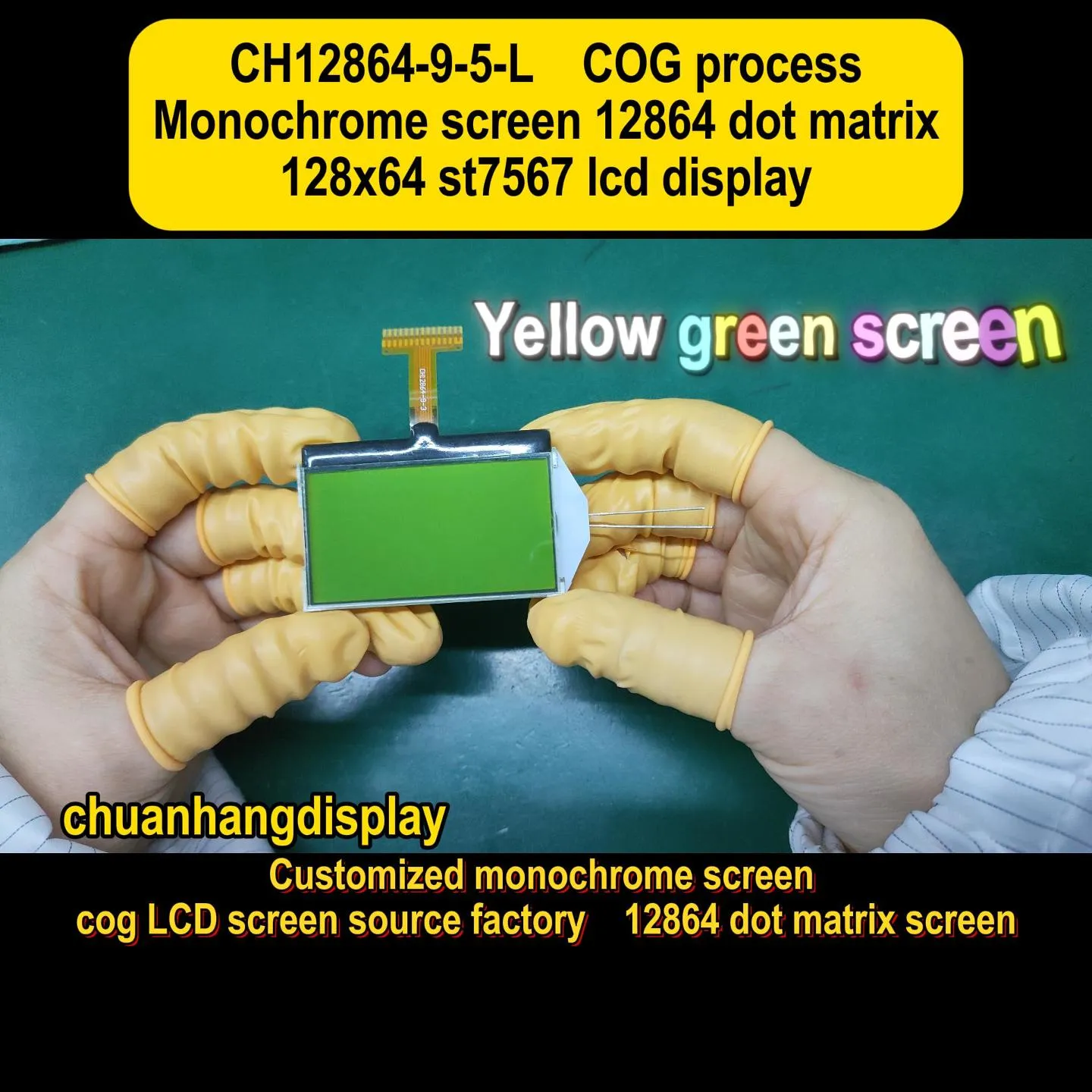
Despite the rise of full-color TFTs, the monochrome graphic lcd continues to dominate in sectors where power efficiency and legibility are the primary concerns. For a handheld gas detector that must run for weeks on a single charge, or a remote telecommunications base station that operates in extreme heat, the simplicity and efficiency of the dot-matrix LCD are unmatched.
Innovations such as FSTN with high-brightness LED backlighting have significantly closed the gap in visual appeal, offering a clean, professional aesthetic that communicates reliability. By focusing on the technical nuances—from duty cycles to polarizer chemistry—engineers can implement a display solution that enhances the overall integrity of their hardware.
The future of the graphic lcd lies in further integration, with more controllers supporting ultra-low-power "sleep" modes and higher levels of integration on the FPC, reducing the overall bill of materials (BOM) for the OEM. As a dedicated partner, Chuanhang Display continues to drive these innovations, ensuring that industrial interfaces remain clear, durable, and efficient.
Q1: What is the difference between a character LCD and a graphic lcd?
A1: A character LCD is limited to displaying text and numbers within fixed 5x8 pixel blocks. In contrast, a graphic lcd provides a continuous grid of pixels, allowing the display of any shape, icon, or font. This makes the graphic version far more flexible for modern user interfaces that require icons or localized languages.
Q2: How do I choose between an SPI and a Parallel interface for my display?
A2: The decision depends on your hardware constraints. If you have limited pins on your microcontroller, SPI (Serial Peripheral Interface) is the best choice as it only requires 3 or 4 pins. If you need to update the screen very rapidly with animations or high-speed data, a Parallel interface (8-bit) is faster but requires significantly more wiring.
Q3: Can a graphic lcd be used in direct sunlight?
A3: Yes, provided you choose a "Transflective" or "Reflective" polarizer. Transflective displays are the most versatile for industrial use because they use ambient sunlight to illuminate the screen during the day and a built-in backlight for nighttime visibility.
Q4: What causes "ghosting" on a dot-matrix display and how can it be fixed?
A4: Ghosting usually occurs due to an incorrect bias voltage or an inappropriate duty cycle for the liquid crystal fluid. It can often be corrected by fine-tuning the contrast voltage (VOP) in your software or by selecting a higher-quality FSTN fluid that has a steeper electro-optical response curve.
Q5: What is the typical lead time for a custom graphic lcd project?
A5: For a custom module, the design and drawing phase usually takes 1 week. Once drawings are approved, sample production takes approximately 4 to 6 weeks. Mass production typically follows in 6 to 8 weeks, depending on the complexity of the custom glass and the availability of the driver ICs.
Q6: Are monochrome graphic displays becoming obsolete?
A6: Not at all. While color screens are popular, monochrome graphic displays offer much lower power consumption, higher sunlight readability, and significantly lower costs. For industrial, medical, and marine applications where reliability is more important than "eye candy," they remain the preferred choice.