Organic Light-Emitting Diode (OLED) technology has transitioned from a laboratory curiosity to the dominant display paradigm in high-end mobile devices and televisions. Unlike liquid crystal displays that require backlight units, oled screens generate light through electroluminescent organic compounds, enabling thinner form factors, superior contrast ratios, and faster response times. This article dissects the underlying physics, compares driving architectures, addresses reliability challenges, and outlines the roadmap for next-generation applications.

At the heart of every OLED pixel is a stack of organic semiconductor layers sandwiched between two electrodes. When a voltage is applied, electrons are injected from the cathode and holes from the anode; they recombine within the emissive layer, producing photons. The color of emitted light is determined by the energy gap of the organic molecules used.
Small Molecule (SM-OLED): Deposited via vacuum thermal evaporation, these offer high purity and efficiency. They are the foundation of most high-resolution oled screens today, particularly in smartphones.
Polymer (PLED): Solution-processed using inkjet printing, they promise lower manufacturing costs but currently lag in lifetime and efficiency for blue emitters.
Two primary pixel architectures exist. RGB stripe uses separate red, green, and blue emitters, providing excellent color purity and power efficiency. White OLED with color filters (WOLED+C.F.), employed by some TV manufacturers, simplifies the deposition process but sacrifices some efficiency because the color filters absorb a portion of the emitted white light.
The method of addressing pixels fundamentally separates oled screens into two categories: passive-matrix (PMOLED) and active-matrix (AMOLED).
PMOLED uses external driver circuitry to control rows and columns. Each row is scanned sequentially, and the columns drive current during the row's select time. This architecture is cost-effective for small displays (typically under 3 inches) like those found in wearables and industrial control panels. However, as size and resolution increase, the peak current required to maintain brightness causes excessive power consumption and voltage drops.
AMOLED integrates a thin-film transistor (TFT) backplane with a storage capacitor at each pixel. The TFT acts as a current source, holding the pixel at the desired luminance between refresh cycles. This allows for large, high-resolution displays with uniform brightness. Low-temperature polysilicon (LTPS) TFTs are preferred for their high mobility, enabling smaller transistors and higher aperture ratios.
When specifying oled screens for industrial or medical applications, engineers must evaluate metrics beyond resolution and diagonal size.
Luminance Efficiency (cd/A): Indicates how effectively electrical power is converted to light. State-of-the-art green phosphorescent emitters achieve >100 cd/A, while blue fluorescent emitters lag at ~10 cd/A, a key bottleneck.
LT95 Lifetime (hours): The time for luminance to decay to 95% of initial value at a given drive current. For demanding applications, Chuanhang Display offers modules rated for LT95 > 1000 hours at 1000 nits, crucial for outdoor readability.
Color Shift Over Viewing Angle: OLEDs maintain color fidelity across wide angles, unlike LCDs which suffer from gamma shift. However, microcavity effects in top-emission OLEDs can cause slight color variations with angle.
Despite their advantages, oled screens face two significant hurdles in long-life applications: burn-in (permanent image retention) and sensitivity to moisture/oxygen.
Burn-in occurs when uneven aging of organic materials leads to ghost images. It is exacerbated by static elements like taskbars. Modern AMOLED displays integrate compensation circuits that monitor pixel voltage and adjust drive currents to equalize aging. External optical feedback systems, using cameras to measure actual luminance, are employed in high-end monitors to dynamically correct non-uniformity.
Organic materials degrade rapidly when exposed to atmospheric water vapor or oxygen. The industry standard for flexible OLEDs is thin-film encapsulation (TFE), a multilayer stack of inorganic (SiNx, Al₂O₃) and organic layers deposited by ALD or PECVD. Water vapor transmission rates (WVTR) below 10⁻⁶ g/m²/day are required for 10-year lifetime—comparable to a glass lid but in a flexible form.
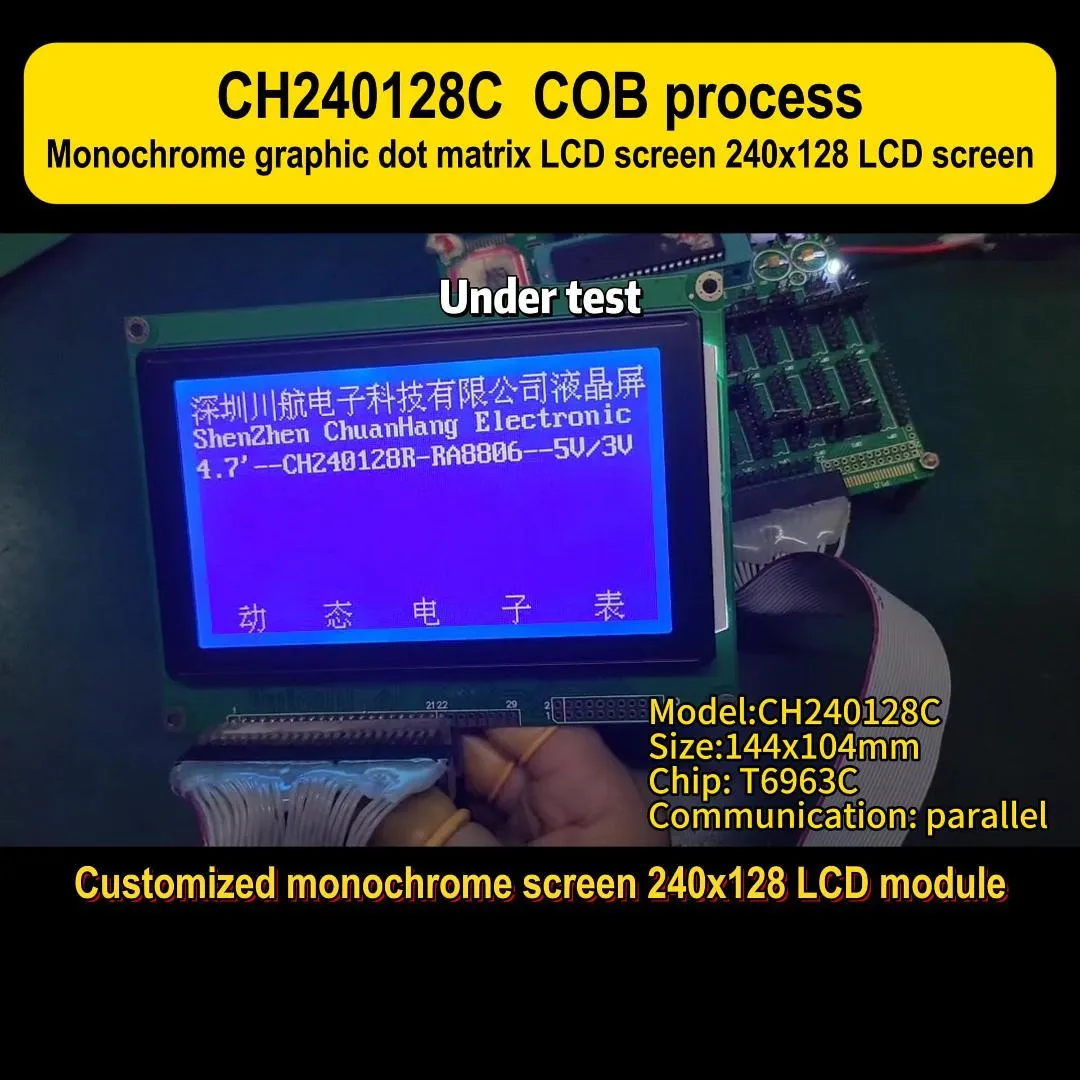
Beyond smartphones and TVs, oled screens are penetrating specialized markets where their unique properties provide decisive value.
OLEDs enable curved, transparent, and even foldable dashboards. Their high contrast improves visibility under direct sunlight, and fast response eliminates motion blur in navigation maps. Chuanhang Display supplies ruggedized OLED modules that meet AEC-Q104 automotive reliability standards, including wide temperature operation (-40°C to +85°C).
PMOLEDs dominate fitness trackers and smartwatches due to their low power consumption in always-on mode. In medical equipment, OLED's true black allows clear viewing of waveforms in dark operating rooms, while the thin profile facilitates portable ultrasound devices.
Transparent OLEDs, with transmittance >40%, are finding use in augmented reality (AR) heads-up displays and smart windows. Silicon-based OLED microdisplays (OLED-on-Silicon) offer resolutions exceeding 5000 PPI for near-eye applications, leveraging CMOS backplanes.
The production of high-resolution OLED displays relies on precise deposition through fine metal masks (FMM) for RGB patterning. As pixel density increases, mask sagging and shadow effects reduce yield. Alternative approaches like inkjet printing of soluble OLED materials are gaining traction, particularly for large-area panels, potentially cutting material waste by 90% compared to evaporation.
Another critical aspect is the TFT backplane uniformity. LTPS exhibits variation in threshold voltage (Vth) across the panel, which must be compensated by pixel circuits with multiple transistors (e.g., 7T1C or 8T2C) to ensure consistent brightness.
MicroLED technology threatens to surpass OLED in brightness and lifetime, but it faces monumental manufacturing hurdles in mass-transferring millions of micron-sized LEDs. For the foreseeable future, OLED will remain the premium display choice, with incremental improvements in blue emitter efficiency (using thermally activated delayed fluorescence, TADF) and tandem (stacked) structures to double lifetime at high brightness.
oled screens have matured into a reliable, high-performance technology suitable for a broad spectrum of industries. By understanding the interplay between material selection, driving schemes, and environmental robustness, engineers can successfully deploy OLEDs in applications demanding exceptional image quality and design flexibility. Companies like Chuanhang Display continue to push the boundaries with customized modules that address specific industrial requirements, ensuring OLED remains a cornerstone of advanced display solutions.
A1: Modern OLED screens have a rated lifetime (LT50) of 30,000 to 100,000 hours, comparable to LCD backlights. However, OLED brightness degrades gradually over time, whereas LCD backlights often fail catastrophically. For applications requiring consistent luminance, derating the drive current significantly extends operational life.
A2: Burn-in can be minimized by using screen savers, reducing overall brightness, and enabling pixel shifting (where the image moves by a few pixels periodically). Hardware solutions include implementing a compensation cycle that measures pixel voltage degradation and adjusts the drive signal accordingly.
A3: Yes, with proper design. Circular polarizers are used to reduce ambient light reflection, enhancing sunlight readability. Additionally, high-brightness OLEDs (≥1000 nits) combined with dynamic brightness control can maintain visibility even under intense illumination.
A4: PMOLED is simpler and cheaper for small sizes (typically 0.5–1.5 inches) and offers low power consumption for static or low-information content. AMOLED, while more expensive, provides higher resolution, better uniformity, and is preferred for smartwatches that require detailed graphics and video playback.
A5: OLED efficiency and lifetime are temperature-dependent. At low temperatures (below -20°C), carrier mobility decreases, increasing drive voltage and reducing brightness. At high temperatures (above 70°C), degradation accelerates. Industrial-grade OLED modules, like those from Chuanhang Display, are thermally managed and qualified for extended temperature ranges.
A6: Flexible OLEDs are built on plastic substrates instead of glass, allowing curved, bendable, and even foldable displays. This enables new form factors in consumer electronics and automotive interiors, as well as lighter and more rugged devices for industrial handhelds.