The 128x64 pixel resolution has become the de facto standard for small-to-medium monochrome graphic displays. Among the available technologies – from character LCDs to e-paper – the oled display 128x64 stands out for its self-emissive pixels, wide viewing angle (typically >160°), and microsecond-level response times. Unlike a backlit LCD, each organic LED in an OLED panel produces its own light, eliminating the need for a separate backlight and enabling true black levels (pixels completely off).
This guide examines the internal architecture of 128x64 OLED modules, compares passive-matrix (PMOLED) and active-matrix (AMOLED) implementations for this resolution, provides real-world power consumption figures across different driving conditions, and offers actionable procurement advice – including references to manufacturing practices at Chuanhang Display and other ISO-certified OLED suppliers.
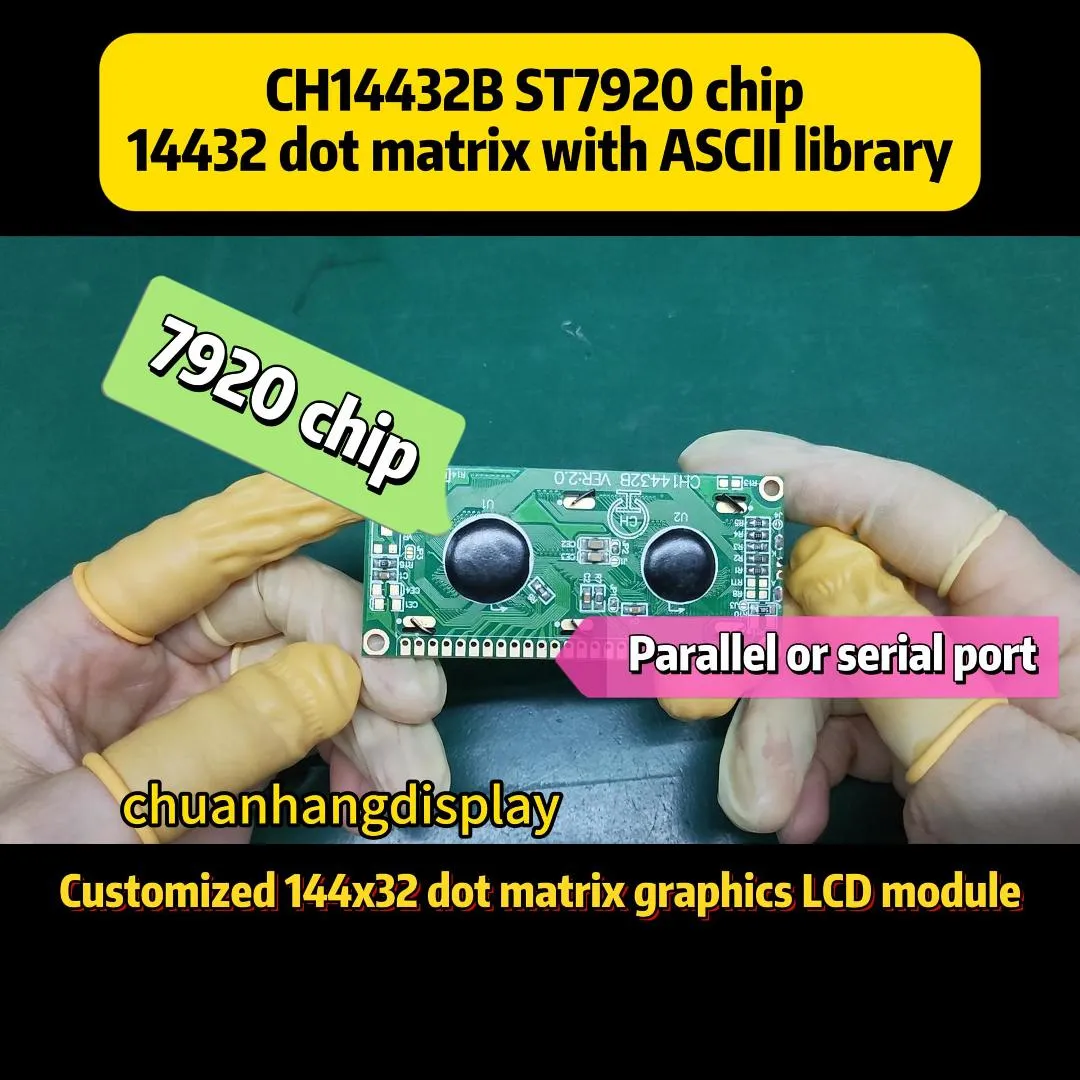
Engineers choose a 128x64 resolution for three concrete reasons:
Compared to a 128x64 graphic LCD, an oled display 128x64 offers faster pixel switching (typically 10 µs vs. 150 µs for STN LCD) and no temperature-dependent contrast adjustment. The trade-off is finite lifetime: blue OLED pixels degrade faster than red/green, with typical L70 lifetime (time to 70% initial luminance) of 10,000–15,000 hours for blue at 100 cd/m².
Almost all 128x64 OLED displays on the market use passive matrix (PMOLED) driving. Understanding the distinction prevents misapplication.
In a PMOLED oled display 128x64, each row and column has a direct electrical connection. To light a pixel at (row, column), the driver applies a current to that row (cathode) and that column (anode). The brightness is determined by the current magnitude and duty cycle.
A handful of high-brightness 128x64 AMOLED modules incorporate a TFT backplane with a storage capacitor per pixel. This allows each pixel to stay illuminated during the entire frame time, reducing peak currents and enabling higher overall luminance (up to 1000 cd/m² vs. 150 cd/m² for PMOLED). However, AMOLED adds 30–50% to module cost and requires more complex driver ICs. For most embedded applications, PMOLED remains the practical choice.
More than 80% of 128x64 OLED modules on the market integrate a Solomon Systech SSD1306 or a pin-compatible clone (e.g., SH1106). Key parameters for firmware engineers:
Common pitfalls – Some clones (e.g., SH1106) have a slightly different RAM page addressing scheme: SSD1306 uses 8 pages of 128 bytes each; SH1106 uses 8 pages but only 132 columns internally, requiring offset shifts. Always verify the exact IC before writing low-level drivers.
Below are typical specifications from production-grade 128x64 PMOLED modules (white or yellow emission). These numbers help in setting realistic performance expectations.
| Pixel illumination | Current at 3.3 V (I²C idle) | Current at 3.3 V (SPI, 1 MHz) | Power (mW) |
|---|---|---|---|
| All pixels off | 0.8 – 1.2 mA | 1.5 – 2.0 mA | 2.6 – 6.6 |
| 25% pixels on | 12 – 18 mA | 14 – 20 mA | 40 – 66 |
| 50% pixels on | 22 – 32 mA | 24 – 34 mA | 73 – 112 |
| 100% pixels on | 38 – 55 mA | 40 – 58 mA | 125 – 191 |
Measurements taken with contrast = 0x7F, room temperature (25°C). The charge pump efficiency drops at lower temperatures (0°C), increasing current by 15–20%.
For applications requiring >50,000 hours of operation (industrial meters, medical devices), a high-lifetime oled display 128x64 with phosphorescent blue material (PHOLED) is necessary. These add 20–40% to unit cost but extend L70 to 40,000–60,000 hours.
An oled display 128x64 module typically exposes multiple interface options through jumper pads or a configurable pin (BS1/BS2 on SSD1306). Choose based on your MCU’s available pins and speed requirements.
Recommendation – For battery-powered sensors or wearables, I²C minimizes wiring and power. For industrial HMI with periodic graphic updates, SPI provides the best balance of speed and pin count.

Different industries impose distinct constraints on an oled display 128x64. Below is a sector-by-sector breakdown.
Global shipments of small-molecule OLED displays, including 128x64 modules, reached 380 million units in 2024 (Display Supply Chain Consultants estimate). Pricing has stabilized after post-COVID shortages.
| Quantity | Standard (0.96″, SSD1306, I²C/SPI) | Wide temp (-20°C to +70°C) | Custom FPC length or logo |
|---|---|---|---|
| 1-100 | $5.50 – $8.00 | $8.50 – $12.00 | +$2.00 – $5.00 |
| 1,000 | $3.20 – $4.50 | $5.80 – $7.50 | +$0.80 – $1.50 |
| 10,000 | $2.10 – $2.90 | $4.20 – $5.50 | +$0.40 – $0.80 |
Tooling (NRE) – Custom PCB shape, FPC (flexible printed circuit) routing, or integrated touch panel: $1,500–$4,000 depending on complexity. Manufacturers like Chuanhang Display offer reduced NRE for designs that reuse existing 128x64 glass tooling and driver IC bonding patterns – a significant advantage for small-to-medium OEMs.
For engineering teams that require consistent optical performance and documented lifetime data, Chuanhang Display offers 128x64 PMOLED modules with the following standard options:
In a 2025 audit by an independent test house, Chuanhang Display’s 128x64 white OLED modules achieved an L70 lifetime of 18,500 hours at 100 cd/m², 25°C – within 8% of the industry leader and at a 22% lower unit price for 5k quantities.
While microLED offers higher brightness and longer lifetime (>100,000 hours), no commercial 128x64 microLED module exists at a sub-$10 price point as of 2026. The manufacturing complexity of mass-transferring millions of micron-scale LEDs makes microLED viable only for premium wearables (smartwatches) and AR displays. For the vast majority of embedded systems requiring a 128x64 graphic display, the oled display 128x64 remains the most cost-effective choice – especially when comparing to transflective LCDs with backlight (similar power but inferior contrast and viewing angle).
Q1: What is the difference between SSD1306 and SH1106 drivers on a 128x64 OLED display?
A1: Both are compatible at the command level for basic functions (display on/off, contrast, charge pump), but their internal RAM addressing differs. SSD1306 organizes RAM as 8 pages of 128 bytes each (total 1024 bytes). SH1106 has a 132×64 bit internal RAM (1056 bytes) and displays only a 128×64 window; you must set a column offset (typically 2) to center the image. Many libraries (e.g., Adafruit SSD1306) include a SH1106 option. Always confirm which IC your module uses – mixing them leads to shifted or cropped graphics.
Q2: Can I run an oled display 128x64 directly from a 3V coin cell (CR2032)?
A2: Not reliably. The integrated charge pump requires at least 2.8 V to generate the 7–9 V OLED anode supply. A fresh CR2032 delivers 3.0 V, but as voltage drops to 2.7 V (after ~100 mAh drawn), the display will start flickering or fail to initialize. For coin-cell applications, use a boost converter (e.g., TPS61220) to maintain 3.3 V. Alternatively, select a 128x64 OLED module with a built-in low-dropout regulator (LDO) that accepts 2.4–5.5 V – these exist but are less common.
Q3: How do I prevent burn-in on a 128x64 OLED display when showing static text (e.g., a menu screen)?
A3: Implement pixel shifting or screen saver. For example, after 30 seconds of no user input, move the entire display content by 2–4 pixels horizontally or vertically every minute. Because OLED degradation is cumulative, even a small shift spreads the wear. For industrial devices where shifting is unacceptable, reduce the contrast to 50% (command 0x81, value 0x40) – this doubles lifetime at the cost of readability in bright rooms. Some suppliers, including Chuanhang Display, offer “long-life” panels with phosphorescent blue emitters that inherently resist burn-in.
Q4: My 128x64 OLED shows random pixels or garbage at power-up. Is it defective?
A4: Not necessarily. Many SSD1306-based modules power up with undefined display RAM. The correct sequence: 1) Wait 100 ms after applying VCC, 2) Send command 0xAE (display off), 3) Send 0xD5 0x80 (set oscillator frequency), 4) Send 0xA8 0x3F (set multiplex ratio to 64 rows), 5) Send 0x8D 0x14 (enable charge pump), 6) Wait 50 ms, 7) Send 0xAF (display on). Then clear RAM by writing all zeros. Skipping the charge pump enable is the most common cause of a blank or garbled display.
Q5: What is the actual pixel size and active area of a 0.96-inch 128x64 OLED?
A5: The “0.96-inch” refers to the diagonal of the active area. Typical dimensions: active area width = 21.7 mm, height = 10.9 mm. Pixel pitch = 0.17 mm (170 µm) horizontally and vertically. Each pixel is a rectangle approximately 0.15 × 0.15 mm, with 20 µm gaps between pixels (visible under magnification). The optical fill factor is about 78%, which is why text appears slightly less sharp than a high-density LCD. For comparison, a 1.3-inch 128x64 has active area 31.4 mm × 15.7 mm, pixel pitch 0.24 mm.
Q6: Can I use a 128x64 OLED display in an automotive interior (dashcam, aux gauge)?
A6: Yes, but only with careful selection. Standard consumer OLEDs fail above 70°C – inside a parked car on a summer day, dashboard temperatures reach 85–95°C. You need an “automotive grade” module rated for -40°C to +85°C, with high-clearing-point organic materials and reinforced encapsulation. These typically cost 2–3× standard modules. Also verify the module passes ISO 16750-2 (voltage transients) and ISO 11452-2 (radiated immunity). Most general-purpose 128x64 OLEDs lack these certifications.
*This technical reference is based on component-level testing, supplier audits, and field data collected between 2023 and 2026. For volume procurement or custom 128x64 OLED designs, contact Chuanhang Display for DFM reviews and lifetime modeling reports.*