Selecting the right display for industrial equipment requires a balance between modern visual appeal and long-term operating stability. If you are developing a mission-critical system or maintaining a legacy product line, you have likely encountered the classic CH12864 graphic LCD module.
Are you updating an existing design or building a new field device? Contact the engineering team at Chuanhang Display today to discuss your project requirements, request a CH12864 LCD sample, or receive a quick manufacturing quote.
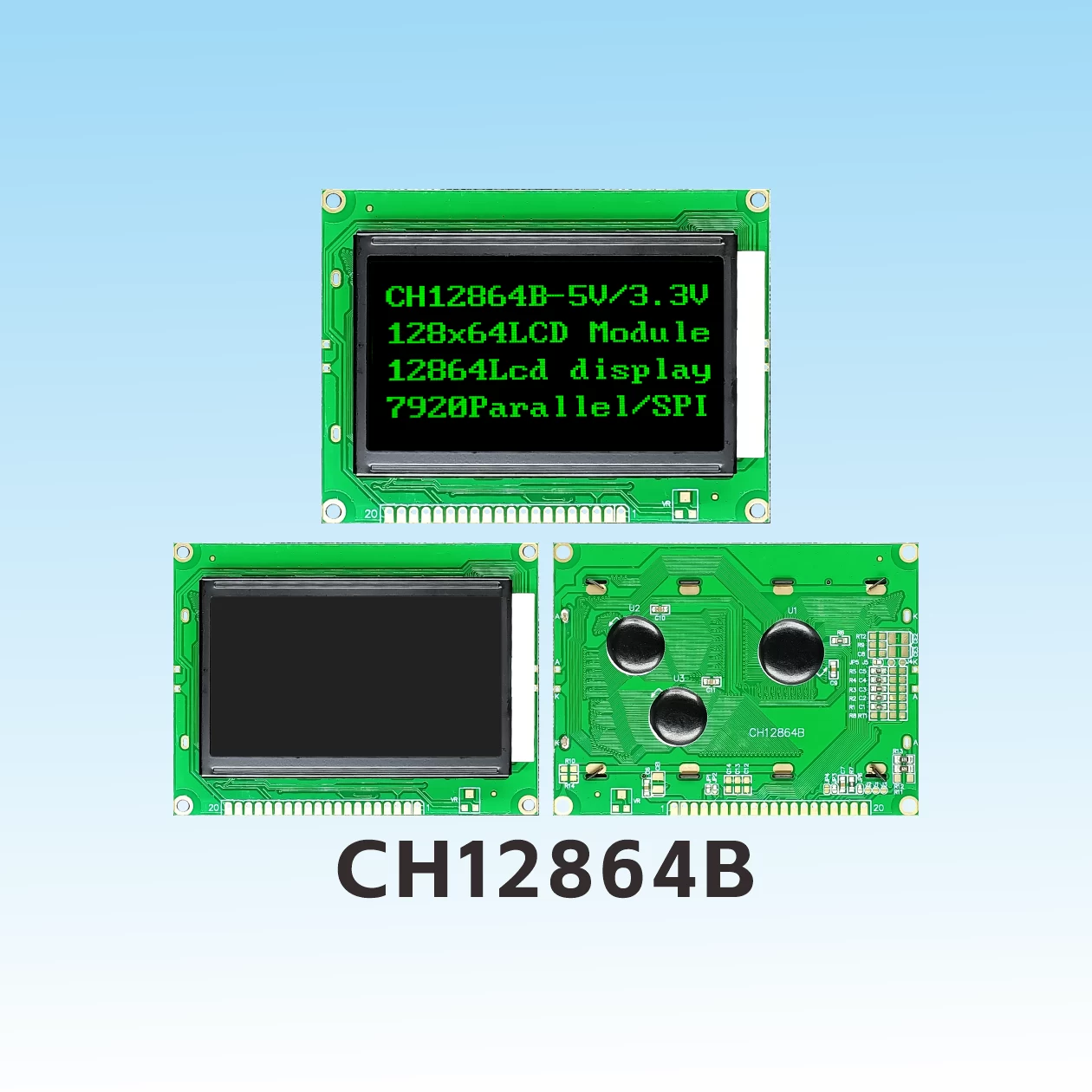
For more than two decades, the 128x64 graphic LCD has served as the backbone of embedded human-machine interfaces (HMI). From factory floor terminals to grid monitoring units, the CH12864 model number remains standard across thousands of technical drawings.
The display market has evolved rapidly. Full-color TFT panels and high-contrast OLEDs are now cheaper than ever. Despite these newer alternatives, the CH12864 continues to populate industrial bills of materials (BOMs) worldwide.
Why do hardware engineers stick with this monochrome workhorse in 2026? The answer comes down to operational predictability. Consumer electronics prioritize visual trends. Industrial design prioritizes uninterrupted uptime, predictable lifecycle supply, zero software bloat, and total immunity to electrical interference.
The CH12864 is not just a raw glass panel. It is an integrated, robust module designed to endure environments where consumer-grade displays fail within months.
The CH12864 typically features one of two classic driver architectures:
Factory environments present harsh electrical conditions. The CH12864 features high resistance to electromagnetic interference (EMI) and electrostatic discharge (ESD), meeting stringent standards outlined by organizations like the IEEE for industrial electronics.
Standard industrial builds operate smoothly between -20°C and +70°C. Upgraded extended-temperature versions push boundaries further, from -30°C to +80°C. Unlike organic films or complex driver arrays, the liquid crystal chemistry inside the CH12864 retains structural stability under thermal shocks.
The module is available in several optical modes:
Modern microcontrollers often run complex operating systems, but many industrial nodes still rely on simple 8-bit or 32-bit MCUs (such as PIC, AVR, or STM32). The CH12864 requires only a few kilobytes of flash memory and minimal RAM. Thousands of mature, bug-free C libraries are publicly available on repositories and distributor portals like DigiKey, keeping firmware development fast and predictable.
Hardware engineers frequently ask if modern display types should replace the CH12864 graphic LCD. The table below compares the core trade-offs.
| Metric | CH12864 Graphic LCD | 0.96" / 1.3" OLED | 2.4" - 2.8" Color TFT | Monochrome E-Paper |
|---|---|---|---|---|
| Operating Lifetime | 50,000 to 100,000+ hours (stable) | 15,000 to 30,000 hours (burn-in risk) | 30,000 to 50,000 hours | Static image: infinite; refresh limited |
| Power Consumption | Very low (mA range, mostly backlight) | Moderate (scales with lit pixels) | High (demanding continuous backlight) | Near zero (static); high per refresh |
| Sunlight Legibility | Excellent (Transflective modes) | Poor to moderate in direct sun | Requires high nits (>800 nits) | Excellent (pure reflective) |
| MCU Overhead | Minimal (Direct parallel or 3-wire SPI) | Low to moderate (I2C / SPI) | High (requires framebuffers & RAM) | Moderate (requires full-screen LUTs) |
| Thermal Resilience | High (-30°C to +80°C options) | Degrades rapidly at high temperatures | Fair; shifts colors at extremes | Poor below 0°C (slow update) |
OLED displays offer brilliant contrast and wide viewing angles. However, static industrial interfaces cause OLED pixels to degrade unevenly. This burn-in permanently etches warning icons or numeric readouts onto the glass. The CH12864 avoids this issue completely, displaying static numbers for a decade without ghosting.
Color TFT displays improve aesthetic appeal, but they require significant computing resources. Driving a TFT requires a faster processor, more internal RAM, and complex GUI libraries. For a basic pressure transmitter or power meter, this adds unnecessary cost and power consumption to the BOM.
E-paper is unmatched for static readouts, but its refresh cycle is too slow for real-time monitoring. Industrial instruments often require sub-second updates to display motor speeds, fluid levels, or warning flags. The CH12864 delivers refresh rates fast enough for dynamic bar graphs without display lag.
Engineers must also evaluate the limitations of the CH12864 when planning new installations.
First, user expectations have shifted. Modern operators are accustomed to smartphones. The monochrome 128x64 dot matrix cannot provide smooth animations, gradients, or complex multi-language layouts outside of standard character sets.
Second, physical dimensions can be an issue. Traditional Chip-On-Board (COB) versions of the CH12864 are thick. The PCB backing, mounting holes, and through-hole pin header require significant enclosure depth compared to modern Chip-On-Glass (COG) modules.
Third, legacy controller ICs face occasional supply chain interruptions. Sourcing teams must ensure their supplier uses actively supported driver silicon rather than discontinued or unauthorized grey-market chips.
Certain industrial sectors continue to specify the CH12864 LCD because alternative technologies introduce unnecessary failure points.
For custom variations suited to demanding sectors, industrial clients work with dedicated manufacturers like Chuanhang Display to tailor backlight intensity, pin assignments, and temperature tolerances.
Not every CH12864 module on the market meets true industrial standards. Keep these checkpoints in mind when qualifying suppliers:
Decide early between traditional COB (Chip-On-Board) and COG (Chip-On-Glass). COB modules feature black epoxy blobs on a rigid PCB backing. They offer maximum mechanical strength and easy mounting. COG versions place the driver IC directly on the glass, resulting in a thin, lightweight profile that suits compact handheld tools.
Legacy architectures ran almost exclusively on 5.0V rails. Many modern microcontrollers run on 3.3V logic. Always check your module specifications. Sourcing a native 3.3V CH12864 avoids the need for external logic-level shifters and dedicated power rails. You can review design guidelines via semiconductor references like STMicroelectronics to match display interfaces with modern MCUs.
Industrial product designs often remain active for 7 to 15 years. Confirm that your manufacturing partner provides guaranteed supply longevity. Reliable vendors provide formal End-of-Life (EOL) notices and drop-in replacement pathways before retiring any sub-components.
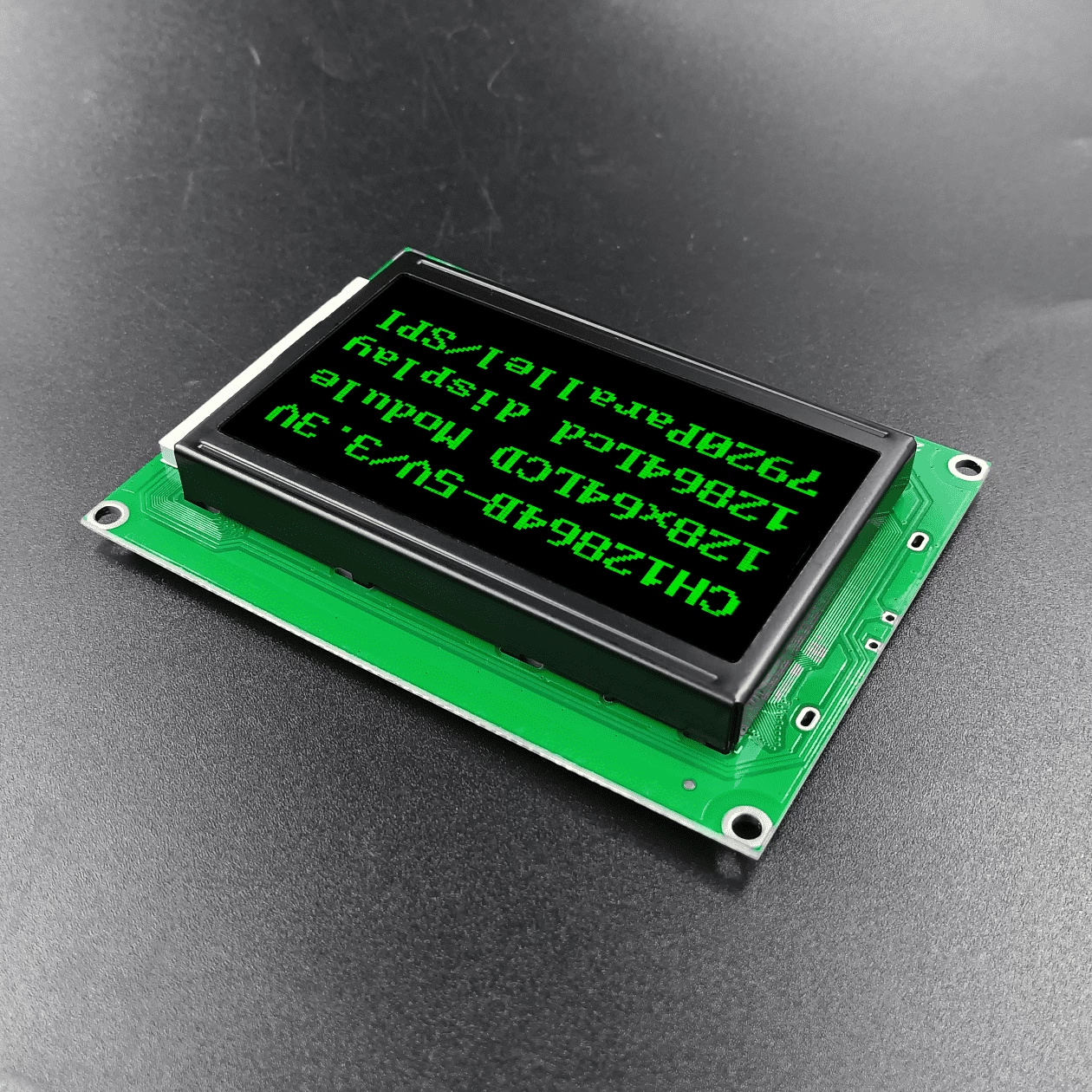
Is the CH12864 still the best 128x64 graphic LCD for industrial devices in 2026? If your device needs a dynamic, full-color interface, the answer is no. A modern TFT or touch panel is the proper choice for complex GUIs.
However, if your priorities are 10-year hardware reliability, zero image burn-in, instant sunlight legibility, low power draw, and immunity to electrical noise, the CH12864 remains the most cost-effective and dependable display solution available.
Chuanhang Display produces high-reliability CH12864 modules built to withstand harsh working conditions. Whether you need standard pinouts, wide-temperature fluid, or custom connector assemblies, our engineering team is ready to assist. Contact Chuanhang Display today to request engineering datasheets or discuss your production schedule.
A1: Electrically, both can run on standard 5V rails, but their pinouts and driver commands differ significantly. The ST7920 supports serial and parallel modes with built-in font sets, whereas the KS0108 requires distinct chip-select lines (CS1/CS2) for pure bitmap control. You must adjust your PCB layout and rewrite the low-level firmware driver to make the switch.
A2: Liquid crystals naturally thicken at sub-zero temperatures, slowing response times and changing contrast curves. To resolve this, specify an extended-temperature model with built-in negative voltage circuitry (VEE/Vout). Adjusting the contrast potentiometer can also compensate for temperature-induced voltage shifts.
A3: The liquid crystal logic circuitry draws negligible current, often less than 2 to 5 mA. The majority of power goes to the LED backlight. A traditional yellow-green array backlight consumes between 60 mA and 120 mA, while modern edge-lit white LED backlights require only 15 mA to 30 mA at full brightness.
A4: Aside from direct physical impact, the most common issues stem from overvoltage spikes on the VDD or backlight lines, poor grounding that lets EMI corrupt parallel data buses, and prolonged exposure to moisture without conformal coating on the rear PCB components.
A5: Yes, but you must ensure hardware compatibility. If you use a 5V CH12864, driving it directly with 3.3V logic can cause missed reads or erratic writes unless level shifters are present. Alternatively, you can order native 3.3V CH12864 variants from your display supplier, eliminating the need for external buffer ICs.