Deciding between an OLED or LCD module is one of the most critical hardware trade-offs in embedded design—dictating your system's battery runtime, sub-zero thermal responsiveness, direct sunlight legibility, and multi-year supply chain longevity. While self-emissive PMOLED and AMOLED modules deliver infinite contrast ratios, razor-thin Z-heights, and microsecond response times, transmissive TFT-LCD modules dominate outdoor high-ambient environments (>1,000 nits) with zero risk of static image burn-in. Founded in 2011, Shenzhen Chuanhang Electronic Technology Co., Ltd. (Chuanhang Display) operates a modern 5,000-square-meter facility with over 100 skilled technicians and 10+ R&D engineers. We manufacture custom monochrome LCDs, color TFTs, and tailored display sub-assemblies across automated COG, FOG, COB, and SMT production lines, providing guaranteed 5-to-7+ year component availability.
Specify an OLED module for ultra-low power dark-mode interfaces, sub-zero instant response (-40°C), and ultra-thin profiles (<1.5 mm="">TFT-LCD module for continuous high-brightness outdoor sunlight readability (>1,000 cd/m²), 24/7 static UI installations without differential burn-in, and extended operational lifespans (>50,000 hours) in industrial HMIs. Chuanhang Display manufactures and customizes both display branches within its 5,000 m² Shenzhen cleanroom facility, providing custom FPC pinouts, optical bonding (OCA/OCR), and long-term anti-EOL supply security.
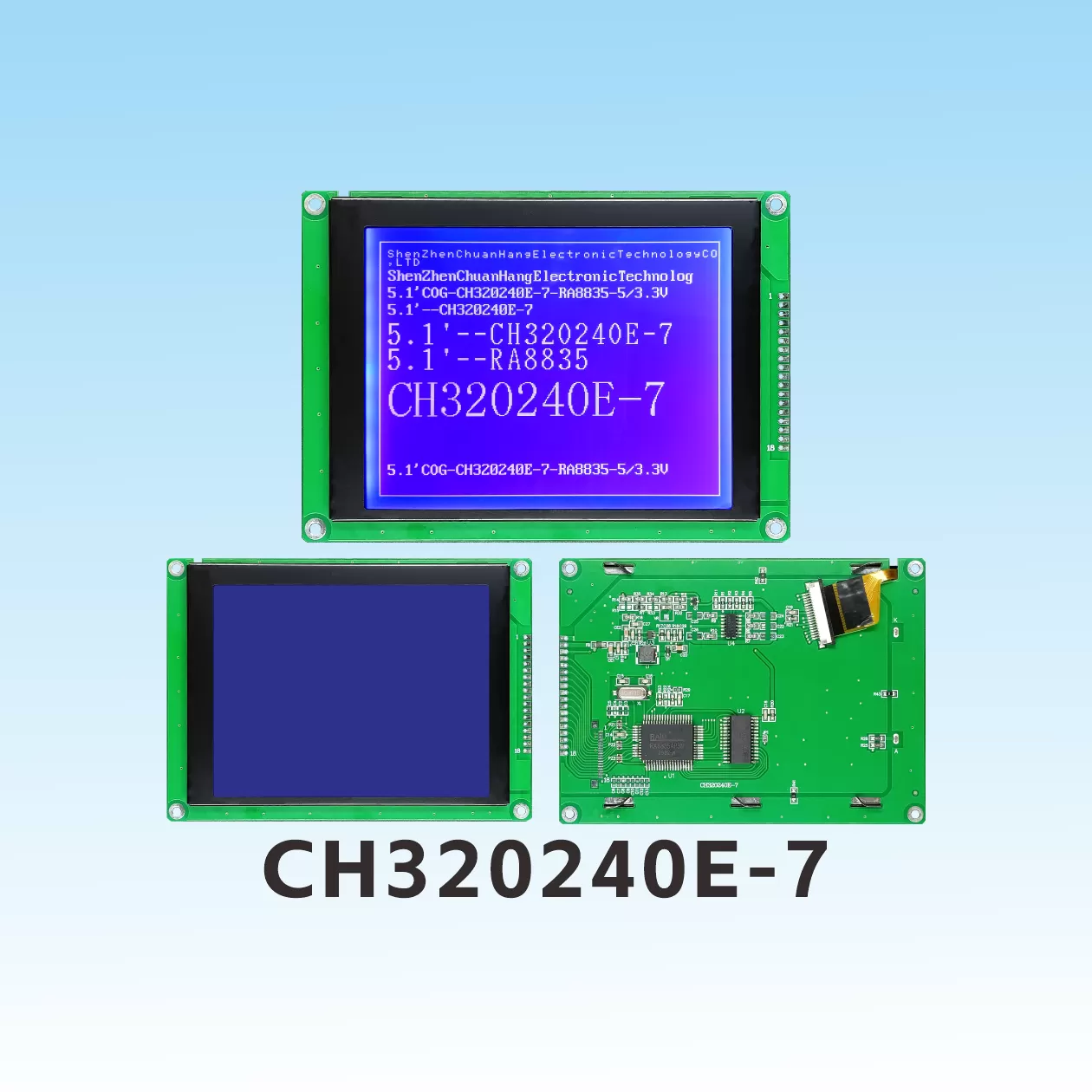
The core distinction between OLED and LCD modules lies in illumination physics. An OLED module utilizes carbon-based organic diodes that emit light independently per pixel, whereas an LCD module modulates a continuous LED backlight through an active-matrix liquid crystal layer sandwiched between crossed polarizers.
This fundamental physics gap dictates operational performance in the field. When an LCD displays pure black, residual light always bleeds around the edge of the liquid crystal matrix, limiting static contrast ratios to roughly 1,000:1. In contrast, an OLED module cuts drive current completely to unlit pixels, achieving true-black contrast (>100,000:1) and dramatic power savings on dark user interfaces.
Technical standards maintained by the Society for Information Display (SID), alongside electro-optical specifications codified under IEC 61747 (LCD) and IEC 62341 (OLED) standards and display ergonomics under ISO 9241-307 visual requirements, dictate strict control over specular reflection and luminance decay. Chuanhang Display bridges both technological paths, engineering high-brightness TFTs up to 2,000 nits alongside ultra-contrast OLED assemblies.
Industrial environments disqualify consumer-grade display panels. While LCD modules are prone to liquid crystal sluggishness at cold extremes and optical clearing at high heat, OLED modules face differential subpixel aging (burn-in) when subjected to non-changing, static high-luminance icons.
Liquid crystals are viscous fluids. When operating temperatures plummet toward -20°C or -40°C, molecular rotational viscosity rises exponentially. In outdoor military gear or sub-zero logistics scanners, an LCD display will smear moving graphics. To bypass this without adding costly ITO resistive glass heaters, engineers specify Chuanhang's industrial OLED modules, which retain sub-millisecond response rates in sub-zero freezers.
Organic blue emitters degrade faster than red and green compounds under sustained drive currents. In an industrial SCADA console or patient monitor displaying non-changing navigation bars 24/7, an unmitigated OLED will exhibit permanent ghost outlines within 10,000 hours. For continuous 24/7 static UI installations, Chuanhang’s ultra-wide-temp IPS-LCD modules deliver over 50,000 hours of unblemished MTBF lifespan.
Direct ownership of automated assembly machinery defines a premier display module factory. Founded in 2011, Chuanhang Display operates fully owned COG (Chip-on-Glass), FOG (Film-on-Glass), COB (Chip-on-Board), COPB, and SMT production lines within its 5,000 m² modern manufacturing hub in Shenzhen.
A critical failure point in high-density graphic modules is micro-pitch interconnect breakdown. Sourcing directly from an authentic manufacturing plant eliminates middleman markups and guarantees micron-level anisotropic conductive film (ACF) bond integrity:
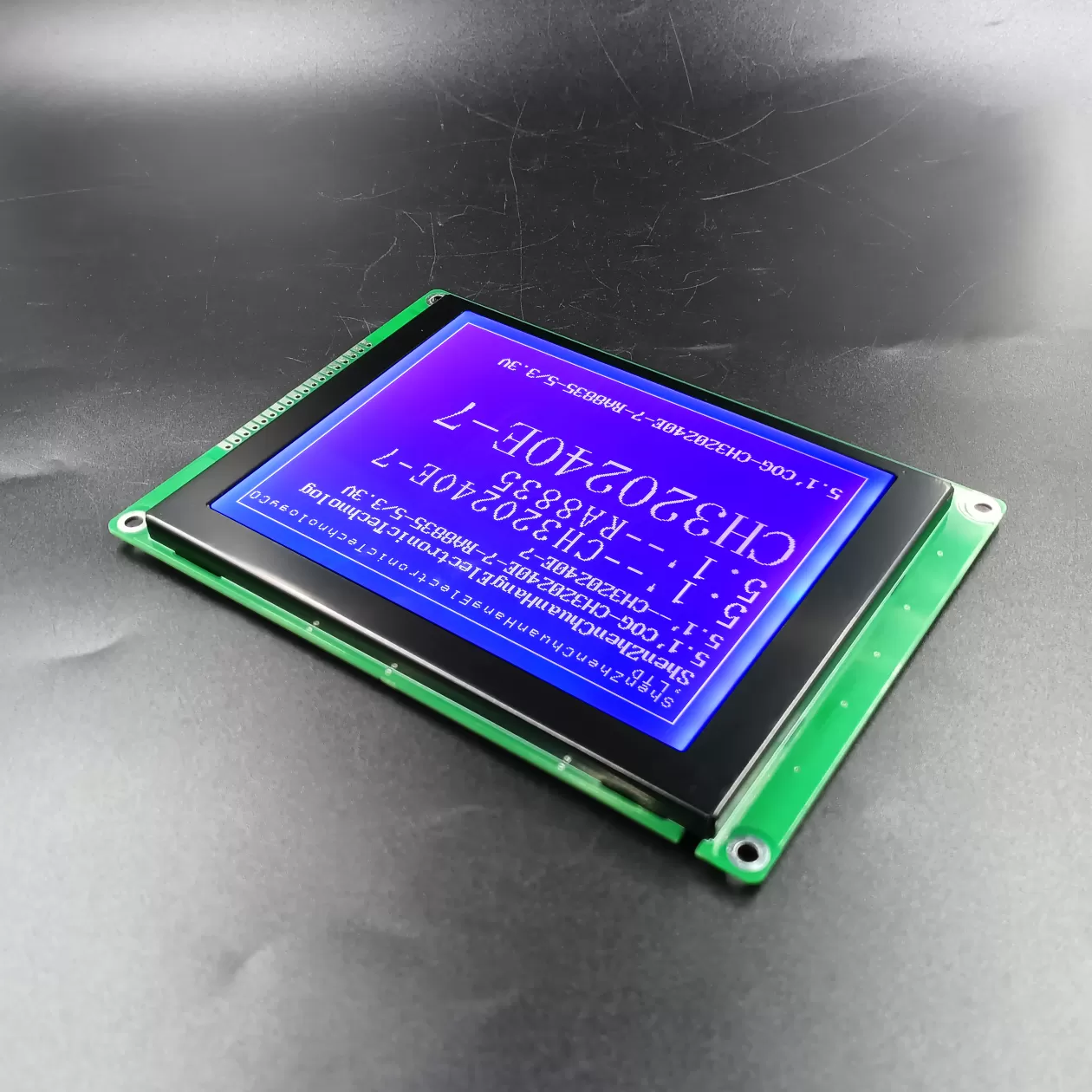
Operating over 5,000 square meters of modern manufacturing facilities, Chuanhang Display implements an exhaustive 6-stage qualification loop on every production lot of OLED and LCD modules, validating anisotropic bond reliability, electrical drive margins, and optical contrast uniformity before release.
100% optical and electrical probing of bare glass cells and driver silicon to eliminate latent micro-cracks.
Automated optical ACF thermocompression inside ISO Class 4 cleanrooms with pitch tolerances under ±0.015 mm.
Spectroradiometric calibration confirming contrast ratio, response speed, and chromaticity (CIE 1931).
168+ hours at +60°C / 90% RH humidity alongside rapid thermal shock cycling (-30°C to +80°C).
Calibrated photometer mapping aligned with NIST optical measurement protocols, confirming >85% luminance uniformity across active areas.
High-voltage ESD protection verification and vacuum heat sealing in antistatic conductive trays with lot barcoding.
A1: Power draw is strictly interface-dependent. An OLED module draws near-zero current for black pixels, making it vastly superior when running dark-mode themes (text and icons on black backgrounds). Conversely, an LCD module draws constant current via its LED backlight regardless of displayed image; if your interface is predominantly white or colorful, an LCD will consume less power than an OLED at equivalent luminance.
A2: Yes. Backed by 13+ years of specialized manufacturing, Chuanhang Display provides turnkey FPC redesigns. Operating our own automated COG and SMT lines, we can customize tail length, bend radii, connector pin assignments (ZIF/Hirose), and integrate dedicated EMI ground shielding, enabling our display to drop directly into your motherboard without host PCB re-spins.
A3: Traditional tape bonding leaves an internal air gap between the display panel and cover glass, reflecting up to 15% of ambient sunlight. Chuanhang Display utilizes optical clear adhesive (OCA/OCR) to eliminate the air boundary, matching refractive indexes and reducing internal reflection to under 0.5% while dramatically improving impact strength and condensation resistance.
A4: Industrial TFT-LCD modules typically feature a backlight half-life (LT50) of 50,000 to 70,000 hours (over 8 years of 24/7 continuous operation). Modern industrial OLED modules achieve 30,000 to 50,000 hours under nominal brightness. For prolonged static industrial interfaces, LCD offers superior resistance against image retention, whereas OLED provides superior mechanical thinness and instant responsiveness.
A5: Yes. Our Projected Capacitive (PCAP) touch assemblies are tuned at the controller firmware level to support thick industrial gloves (up to 5mm leather or latex), saline water droplet rejection, and heavy cover lenses up to 6mm vandal-proof tempered glass without false triggers or touch loss.
A6: Standard catalog display samples ship within 3 to 5 business days. Custom display tooling projects (custom glass dimensions, custom FPC tails, or modified backlights) deliver working first-article prototypes within 2 to 3 weeks, supported by mass-production MOQs starting flexibly from 500 to 1,000 units.
Bypass trading brokers and engineer your display sub-assembly directly with Chuanhang Display. We provide 24-hour CAD counter-drawings, in-house optical bonding, and working prototype delivery within 2 to 3 weeks.