The transition from traditional Liquid Crystal Displays (LCDs) to Organic Light-Emitting Diodes (OLEDs) has redefined the expectations for small-form-factor user interfaces. Among the various resolutions available, the oled display 128x64 has emerged as the industry standard for compact systems requiring high legibility and low power consumption. This specific resolution provides a balanced aspect ratio for both text and graphical icons, making it a staple in industrial, medical, and consumer electronics.
Unlike traditional TFT or STN displays that require a dedicated backlight unit (BLU), the pixels in an OLED panel are self-emissive. This fundamental difference allows for deeper black levels, an nearly infinite contrast ratio, and a significantly thinner profile. For B2B procurement officers and hardware engineers, understanding the nuances of this technology is vital for long-term project success.

At the heart of the oled display 128x64 is the Passive Matrix OLED (PMOLED) structure. While Active Matrix (AMOLED) dominates the smartphone market, PMOLED is the preferred choice for 0.96-inch to 2.42-inch displays due to its cost-efficiency and simplicity in driving circuitry.
The most common controller used for this resolution is the Solomon Systech SSD1306. It is a single-chip CMOS OLED/PLED driver with a controller for organic light-emitting diode dot-matrix graphic display systems. It consists of 128 segments and 64 commons. Other alternatives include the SH1106 or the SSH1106, which are similar but often require slight adjustments in the initialization code regarding the start column address.
Key features of these controllers include:
Built-in Charge Pump: This allows the display to operate from a single low-voltage power supply (3.3V), generating the necessary higher voltage for the OLED panel internally.Contrast Control: A 256-step contrast control register allows for fine-tuning the brightness via software.Memory Mapping: The GDDRAM (Graphic Display Data RAM) stores the bit pattern to be displayed, reducing the processing load on the host microcontroller (MCU).
When integrating an oled display 128x64 into a system, engineers typically choose between I2C (Inter-Integrated Circuit) and SPI (Serial Peripheral Interface).
I2C (2-wire): Ideal for systems where GPIO pins are scarce. It operates at speeds up to 400kHz, which is sufficient for static or slow-moving data.4-wire SPI: Preferred for applications requiring higher refresh rates. By using a dedicated clock and data line, SPI can achieve much higher throughput, making animations or real-time sensor graphs appear smoother.
The longevity and performance of an OLED panel are dictated by the quality of the organic layers and the encapsulation process. The stack typically consists of a substrate, an anode, organic layers (hole injection, transport, emissive, and electron transport), and a cathode.
Most 128x64 modules use a soda-lime glass substrate. However, the "Achilles' heel" of any OLED is its sensitivity to oxygen and moisture. Even trace amounts of water vapor can cause "dark spots" (non-functional pixels) to grow. High-quality manufacturers like [Chuanhang Display] utilize advanced thin-film encapsulation (TFE) or glass-to-glass sealing with specialized desiccants to ensure the organic materials remain isolated from the environment.
While monochromatic white is common, yellow and blue phosphors are also widely used.
Yellow Phosphors: Generally offer the longest operational life (often exceeding 50,000 hours to 50% brightness).White Phosphors: Offer high clarity but may have a slightly shorter lifespan due to the blend of colors needed to achieve the white point.Blue Phosphors: Historically the fastest to degrade, though modern chemical formulations have significantly closed the gap.
The versatility of the oled display 128x64 allows it to function across diverse sectors. Its ability to operate at extreme temperatures—often from -40°C to +70°C—gives it a distinct advantage over standard LCDs, which become sluggish or lose contrast in cold environments.
In portable pulse oximeters and glucose meters, the high contrast ratio ensures that readings are visible even in low-light hospital wards. The wide viewing angle (typically >160 degrees) allows medical staff to read data from various positions without color inversion or fading.
In DIN-rail mounted energy meters or PLC (Programmable Logic Controller) status screens, the 128x64 resolution is used to display voltage, amperage, and fault codes. Since these devices often run 24/7, implementing software-level burn-in protection is a standard practice in this field.
For battery-powered IoT devices, the self-emissive nature of the OLED is a key advantage. Since only the active pixels consume power, displaying a few lines of text on a black background is far more energy-efficient than powering a full LCD backlight.
A common concern in the B2B sector regarding OLED technology is the "burn-in" effect, technically known as differential aging. When static images are displayed for thousands of hours, the organic material in those specific pixels wears out faster than the surrounding area.
To mitigate this, professional-grade modules from [Chuanhang Display] are often paired with firmware-level solutions:
Pixel Shifting: Periodically moving the entire image by one or two pixels in a circular pattern to distribute the load across a wider area.Screen Flipping: Inverting the display colors (black on white vs. white on black) at set intervals.Automatic Dimming: Using a proximity sensor or a timeout function to reduce brightness when the user is not actively interacting with the device.
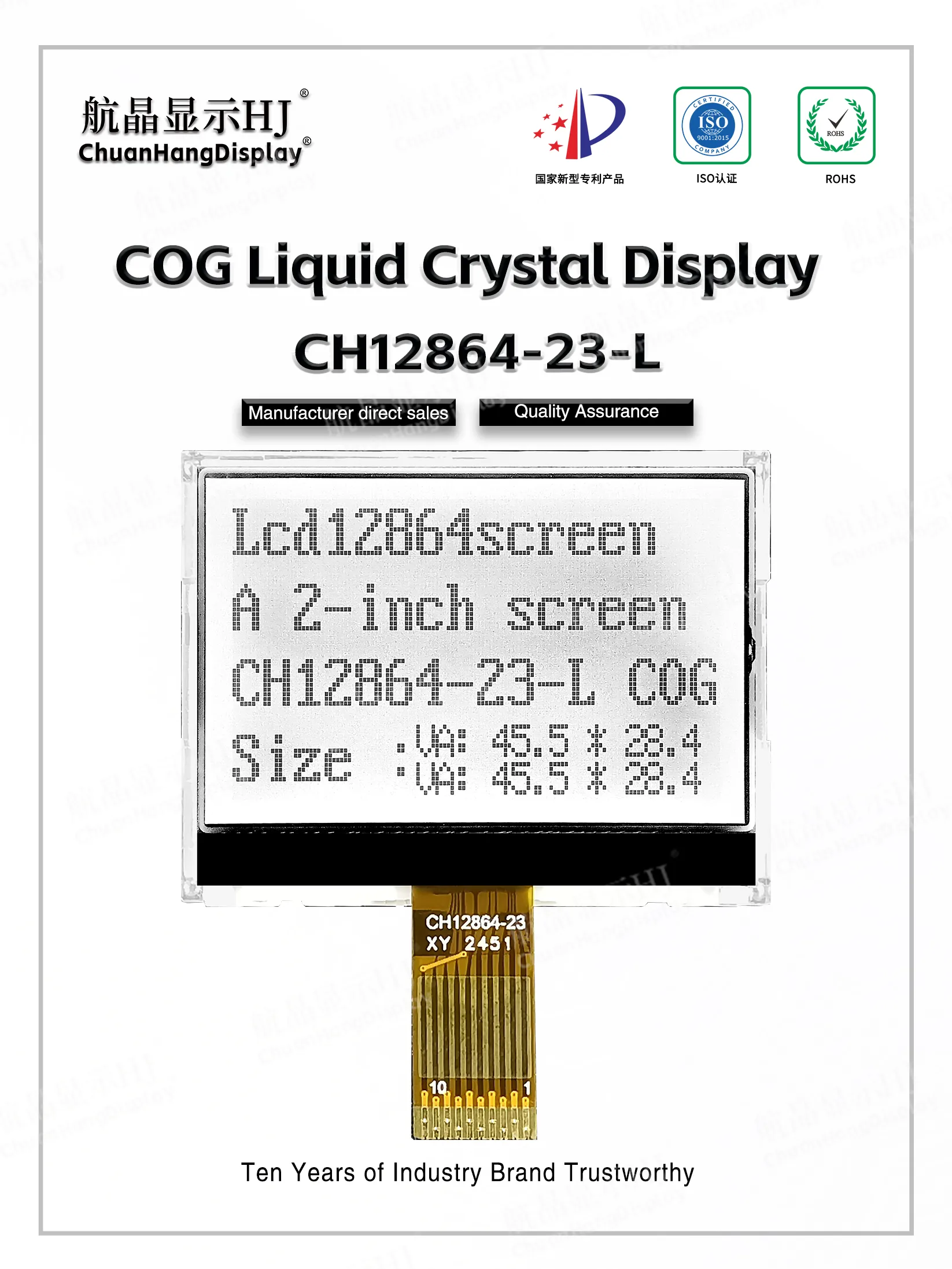
Another vital consideration is the FPC (Flexible Printed Circuit) design. In many low-cost modules, the FPC is brittle and prone to cracking at the bonding point (COG - Chip on Glass). High-reliability modules use reinforced FPC materials and gold-plated contacts to ensure stable connections in high-vibration industrial environments.
When sourcing the oled display 128x64, price is rarely the only factor. For industrial projects, the total cost of ownership (TCO) includes the cost of potential field failures and the difficulty of redesigning a product if a component goes End-of-Life (EOL).
The display market is volatile. It is fundamental to partner with a supplier that offers a "long-term availability" guarantee. [Chuanhang Display] provides consistent product cycles, ensuring that the mechanical dimensions and electrical characteristics of the modules remain stable over several years, which is a key requirement for medical and automotive certifications.
A professional supplier should provide:
Luminance Data: Measured in nits (cd/m²), typically ranging from 100 to 150 nits for standard modules.Chromaticity Coordinates: Ensuring color consistency across different batches.Reliability Reports: Including high-temperature/high-humidity bias tests (e.g., 60°C/90% RH).
While "open-market" modules are available at very low costs, they often utilize "B-grade" glass or reclaimed driver ICs. For B2B applications, investing in "A-grade" panels is necessary to avoid the high costs associated with warranty returns and brand damage. Bulk pricing for a standard oled display 128x64 varies based on the interface (I2C/SPI), the color of the phosphor, and the presence of a metal frame or customized FPC.
The market is moving toward integration. We are seeing more 128x64 modules that incorporate capacitive touch overlays (PCAP), allowing for a more modern user experience without increasing the device's footprint. Additionally, there is a growing demand for "gray-scale" capabilities. While the standard 128x64 is often used as a 1-bit (on/off) display, the SSD1306 controller actually supports 4-bit grayscale, allowing for sophisticated shading and more professional graphical user interfaces.
The shift toward sustainable electronics is also influencing manufacturing. Reducing the chemical waste produced during the glass etching process and using recyclable packaging are becoming standard requirements for European and North American B2B clients.
The oled display 128x64 remains a cornerstone of modern industrial design. Its combination of high contrast, wide operating temperatures, and low power consumption makes it irreplaceable for many specific applications. By understanding the underlying material science and the importance of driver IC stability, engineers can create more robust and user-friendly products.
Choosing a reliable partner like [Chuanhang Display] ensures that your project benefits from high-grade materials and long-term supply chain security. Whether you are developing a new medical device or upgrading an industrial controller, focusing on quality at the component level is the most effective way to ensure field reliability.
Q1: What is the typical lifespan of an oled display 128x64 module?
A1: The lifespan, usually defined as the time it takes for the display to reach 50% of its original brightness (L50), typically ranges from 30,000 to 50,000 hours for yellow and white displays, depending on the drive current and usage patterns.
Q2: Can I use an SSD1306 driver for an SH1106-based display?
A2: While the command sets are very similar, the SH1106 is designed for a 132x64 resolution. When used with a 128x64 panel, the data is usually centered, meaning you must offset the starting column address by 2 in your initialization code to prevent visual artifacts.
Q3: How does temperature affect the performance of these OLEDs
?A3: Unlike LCDs, which have liquid crystals that thicken in the cold, OLEDs use solid-state organic films. This allows them to maintain nearly instantaneous response times even at -40°C, making them the gold standard for outdoor and high-altitude equipment.
Q4: Is the oled display 128x64 sunlight-readable?
A4: Standard OLEDs are highly readable in indoor or shaded environments. For direct sunlight readability, a high-brightness panel (over 500 nits) or a specialized circular polarizer is required to minimize reflections and maintain the contrast ratio.
Q5: What are the benefits of SPI over I2C for this resolution?
A5: SPI is a full-duplex communication protocol with a dedicated clock line, allowing for much higher data transfer rates. If your application involves real-time graphs, scrolling text, or animations, SPI will provide a much smoother visual experience without the "lag" sometimes seen with I2C.
Are you looking for a reliable, industrial-grade display solution for your next project?
At Chuanhang Display, we specialize in providing high-performance display modules tailored to rigorous B2B requirements. Whether you need custom FPC lengths, specific phosphor colors, or long-term supply guarantees, our technical team is ready to assist.