Designing human-machine interfaces (HMIs) for industrial, medical, automotive, or consumer electronics demands highly specific hardware configurations. Standard, off-the-shelf display modules rarely meet the exact dimensional, optical, and environmental requirements of specialized B2B projects. This necessitates sourcing specialized components that align perfectly with the end product's hardware architecture. Selecting the right custom LCD display manufacturer is a fundamental step in product development, impacting everything from bill of materials (BOM) costs to long-term field reliability.
This article examines the deep technical specifications, material selections, and supply chain dynamics that procurement teams and hardware engineers must analyze when developing custom liquid crystal displays.

Standard displays are manufactured for mass-market applications, prioritizing scale over specific environmental tolerances. When customizing a display, engineers have control over every layer of the TFT (Thin-Film Transistor) module.
The core of any display is the liquid crystal fluid and how it aligns between the Indium Tin Oxide (ITO) glass substrates.
TN (Twisted Nematic): The most cost-effective technology, suitable for basic industrial indicators. However, TN panels suffer from grayscale inversion—a phenomenon where colors shift or invert when viewed from a specific angle (usually the 6 o'clock or 12 o'clock viewing direction). VA (Vertical Alignment): VA panels offer superior contrast ratios (often exceeding 3000:1) by effectively blocking the backlight when pixels are inactive, resulting in deep blacks. They are widely used in automotive clusters and high-end consumer appliances. IPS (In-Plane Switching): IPS technology rotates liquid crystal molecules parallel to the glass substrates. This provides accurate color reproduction and wide viewing angles (typically 85/85/85/85 degrees). Medical imaging equipment and high-end outdoor kiosks predominantly rely on IPS panels for their consistent optical performance.
The Backlight Unit dictates the brightness, power consumption, and thermal footprint of the display. A proficient custom LCD display manufacturer can re-engineer the BLU to meet specific luminance targets.Standard indoor displays typically output 250 to 350 Nits (cd/m²). Outdoor applications require sunlight-readable displays, demanding 1000 to 2500 Nits. Achieving this requires modifying the LED strings, utilizing high-efficiency Light Guide Plates (LGPs), and adding specialized optical films such as Brightness Enhancement Films (BEF) and Dual Brightness Enhancement Films (DBEF). Managing the thermal output of these high-brightness LEDs is paramount to prevent premature diode degradation and maintain a high Mean Time Between Failures (MTBF).
Connecting the raw TFT LCD to an embedded motherboard requires exact alignment of communication protocols and physical connectors.
The FPC is the bridge between the display's source/gate drivers and your primary PCB. Customization at this stage includes:
Pinout Mapping: Aligning the pin configuration to match the host controller, eliminating the need for intermediate adapter boards. Form Factor and Bending Radius: Designing the shape, length, and flexibility of the FPC to accommodate tight mechanical enclosures. Electromagnetic Interference (EMI) Shielding: Applying silver paste, copper mesh, or EMI absorption tape directly onto the FPC to pass stringent FCC or CE electromagnetic compatibility testing.
Displays communicate via different protocols depending on their resolution and the processing power of the host MCU or MPU.
SPI/I2C and MCU Interfaces: Used for low-resolution, monochrome, or basic color displays in embedded systems with limited processing power. RGB and LVDS: The industry standards for mid-to-high resolution displays. Low-Voltage Differential Signaling (LVDS) is particularly effective at transmitting high-speed data over longer distances with minimal electromagnetic radiation. MIPI DSI and eDP: Used for ultra-high-resolution (FHD, 4K) and high-refresh-rate applications. Mobile Industry Processor Interface (MIPI) requires fewer pins while offering massive bandwidth.
Displays deployed in harsh environments require significant ruggedization. This involves specific material selection for cover glass and advanced bonding techniques.
Projected Capacitive (PCAP) touch panels dominate modern device design. Customization allows for the integration of specific touch controller ICs (such as ILITEK, Goodix, or FocalTech) tuned for specialized use cases. Firmware can be calibrated to recognize touch inputs through thick industrial gloves, or to reject false inputs caused by water droplets on the screen.
Cover glass (CG) customization involves modifying the glass thickness (up to 6mm for vandal resistance) and applying surface treatments:
Anti-Glare (AG): Chemical etching of the glass surface to scatter reflected light, improving readability under harsh lighting. Anti-Reflective (AR): Vacuum-deposited optical coatings that reduce light reflection and increase light transmission. Anti-Fingerprint (AF): Oleophobic coatings that resist skin oils and make the glass easier to clean.
Standard displays utilize double-sided tape to adhere the touch panel to the LCD perimeter, leaving an air gap. This air gap causes internal reflections that degrade sunlight readability and creates a space where condensation can form.Advanced facilities use Optical Bonding, injecting Optically Clear Adhesive (OCA) or Optically Clear Resin (OCR) between the LCD and the touch panel. This eliminates the air gap, vastly improves contrast in ambient light, and increases the structural integrity of the module against mechanical shocks.
Hardware teams frequently encounter supply chain hurdles when sourcing displays. Two of the most prominent challenges are High NRE (Non-Recurring Engineering) costs and EOL (End-of-Life) notices.
Customizing a display requires initial investments in tooling. Modifying an FPC might incur a tooling fee of $300 to $600. Developing a fully custom capacitive touch sensor and cover glass tooling can range from $1,500 to $4,000 depending on the mask layers required.Furthermore, large panel fabricators often demand massive MOQs (e.g., 10,000+ units) that are unfeasible for specialized B2B medical or aerospace equipment. Partnering with established providers like Chuanhang Display ensures access to flexible manufacturing lines that support mid-volume production runs, allowing companies to scale without tying up excessive capital in inventory.
Consumer-grade panels face rapid EOL cycles, often being discontinued within 18 to 24 months. For medical and industrial equipment with 7-to-10-year lifecycles, this is disastrous. A competent custom LCD display manufacturer mitigates this by utilizing industrial-grade TFT glass from foundries that guarantee long-term availability, or by designing custom modules that can accept alternative, pin-to-pin compatible driver ICs without requiring a redesign of the host product's motherboard.
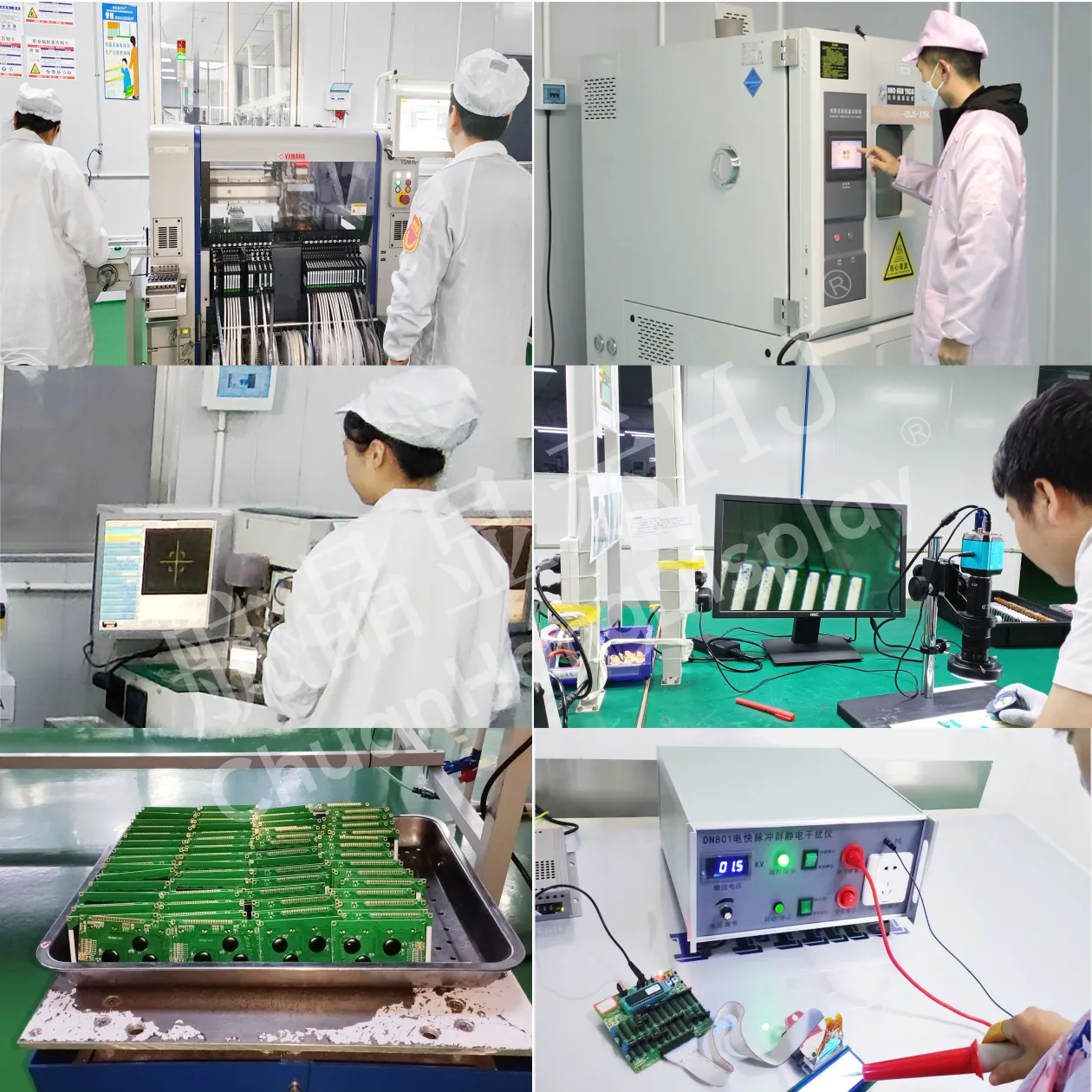
Validating the build quality of a custom display requires rigorous laboratory testing. Factory evaluation should confirm that the manufacturer adheres to cleanroom standards (Class 1k or 10k) to prevent dust particles from contaminating the bonding processes.
Comprehensive reliability testing parameters typically include:
High Temperature Operating Life (HTOL): Running the display at 70°C to 85°C for 240 to 500 hours to identify premature component failure. Temperature and Humidity Bias (THB): Testing at 60°C and 90% Relative Humidity to ensure seals and adhesives do not degrade or allow moisture ingress. Thermal Shock Testing: Rapidly cycling the display between -30°C and +80°C to test the expansion and contraction tolerances of the ITO glass and FPC bonding sites. ESD (Electrostatic Discharge) Testing: Subjecting the module to contact and air discharges (e.g., ±8kV and ±15kV) to ensure the driver ICs do not reset or sustain permanent damage.
Facilities operated by Chuanhang Display utilize stringent quality assurance frameworks, ensuring each custom module passes these harsh environmental benchmarks before mass production approval.
Understanding the cost breakdown of a custom module allows procurement teams to negotiate effectively. The primary cost drivers include:
TFT Glass Substrate: The physical dimensions and resolution of the raw glass account for the largest percentage of the unit price. High-resolution IPS glass yields fewer panels per motherglass sheet, driving up costs. Driver ICs: Global silicon shortages can cause IC prices to fluctuate. Customizing the module to accept widely available, secondary-source ICs can stabilize costs. Backlight Materials: High-luminance LEDs and specialized DBEF films add significant material costs compared to standard LED arrays. Yield Rates: Complex custom assemblies (such as optical bonding on a curved surface) naturally have lower initial yield rates. A mature factory optimizes the assembly process rapidly to reduce waste, passing the cost savings onto the buyer.
Procuring specialized visual hardware goes far beyond simply reading a standard datasheet. It involves deep technical collaboration regarding panel chemistry, optical physics, interface protocols, and supply chain longevity. Companies like Chuanhang Display bridge the gap between raw panel fabrication and the exact engineering requirements of B2B hardware developers. Ultimately, an experienced custom LCD display manufacturer functions not merely as a vendor, but as a core extension of your own engineering and procurement teams, ensuring your end product delivers flawless performance in its intended environment.
Q1: How much does a custom LCD display manufacturer typically charge for tooling?
A1: Tooling costs depend entirely on the scope of customization. Simple FPC modifications or basic backlight adjustments typically range from $300 to $800. Fully custom Projected Capacitive (PCAP) touch panels with customized cover glass usually range between $1,500 and $4,000. Full custom LCD glass (where the actual ITO glass masks are drawn from scratch) can exceed $50,000, which is why most customization relies on modifying the FPC, BLU, and touch panel of existing industrial glass sizes.
Q2: What modifications are required to make a custom display sunlight-readable?
A2: Sunlight readability requires two main modifications. First, the backlight unit (BLU) must be upgraded using high-efficiency LEDs and specialized prism films to output at least 1000 Nits of brightness. Second, optical bonding (using OCA or OCR) must be applied to eliminate the air gap between the TFT panel and the cover glass, drastically reducing ambient light reflection.
Q3: How do manufacturers mitigate the risk of display components reaching End-of-Life (EOL)?
A3: Reliable manufacturers focus on sourcing raw TFT motherglass from industrial product lines (rather than consumer smartphone/tablet lines) which typically carry a 5-to-7-year availability guarantee. Additionally, they can design the custom FPC and firmware to be backward compatible with alternative driver ICs, so if one IC goes EOL, a drop-in replacement can be used without altering the customer's mainboard.
Q4: What is the typical lead time for developing a custom LCD module?
A4: The standard timeline for designing, tooling, and producing the first batch of functional prototypes is generally 4 to 6 weeks. Following prototype approval by the client, the mass production phase typically requires an additional 4 to 8 weeks, depending on component availability and the complexity of the optical bonding processes.
Q5: Can a custom display support multiple video interfaces simultaneously?
A5: The bare TFT panel itself natively accepts one specific protocol (such as RGB, LVDS, or MIPI) based on its integrated Source/Gate drivers. However, a custom module can be engineered with an integrated bridge board or controller board on the back of the display. This board can house bridge ICs (e.g., HDMI to LVDS, or SPI to RGB) allowing the final module to interface with whatever specific protocol the host system outputs.