The 20x4 lcd display remains a foundational component in industrial automation, medical instrumentation, and human-machine interfaces. Its ability to present four lines of twenty characters each offers a balanced combination of information density and readability. This technical deep dive, informed by engineering expertise at Chuanhang Display, provides B2B professionals with essential parameters for selecting, integrating, and optimizing these modules for long-term reliability.
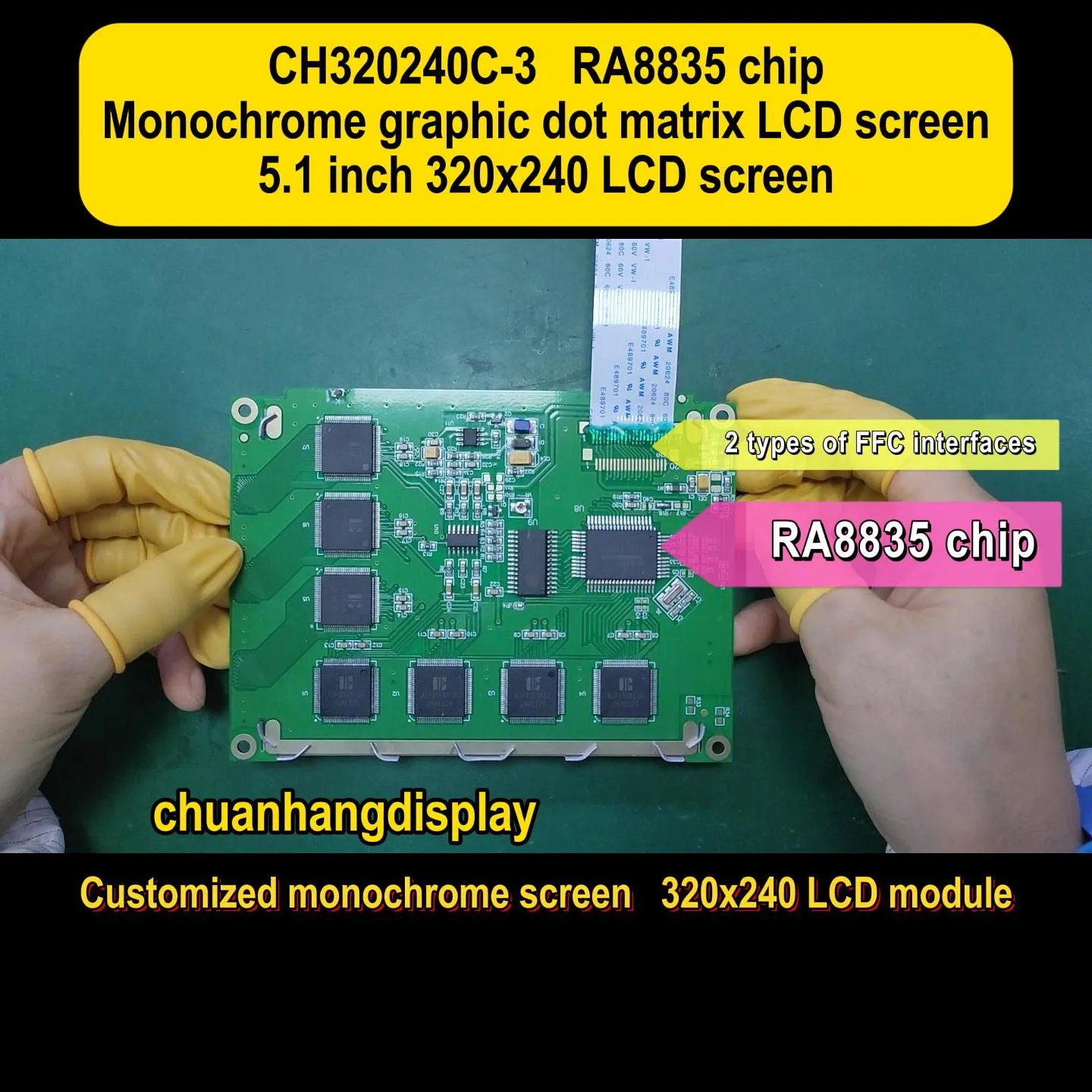
A standard 20x4 lcd display consists of a liquid crystal glass panel, a row/column driver IC (typically COB or COG), and an optional backlight. The display matrix is organized as 20 columns and 4 rows, totaling 80 character positions. Each character cell is usually 5×8 dots, allowing for the display of alphanumerics, symbols, and custom-generated glyphs.
The vast majority of 20x4 modules are designed to be compatible with the Hitachi HD44780 controller (or equivalent, like the SPLC780D). This de facto standard defines the command set, register structure, and timing diagrams. Key features include:
DDRAM (Display Data RAM): 80 bytes map directly to the 80 character positions on screen.
CGRAM (Character Generator RAM): 64 bytes allow the user to define up to 8 custom characters (8 patterns of 8 bytes each).
CGROM (Character Generator ROM): Pre-programmed fonts (e.g., English-Japanese, European) contain standard ASCII and katakana characters.
Understanding the memory mapping is critical. For a 20x4 display, the DDRAM addresses are not contiguous in a simple linear fashion; typical mapping uses addresses 0x00-0x13 for line 1, 0x40-0x53 for line 2, 0x14-0x27 for line 3, and 0x54-0x67 for line 4. Firmware must account for this to avoid misaligned text.
Beyond basic dimensions and character count, several electrical and optical parameters determine the suitability of a 20x4 lcd display for your specific application.
4-bit and 8-bit Parallel Interface: The traditional HD44780 interface uses an 8-bit data bus (or 4-bit to save pins) along with RS (Register Select), R/W (Read/Write), and E (Enable) control lines. This offers maximum speed but consumes more GPIO on the host microcontroller.
I²C / SPI Backpack Modules: For space-constrained designs, many 20x4 modules are available with an integrated I²C interface (e.g., using a PCF8574 I/O expander). This reduces the connection to just two wires (SDA, SCL) plus power, significantly simplifying cabling in distributed systems. However, throughput is lower compared to parallel.
The choice of backlight directly impacts power consumption and readability:
LED Backlight (Edge-lit or Array): Most common, available in various colors (yellow-green, white, blue, red). Yellow-green offers the best efficacy (lumens per watt) and longest lifetime. Blue and white typically use blue LEDs with phosphor, requiring careful consideration of color temperature consistency across batches.
Uniformity: For critical readings, specify a module with a well-designed light guide plate (LGP). Inconsistent backlighting can cause brightness variations that obscure characters. Chuanhang Display employs optimized LGP microstructures to achieve >85% uniformity.
Reflective: Uses ambient light; ideal for outdoor terminals and cash registers where sunlight readability is paramount and power consumption must be minimized.
Transmissive: Relies entirely on backlight; suitable for dark environments like laboratory equipment.
Transflective: A hybrid that works well in both low and high ambient light, preferred for portable medical devices or automotive dashboards.
The viewing direction (e.g., 6 o'clock, 12 o'clock) must also be specified based on the intended mounting angle. A display specified for 6 o'clock viewing is optimized for viewing from below the perpendicular axis, typical in benchtop instruments.
Successfully integrating a 20x4 lcd display requires careful attention to initialization sequences, timing, and power supply design.
After power-up, the module must be initialized according to the controller datasheet. Standard steps include:
Wait for Vdd to stabilize (typically >15 ms after power-on).
Send Function Set command (8-bit interface, 2 lines, 5x8 font).
Send Display On/Off command (display on, cursor off, blink off).
Send Clear Display command (requires 1.52 ms execution time).
Send Entry Mode Set (increment, no shift).
Many field failures trace back to insufficient delays during initialization, especially when using faster microcontrollers. Always consult the exact timing specifications for the specific controller variant used in your module. Chuanhang Display provides validated initialization code for all common MCU platforms.
The LCD drive voltage (Vo, adjusted via the contrast pin) is temperature-dependent. In wide-temperature applications, a fixed resistor divider for contrast leads to fading at low temperatures or "ghosting" (faint activation of unselected segments) at high temperatures. Solutions include:
Digital Potentiometer: Firmware-controlled adjustment based on a temperature sensor.
Negative Voltage Generator with TC: Some driver ICs integrate temperature-compensated voltage output.
External Thermistor Network: A simple analog compensation circuit using an NTC thermistor in the Vo divider network.
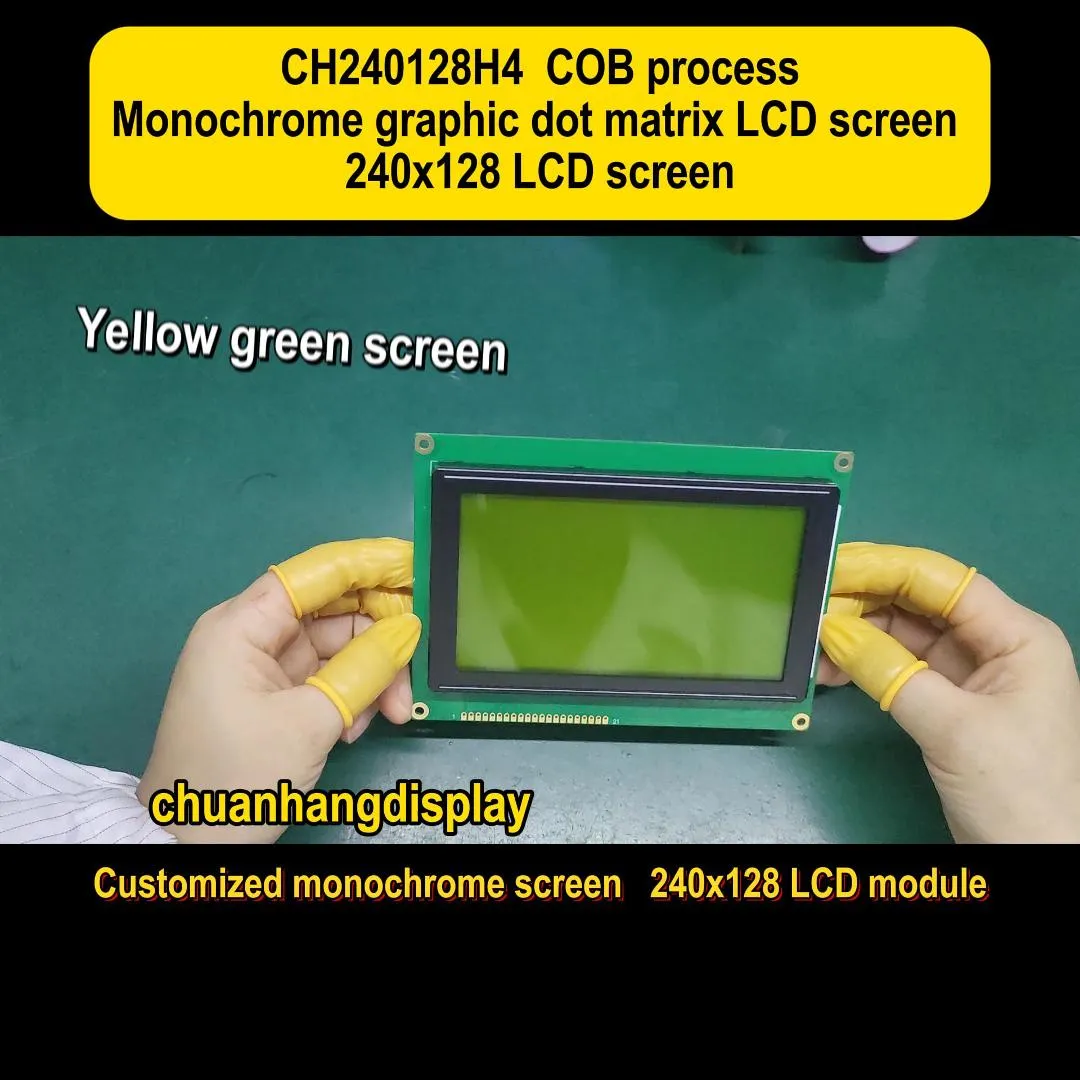
For industrial and medical applications, the 20x4 lcd display must withstand harsh conditions. Qualification testing per standards like ISO 16750 (for automotive) or IEC 60601 (for medical) is essential.
High Temperature Operating Bias (HTOB): Typically 70°C for 1000 hours, with continuous electrical bias to assess material degradation.
Temperature Humidity Bias (THB): 40°C / 90% RH for 500 hours, testing seal integrity and ITO corrosion resistance.
Thermal Shock: -20°C to +70°C, 100 cycles, to verify mechanical robustness of the glass, seal, and flex connections.
The interconnection method is a common failure point:
Pin Headers (soldered): Provide robust connection but require through-holes on the PCB. Suitable for fixed installations.
Heat Seal Connectors (HSC): Low profile but susceptible to misalignment and contamination. Used in cost-sensitive consumer goods.
Zebra (elastomeric) Connectors: Allow easy replacement but require precise mechanical pressure and are sensitive to vibration.
FPC (Flexible Printed Circuit) with ZIF Connector: Preferred for compact designs and repeated mating cycles, common in handheld instruments.
Specifying the correct connector type based on the product's lifecycle and vibration profile is critical. Chuanhang Display offers modules with all these interconnection options, validated through mechanical endurance testing.
Beyond standard off-the-shelf modules, many applications benefit from customization.
While CGRAM allows limited custom characters, some 20x4 lcd display variants can be ordered with custom CGROM masks. This is economical for volumes above 10K units and allows embedding company logos, special units (Ω, µ), or language-specific characters directly in hardware, reducing firmware overhead.
For outdoor applications, consider:
Wide-temperature LC fluid: Operating range from -30°C to +80°C.
High-brightness LED backlight: Using more LEDs or higher current (with thermal management) to overcome ambient light.
Negative voltage option: Some transflective displays perform better with a negative drive voltage for the LCD, enhancing contrast in bright sun.
Partnering with an experienced manufacturer ensures these custom requirements are met without compromising reliability.
The 20x4 lcd display remains a versatile, cost-effective solution for a vast range of applications. By understanding the nuances of controller compatibility, interface selection, optical modes, and environmental robustness, system designers can ensure a reliable and readable interface. Chuanhang Display provides engineering support from prototype to production, helping you navigate these technical choices for optimal performance and longevity.
Q1: What is the typical power consumption of a 20x4 LCD display?
A1: The LCD glass itself consumes very little, typically 1-2 mA at 5V. The backlight dominates consumption: a standard yellow-green LED backlight may draw 20-40 mA at 4.2V. Choosing a reflective mode or pulsing the backlight can significantly reduce power.
Q2: Can I display custom characters like battery symbols or arrows?
A2: Yes, the HD44780-compatible controller includes 64 bytes of CGRAM, allowing you to define up to 8 custom 5x8 characters. These can be created on the fly by your firmware.
Q3: What is the difference between STN and FSTN LCD types for a 20x4 display?
A3: STN (Super Twisted Nematic) has a yellow-green or blue background with moderate contrast. FSTN (Film-compensated STN) adds a retardation film to cancel out the inherent color, resulting in a black-on-white appearance (similar to a calculator), offering higher contrast and better readability.
Q4: How do I interface a 20x4 LCD with only two I/O pins on my microcontroller?
A4: Use an I²C backpack module (e.g., based on PCF8574). This converts the parallel interface to I²C, requiring only SDA and SCL pins. Many suppliers, including Chuanhang Display, offer 20x4 modules with this interface pre-assembled.
Q5: What is the expected lifetime of the LED backlight?
A5: Typical LED backlights have a half-life (L50) of 20,000 to 50,000 hours, depending on drive current and operating temperature. Running LEDs at lower current significantly extends lifetime. For critical applications, specify the required lifetime and ensure adequate thermal design.
Q6: My display shows faint "ghost" images or random segments lighting up. What causes this?
A6: This is often due to incorrect contrast voltage (Vo) setting, especially at temperature extremes. It can also be caused by insufficient DC-balancing in the drive waveform (if using direct drive instead of the built-in controller) or by excessive noise on the power supply lines. Verify the recommended Vo vs. temperature curve and add decoupling capacitors near the module's power pins.
Q7: Can I get a 20x4 LCD that operates at 3.3V logic?
A7: Yes, many modern 20x4 modules are designed for 3.3V operation, with compatible logic levels and an internal charge pump to generate the higher LCD drive voltage needed. Always confirm the supply voltage and logic level compatibility in the datasheet.