Full-color TFT panels and capacitive touchscreens dominate consumer electronics. Yet, embedded hardware engineers continue to specify the classic Character LCD Module for industrial, medical, and utility hardware. Why? Because industrial environments demand instant start-up times, direct sunlight legibility, immunity to electromagnetic noise, and decades of supply continuity.
When selecting a monochrome interface, engineers face a core design trade-off: Should you pick the compact 16x2 format or step up to the spacious 20x4 layout? Choosing wrong leads to either an overcrowded screen or wasted PCB surface area and unnecessary tooling expenses.
Chuanhang Display brings over 13 years of specialized engineering in monochrome liquid crystal manufacturing to this dilemma. This side-by-side technical guide compares layout mechanics, software overhead, operational power budgets, and mechanical dimensions so you can finalize your hardware bill of materials (BOM) with confidence.
Are you drafting panel cutouts for a new hardware release? Contact our engineering team at Chuanhang Display today for detailed mechanical drawings, pinout specs, or custom display samples.
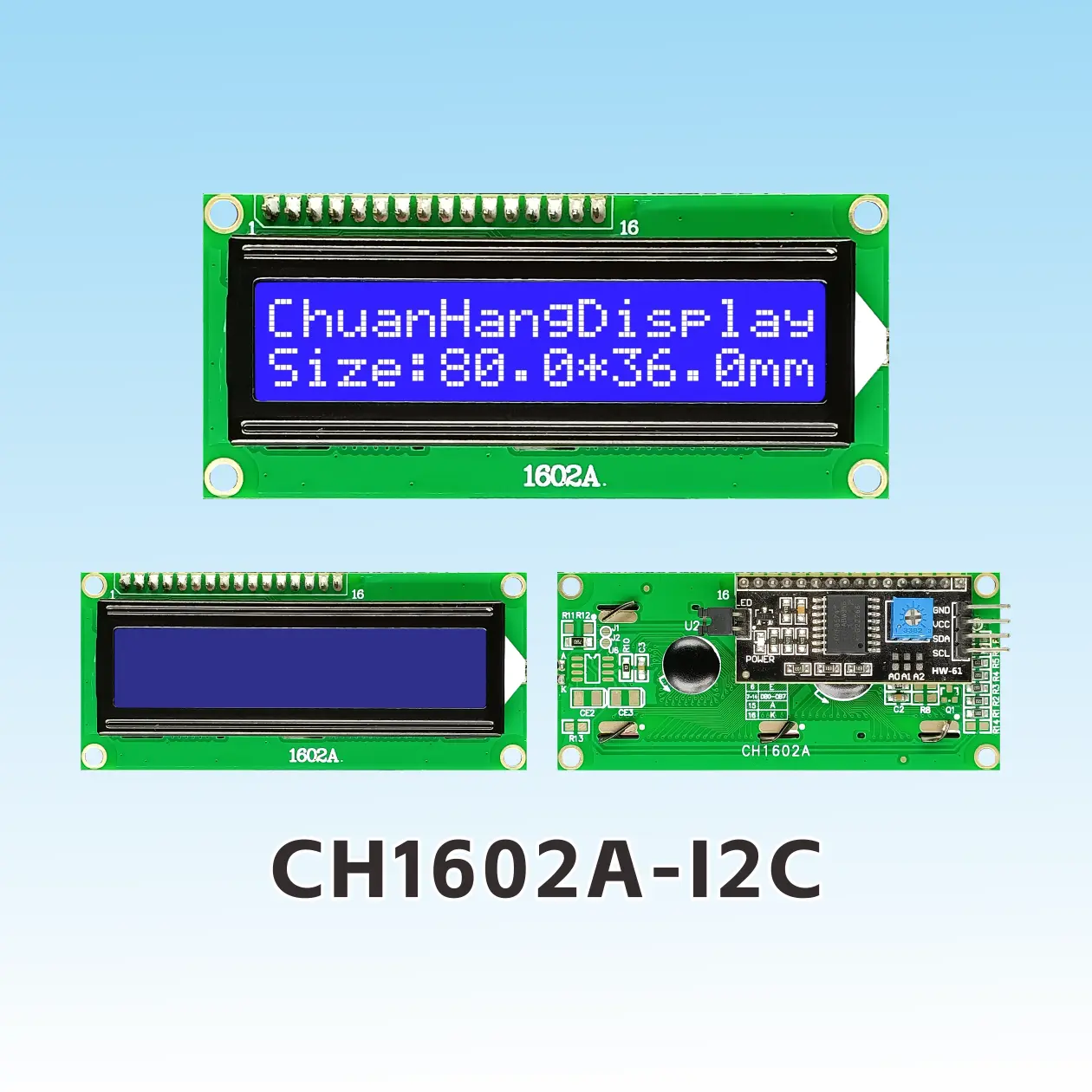
The 16x2 Character LCD Module stands as the industry benchmark for compact numerical readouts. Featuring two horizontal lines with 16 alphanumeric characters per line, it displays up to 32 total characters at once.
Most 16x2 units employ standard 5x8 dot matrix font configurations with cursor lines, driven by the classic HD44780 or equivalent SPLC780D and AIP31066 controller ICs. The assembly relies on a Chip-on-Board (COB) construction. Here, the driver semiconductor mounts directly to the back of the PCB under an epoxy blob, providing physical durability against drops and industrial vibrations.
The 16x2 Character LCD Module excels when your device needs to show a single status metric, an error code, or an alternating value pair:
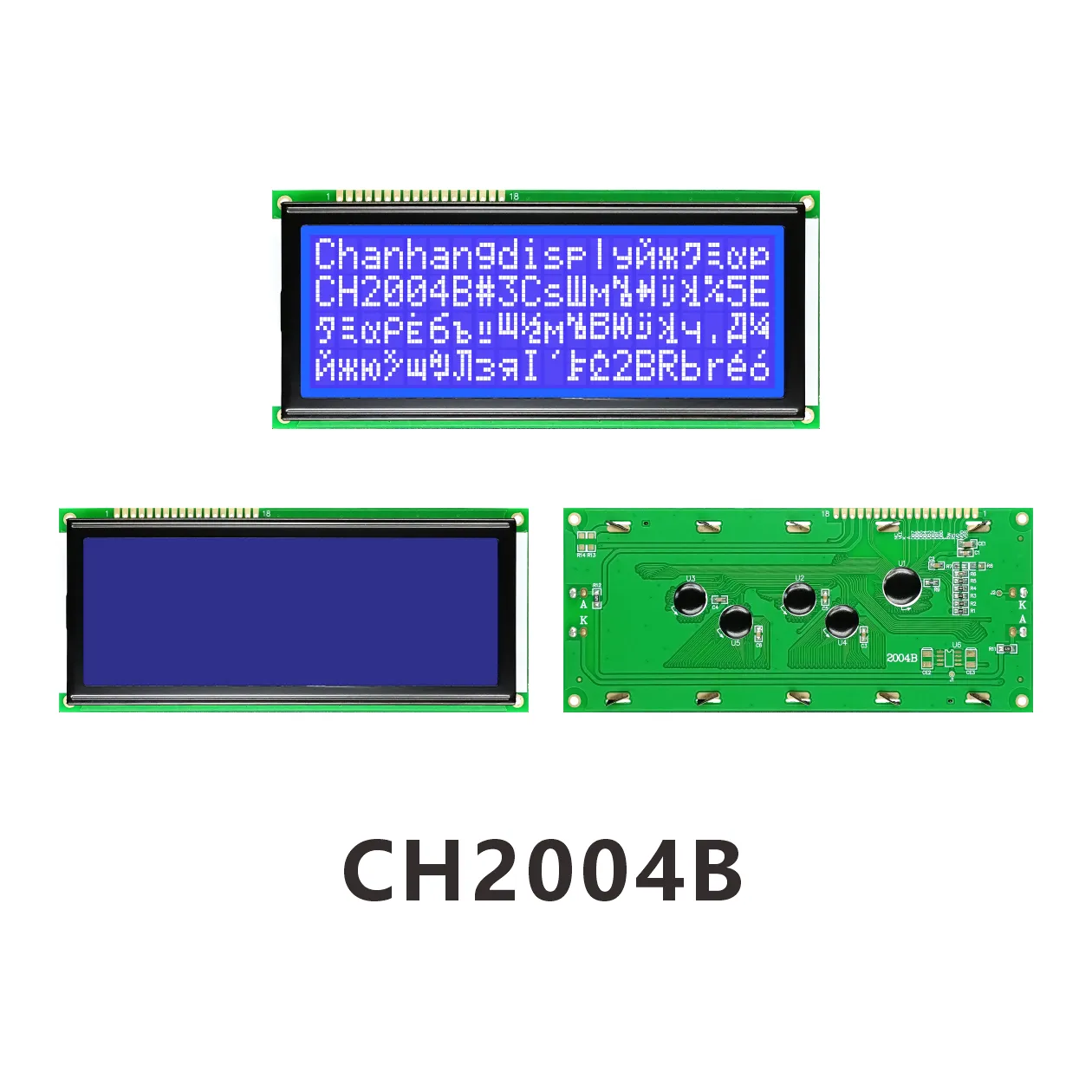
When basic readouts give way to multi-variable diagnostics and interactive system control, the 20x4 Character LCD Module takes over. This panel provides four rows containing 20 characters each—offering 80 characters of visual canvas.
That constitutes a 150% expansion in available on-screen real estate over a 16x2 display. The 20x4 unit uses the same underlying HD44780 command set, but routes control lines across split memory registers. This approach allows software routines to update individual quadrant blocks without clearing the active screen buffer.
Deploy a 20x4 module when your operator needs clear access to multi-parameter data streams:
Selecting between these two physical formats requires balancing mechanical clearances against your firmware budget. The comparison table below highlights the standard specifications Chuanhang Display manufactures for global industrial clients.
| Comparison Criteria | 16x2 Character LCD Module | 20x4 Character LCD Module |
|---|---|---|
| Total Visible Characters | 32 (16 characters x 2 rows) | 80 (20 characters x 4 rows) |
| Typical Outer Outline | 80.0 x 36.0 x 12.0 mm | 98.0 x 60.0 x 13.5 mm |
| Active Viewing Area (VA) | 64.5 x 16.4 mm | 77.0 x 25.2 mm |
| Standard Character Height | 5.55 mm | 4.75 mm - 5.55 mm (application dependent) |
| Display Architecture | Single data block, basic readouts | Multi-line telemetry, parameter matrix |
| Backlight Current draw (5V) | 15 mA to 30 mA (LED edge-lit) | 30 mA to 60 mA (LED array/edge-lit) |
| Standard Interface Options | 6800 4-bit / 8-bit Parallel, I2C, SPI | 6800 4-bit / 8-bit Parallel, I2C, SPI |
| Impact on Device Bill of Materials | Lowest unit cost option | Slightly higher unit cost; offsets secondary buttons |
Every industrial deployment involves mechanical, electrical, and operational trade-offs. Use the criteria below to decide which format suits your bill of materials.
Reliable display components require deep manufacturing expertise. Chuanhang Display began operations in 2011 as a focused production workshop in Xixiang, Bao'an. Over the past 13 years, the company has grown into an industry standard-bearer operating out of a modern 5,000-square-meter manufacturing campus.
Our operations combine automated efficiency with experienced craftsmanship. More than 100 skilled production technicians, specialized research engineers, and international account specialists support your project through every milestone—from prototype design reviews to volume shipments.
Our cleanroom infrastructure handles end-to-end monochrome and color module assembly through dedicated manufacturing lines:
Chuanhang Display produces both 16x2 and 20x4 Character LCD Module assemblies to match exacting physical constraints. We manufacture across multiple fluid technologies—including cost-effective TN, high-contrast STN Yellow-Green, STN Blue, and wide-temperature FSTN black-and-white. We also build custom backlights (white, blue, amber, green) and supply I2C or SPI bridge boards to help you conserve processor I/O pins.
Q1: Can I swap a 20x4 Character LCD Module into a system currently running a 16x2 module without changing my firmware?
A1: Not entirely. While both panels share the exact same 16-pin electrical interface and HD44780 command sets, memory addressing differs between them. Rows 1 and 2 of a 20x4 module align with 16x2 line memory, but rows 3 and 4 write to separate display RAM offsets (usually starting at 0x14 and 0x54). You must update line-wrap and cursor-position functions in your firmware to avoid garbled text.
Q2: What is the functional difference between COB and COG character displays?
A2: COB (Chip-on-Board) modules feature driver ICs mounted directly onto an integrated PCB backing, held under an epoxy drop. This is the classic, durable form factor for standard 16x2 and 20x4 displays. COG (Chip-on-Glass) designs bond the controller silicon directly to the display glass substrate itself. COG modules are substantially thinner and lighter, making them ideal for slim handheld products.
Q3: Should I select STN or FSTN mode for an outdoor industrial installation?
A3: FSTN (Film-compensated Super Twisted Nematic) offers superior visual clarity for outdoor use. Standard STN delivers good visibility with a noticeable yellow-green or blue tint, but its contrast ratio drops off at off-axis angles. FSTN incorporates an optical compensation film that produces clean black-on-white text, a wider viewing cone, and stable operation across wide temperature swings (-20°C to +70°C).
Q4: How do 16x2 and 20x4 character displays compare in total system power draw?
A4: The liquid crystal fluid itself consumes only microamps of current. Almost all operational power goes to the LED backlight. A standard 16x2 edge-lit LED backlight draws roughly 15 mA to 30 mA at 5V DC. Because a 20x4 module uses a larger light-guide plate or a full LED array to achieve even illumination, backlight current climbs to between 30 mA and 60 mA. If you are building battery-powered field devices, budget for this additional power overhead.
Q5: Can Chuanhang Display customize the connection interface and cable termination for volume orders?
A5: Yes. Chuanhang Display routinely tailors modules to meet unique customer specifications. We can convert standard 16-pin single-row headers to dual-row configurations, install pre-soldered JST or Molex wire harnesses, mount I2C/SPI daughterboards, or adjust LED resistor circuits to run natively on 3.3V power rails without requiring level-shifting hardware.
Both the 16x2 and 20x4 displays remain popular choices for industrial user interfaces. If your product demands compact dimensions, ultra-low operating currents, and a bare-bones bill of materials, the 16x2 Character LCD Module remains the standard choice. If your operator needs to manage real-time alerts, configure complex variables, and read data from across a room, the 20x4 Character LCD Module delivers the visual space your application requires.
No matter which format fits your layout, partner with a manufacturer capable of delivering long-term component stability, rigorous quality control, and factory-direct engineering support.
Ready to upgrade your equipment panel? Send an inquiry to Chuanhang Display now to request 2D/3D step files, review detailed module datasheets, and receive fast prototype quotation support for your next build.