For engineering teams integrating human-machine interfaces into medical devices, automotive dashboards, or factory automation systems, the selection of a display module often becomes a balancing act between optical performance, interface compatibility, and long-term supply stability. Among the myriad options available, the 12864 LCD display remains a workhorse—not because it is the newest technology, but because its specifications align exceptionally well with applications requiring reliable alphanumeric and basic graphic rendering under challenging environmental conditions.
This article provides a component-level examination of the 12864 LCD display. We will analyze controller architectures, compare panel material grades, discuss interface selection trade-offs, and outline a practical framework for qualifying suppliers. This is not a general overview; it is a technical reference for professionals making procurement and design-in decisions today.
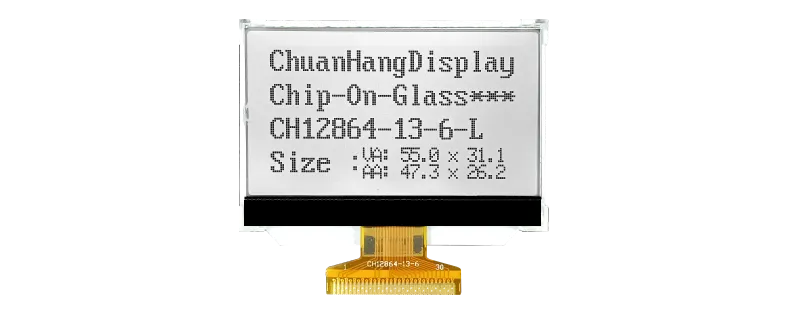
The designation "12864" refers to a pixel matrix of 128 columns by 64 rows. This resolution offers sufficient real estate to display 8 rows of 21 standard ASCII characters (using a 5x7 font) or render custom bitmap graphics for simple menus and status icons. However, understanding the display's capabilities requires examining the underlying driver IC and memory mapping.
Most modules in this category utilize either the ST7920 or KS0108 controller families.
From a system design perspective, the choice between these controllers affects PCB layout complexity and BOM cost. The ST7920's SPI mode reduces pin count from 16 to 5, freeing GPIOs on the main MCU—a significant advantage in compact designs.
The physical construction of the 12864 LCD display determines its readability. Standard modules are available in STN (Super-Twisted Nematic) and FSTN (Film-Compensated STN) types.
For outdoor equipment or high-ambient-light environments, a positive-mode FSTN with a transflective polarizer is recommended. This configuration allows ambient light to illuminate the display, reducing backlight power consumption while maintaining visibility.
The continued relevance of this resolution tier stems from its presence in mission-critical equipment where OLED or TFT panels present reliability or cost barriers.
In portable patient monitors and infusion pumps, the display must function reliably during electrostatic discharge (ESD) events and power fluctuations. The mature manufacturing processes used for the 12864 LCD display result in low leakage currents and predictable behavior across temperature extremes. For these applications, procurement specifications should mandate a -20°C to +70°C operating range and require 1000V ESD protection on the interface pins.
Human-machine interfaces (HMIs) for Programmable Logic Controllers (PLCs) frequently employ these modules. The slow refresh rate of the LCD (typically 50-70 Hz) is adequate for parameter readouts and status LEDs. More importantly, the display's simple command set reduces the processing overhead on the industrial controller, allowing it to prioritize real-time I/O scanning.
Certain vehicle diagnostic tools and fleet management terminals continue to use this resolution for menu navigation. In these cases, the module must comply with AEC-Q100 standards for component reliability. While not all 12864 LCD display modules are automotive-qualified, suppliers such as Chuanhang Display offer variants with enhanced vibration resistance and extended temperature ranges (-30°C to +80°C) that meet these criteria.
The bill of materials for a 12864 LCD display reveals significant cost drivers that vary between suppliers.
The liquid crystal material is sandwiched between two ITO-coated glass substrates. The cell gap—the distance between the substrates—must be maintained within ±0.05μm to ensure consistent threshold voltages. Inexpensive modules often use lower-grade soda-lime glass, which has higher thermal expansion coefficients. This leads to degraded performance during temperature cycling. High-reliability modules use borosilicate glass, which offers better dimensional stability.
For applications requiring long life, look for LED backlight units rated for 50,000 hours or more. Verify the forward voltage and current specifications—most modules require 3.0V to 3.3V for the logic and a separate 4.2V to 5.0V for the LCD driver, unless a built-in charge pump is used.
Pin headers are typically 2.54mm pitch. However, some compact modules use 1.0mm or 0.5mm FPC connectors. While the 2.54mm header is easier for prototyping, the FPC connector reduces the overall module height and is preferred in portable devices. When evaluating a 12864 LCD display for a new project, consider the mating connector's availability and the assembly cost—FPC connectors often require hot-bar soldering or zero-insertion-force (ZIF) sockets, which add to manufacturing complexity.
Procurement of this component involves more than comparing unit prices. The total cost of ownership includes engineering support, lead times, and failure rates.
| Specification | Price Range (USD/Unit, 1k MOQ) | Notes |
|---|---|---|
| STN, Yellow-Green, Parallel | $3.50 - $5.00 | Standard, widely available. |
| FSTN, White, SPI Interface | $6.00 - $8.50 | Better contrast; premium option. |
| FSTN, Wide Temp, LED Backlight | $9.00 - $12.00 | Industrial/Automotive grade. |
These prices are indicative as of Q2 2026. Chuanhang Display offers competitive pricing in the FSTN category, leveraging automated assembly lines to maintain consistency across batches.
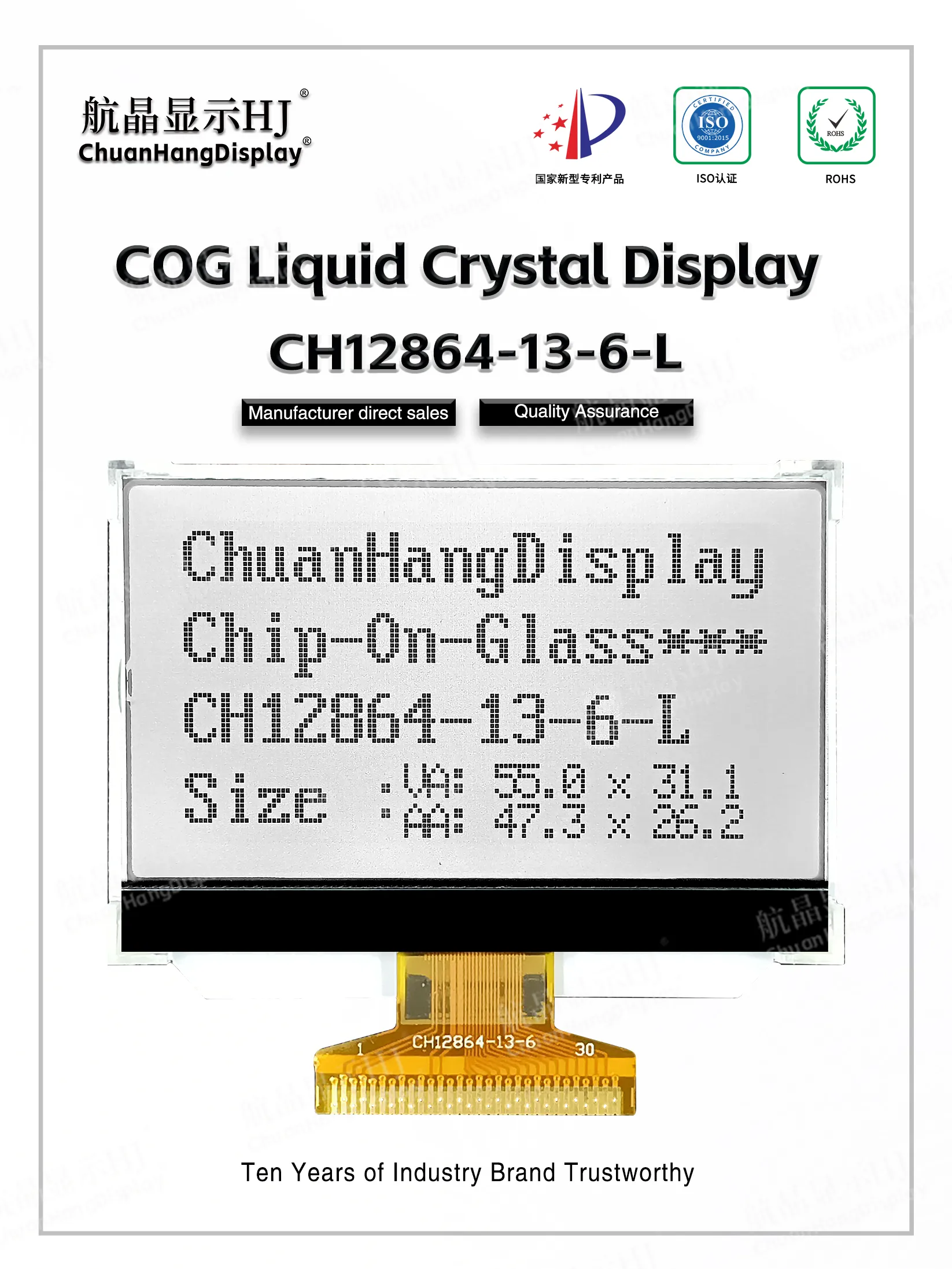
A common pitfall in B2B procurement is treating the sample unit and the mass-produced unit as identical. Subtle variations in the polarizer alignment or the backlight LED binning can occur between batches.
To mitigate these risks:
Q1: What is the difference between a 12864 LCD and a 128x64 graphic OLED display for industrial use?
A1: While the resolution is identical, the technologies differ significantly. OLEDs provide higher contrast and faster response times but suffer from burn-in and have shorter operational lifetimes (typically 30,000-50,000 hours) compared to LCDs (often exceeding 100,000 hours). Additionally, the 12864 LCD display is generally more tolerant of mechanical shock and humidity, making it preferable for harsh industrial environments where the display is exposed to oils, dust, or high vibration.
Q2: How do I select the correct operating voltage for my 12864 LCD module?
A2: The 12864 LCD display has two distinct voltage requirements: logic voltage (VDD) and LCD drive voltage (V0/VLCD). Most modules operate VDD at 3.3V or 5V. The VLCD voltage determines the contrast and typically ranges from -10V to +10V depending on the temperature. Some controllers include an internal negative voltage charge pump, eliminating the need for an external regulator. Always check the datasheet; if using a 3.3V MCU, select a module with a built-in voltage booster to avoid poor contrast.
Q3: Is the 12864 LCD display suitable for outdoor use in direct sunlight?
A3: Yes, provided you select a transflective or reflective polarizer type with a positive FSTN mode. The transflective design allows ambient light to pass through the reflective layer, illuminating the pixels without requiring the backlight. To maximize sunlight readability, avoid transmissive modules, which rely entirely on the backlight and wash out in bright conditions. Also, ensure the operating temperature range covers your geographic region.
Q4: Can I use the 12864 LCD with an I2C interface?
A4: The native interface of the KS0108 and ST7920 controllers is parallel or SPI. While there are I2C backpack adapters available on the market, they are add-on boards that convert I2C to parallel signals. Native I2C support is rare for the standard 12864 LCD display. If you require I2C, you must use an external I/O expander (e.g., PCF8574) connected to the parallel interface or verify with suppliers like Chuanhang Display if a custom firmware option exists for I2C communication.
Q5: What steps should I take to validate a supplier's quality before placing a large order?
A5: Begin with a formal supplier audit. Request their 8D (Eight Disciplines) report history for previous corrective actions. Obtain 10-20 samples from different production lots and run an HALT (Highly Accelerated Life Test) on a subset to identify failure modes. Finally, compare their COC (Certificate of Conformance) against your incoming inspection checklist. Ensure that the supplier provides comprehensive optical measurement data, including contrast ratio and response time, for each batch.
The 12864 LCD display remains a viable and cost-effective solution for a broad spectrum of B2B applications. Its technical maturity ensures stable supply chains and predictable performance, provided that engineers conduct thorough due diligence on panel materials, controller compatibility, and supplier quality processes.
As your project progresses from concept to production, the distinction between a low-cost generic module and a fully qualified industrial-grade display becomes increasingly critical. For assistance in specifying a 12864 LCD display that aligns with your specific environmental and interface requirements, we encourage you to reach out to our technical team. We can review your schematic, suggest optimizations, and provide samples for evaluation.
For a detailed quotation, technical datasheet, or to discuss custom configuration options (including specific backlight colors and touch panel integration), please submit your project requirements to our engineering support desk. We offer direct consultation to help you optimize your display subsystem for cost, performance, and longevity.
[Inquiry Button / Contact Form Link]
This guide is intended for informational purposes and represents current best practices in display module procurement. Specifications are subject to change. Always verify with your supplier's latest datasheet.