In the high-stakes environment of global electronics manufacturing, the role of a specialized lcd display factory has shifted from simple assembly to complex optical engineering. For B2B procurement professionals and hardware engineers, understanding the intricate layers of Liquid Crystal Display (LCD) production is a requirement for ensuring product longevity, performance reliability, and cost-efficiency.
The procurement of display modules is not a commodity purchase but a strategic partnership. Facilities such as Chuanhang Display represent the sophisticated intersection of semiconductor fabrication and optical science, where micron-level deviations can determine the success or failure of a multi-million dollar product line. This report examines the technical foundations, manufacturing protocols, and market dynamics that define the modern display industry.

At its core, a professional lcd display factory manages the manipulation of light through several specialized layers. Understanding these components is fundamental to specifying the right hardware for industrial or medical applications.
The backplane is the engine of the display. While consumer-grade electronics often prioritize cost, industrial-grade modules focus on stability.
Amorphous Silicon (a-Si): The most common technology, offering a balanced cost-to-performance ratio for standard industrial HMI (Human-Machine Interface).Low-Temperature Polycrystalline Silicon (LTPS): Provides higher electron mobility, allowing for higher resolutions and lower power consumption, often found in high-end handheld devices.Indium Gallium Zinc Oxide (IGZO): A newer material that supports extremely low refresh rates to save power in static image applications, such as medical monitoring.
The choice of liquid crystal mode dictates the viewing experience. An experienced lcd display factory will offer several options:
In-Plane Switching (IPS): Preferred for medical and professional creative work due to its superior color accuracy and 178-degree viewing angles.Vertical Alignment (VA): Known for high contrast ratios and deep blacks, making it ideal for high-end signage and control room displays.Twisted Nematic (TN): Though older, it remains relevant in cost-sensitive markets or high-speed shutter applications where rapid response times are paramount.
The transition from a raw glass panel (Open Cell) to a finished module occurs in highly controlled environments. This stage of production is where the quality of an lcd display factory becomes most apparent.
Display assembly must take place in ISO Class 5 or Class 6 cleanrooms. Even a microscopic dust particle trapped between the polarizer and the glass substrate will result in a visual defect. Manufacturers like Chuanhang Display utilize automated optical inspection (AOI) systems that scan every square millimeter of the panel for inconsistencies, ensuring that the "Zero Bright Pixel" standard is met for high-reliability sectors.
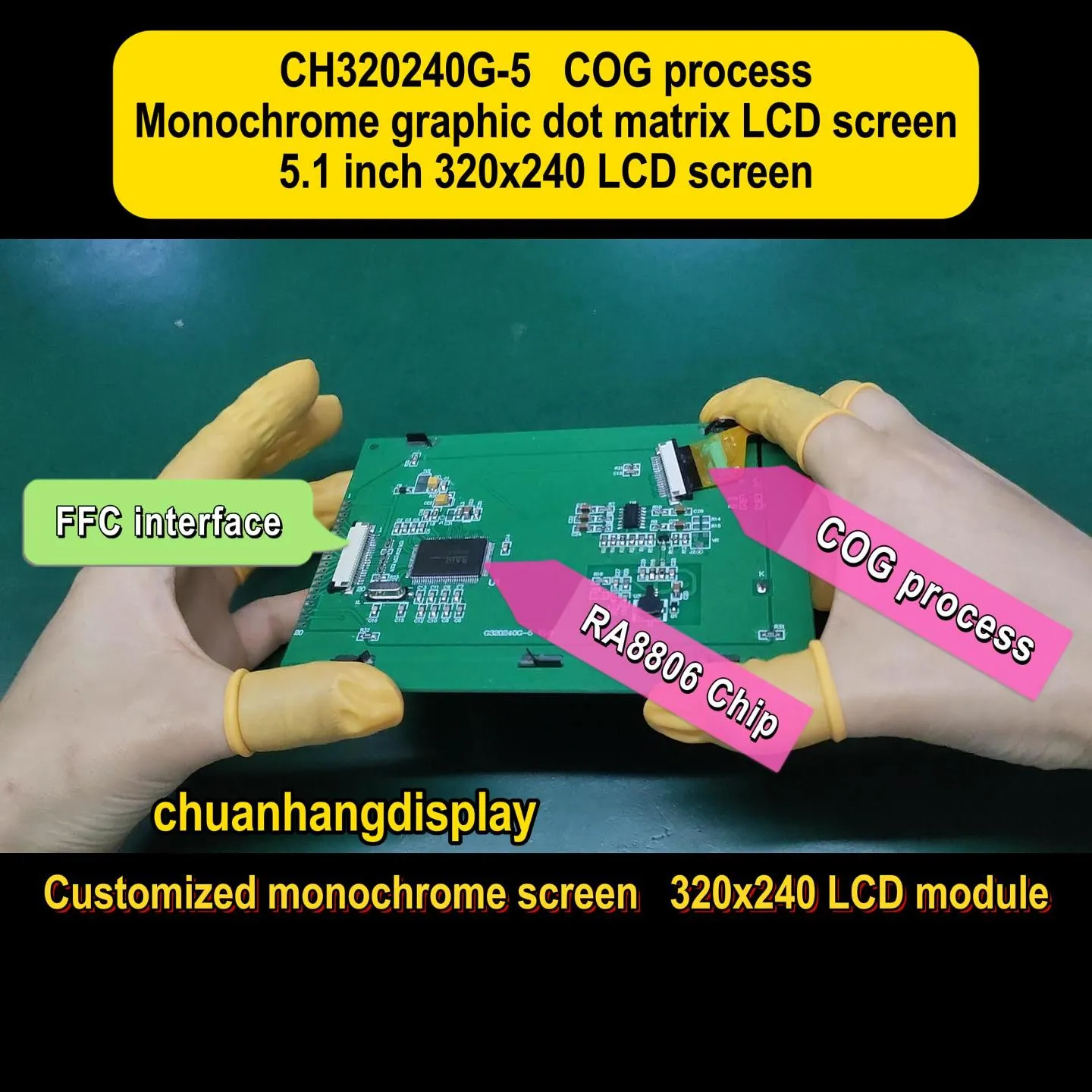
The method used to attach the driver IC (Integrated Circuit) to the display substrate determines the durability and bezel size of the final product.
Chip-on-Glass (COG): The driver IC is bonded directly onto the glass using Anisotropic Conductive Film (ACF). This is the standard for most industrial modules because it offers excellent mechanical stability and heat dissipation.Chip-on-Flex (COF): The IC is mounted on a flexible circuit. This allows the manufacturer to fold the electronics behind the display, enabling the ultra-thin bezels seen in modern smartphone and high-end automotive displays.
In demanding environments, "Air Bonding" (using a perimeter adhesive) is insufficient. Professional factories employ Optical Bonding, where the gap between the LCD and the cover glass is filled with a clear resin (OCR) or film (OCA). This process eliminates the air gap, significantly reducing internal reflections, improving sunlight readability, and preventing internal condensation in high-humidity climates.
The backlight is the primary consumer of power in an LCD. Modern engineering allows a lcd display factory to customize the BLU to meet specific luminance and color gamut requirements.
Edge-lit: LEDs are placed on the periphery, resulting in a thinner module.Direct-lit: LEDs are spread behind the panel, providing more uniform brightness and allowing for local dimming techniques to improve contrast.
To achieve high brightness without excessive power draw, factories use a stack of optical films:
Diffuser Films: Ensure uniform light distribution across the panel.Brightness Enhancement Films (BEF): Use micro-prism structures to redirect light toward the viewer, effectively increasing perceived brightness by up to 40% without increasing power consumption.Dual Brightness Enhancement Films (DBEF): Recycle polarized light that would otherwise be absorbed, further maximizing efficiency.
B2B buyers face unique challenges that do not exist in the consumer market. A top-tier lcd display factory must address these systematically.
Outdoor displays often require 1000 to 2000 nits of brightness to be visible in direct sunlight. This generates significant heat. If not managed, the liquid crystals can reach their isotropic point, causing "black spots" on the screen. Engineers must design specialized heat sinks and select high-efficiency LED drivers to maintain an optimal operating temperature.
In medical and industrial settings, Electromagnetic Interference (EMI) can disrupt display performance or interfere with sensitive nearby equipment. Quality factories implement rigorous EMI shielding on the FPC (Flexible Printed Circuit) and use low-voltage differential signaling (LVDS) or MIPI interfaces to maintain signal integrity over longer distances.
Industrial equipment often has a lifespan of 10-15 years, while consumer display components change every 18 months. A professional partner provides a clear EOL roadmap, ensuring that the form, fit, and function of the display remain consistent throughout the project lifecycle. This is a fundamental value proposition for companies like Chuanhang Display, which focus on long-term supply chain stability.
Finding the right lcd display factory requires a move beyond simple price-per-unit comparisons. Total Cost of Ownership (TCO) is the more accurate metric for B2B procurement.
When vetting a supplier, the following technical markers should be evaluated:
Vertical Integration: Does the factory have in-house SMT (Surface Mount Technology) lines and bonding facilities?R&D Depth: Can they modify the FPC layout or customize the backlight to meet specific mechanical constraints?Testing Infrastructure: Do they have on-site environmental chambers for high/low temperature, humidity, and vibration testing?
The price of a display module is primarily driven by:
Panel Grade: A-grade panels (zero defects) carry a premium over B-grade panels (minor pixel defects).Customization Level: Bespoke cover glass, specialized coatings (Anti-Reflective/Anti-Glare), and high-nit backlights increase the BOM (Bill of Materials).Volume and Lead Times: The current semiconductor market and glass substrate availability can cause price fluctuations of 5-15% within a single quarter.
The display industry is currently transitioning toward higher efficiency and better visual performance.
By using thousands of tiny LEDs instead of dozens of standard ones, a lcd display factory can achieve "Local Dimming." This results in contrast ratios that approach OLED levels while maintaining the 50,000+ hour lifespan required for industrial applications.
The addition of a Quantum Dot layer allows for an exceptionally wide color gamut, reaching over 90% of the DCI-P3 color space. This is becoming a standard requirement in surgical monitors and professional broadcast displays.
For battery-operated outdoor equipment, transflective LCDs remain a vital technology. By reflecting ambient sunlight, these displays become more readable as the environment gets brighter, allowing the backlight to be turned down or off entirely to conserve energy.
In the B2B sector, compliance is not optional. A reputable lcd display factory must adhere to global standards to ensure market access and safety.
ISO 9001 & 14001: For quality and environmental management.IATF 16949: The stringent quality standard for the automotive supply chain.IEC 60601-1: For displays intended for medical electrical equipment.RoHS and REACH: Ensuring the absence of hazardous substances in the glass, solder, and plastics.
Selecting an lcd display factory is a decision that impacts the entire lifecycle of a hardware product. From the initial engineering of the TFT backplane to the final optical bonding of the cover lens, each step requires deep technical expertise and rigorous quality control. By focusing on engineering excellence, thermal management, and long-term component availability, manufacturers like Chuanhang Display provide the foundational technology that powers modern industry, healthcare, and transportation. Success in this field is found in the details of the specification sheet and the reliability of the manufacturing process.
Q1: What are the main causes of "ghosting" or image sticking in industrial LCDs?
A1: Image sticking occurs when a static image is displayed for too long, causing a residual charge buildup in the liquid crystal layer. A high-quality lcd display factory mitigates this by using high-purity liquid crystal materials and optimizing the Vcom (Common Voltage) calibration during the manufacturing process to ensure the DC component is minimized.
Q2: How does high-altitude operation affect LCD performance?
A2: In unpressurized environments, lower air density reduces the efficiency of convective cooling. Furthermore, the pressure differential can affect the air gap in non-bonded displays. For high-altitude applications, optical bonding is recommended to provide structural integrity and prevent moisture ingress during pressure changes.
Q3: What is the difference between "Nits" and "Lumens" in display specifications?
A3: Lumens measure the total amount of light emitted by a source in all directions, whereas Nits (candelas per square meter) measure the luminance of the display as seen from the front. For an lcd display factory, the Nit rating is the primary metric for determining sunlight readability.
Q4: Can an LCD module be customized for use with thick industrial gloves?
A4: Yes. This is achieved through the tuning of the Projected Capacitive (PCAP) touch controller. The factory can adjust the sensitivity thresholds and signal-to-noise ratios within the firmware to allow for touch detection through heavy gloves or even glass overlays up to 10mm thick.
Q5: Why do some displays appear to have a "yellowish" tint over time?
A5: This is typically due to the degradation of the blue LED chips in the backlight or the yellowing of the optical adhesive/diffuser films due to UV exposure. Professional-grade factories use UV-stabilized films and high-bin LEDs with superior thermal stability to prevent this color shift throughout the display's operational life.
Q6: What is the impact of "bit depth" on display color?
A6: Bit depth refers to the number of colors a pixel can display. A 6-bit display can show 262,144 colors, while an 8-bit display can show 16.7 million. For professional applications, an lcd display factory often uses Frame Rate Control (FRC) to simulate higher bit depths, which is vital for smooth grayscale gradients in medical imaging.