

The COG LCD Module (Chip-on-Glass Liquid Crystal Display) represents a significant evolution in display packaging, where the driver IC is directly mounted onto the glass substrate. This technology eliminates the need for a traditional printed circuit board (PCB) and reduces interconnect complexity. As a leading manufacturer, Chuanhang Display has perfected COG production for applications requiring ultra-thin profiles, high reliability, and cost-effectiveness. In this comprehensive guide, we explore the architecture, benefits, design considerations, and future of COG LCD modules.
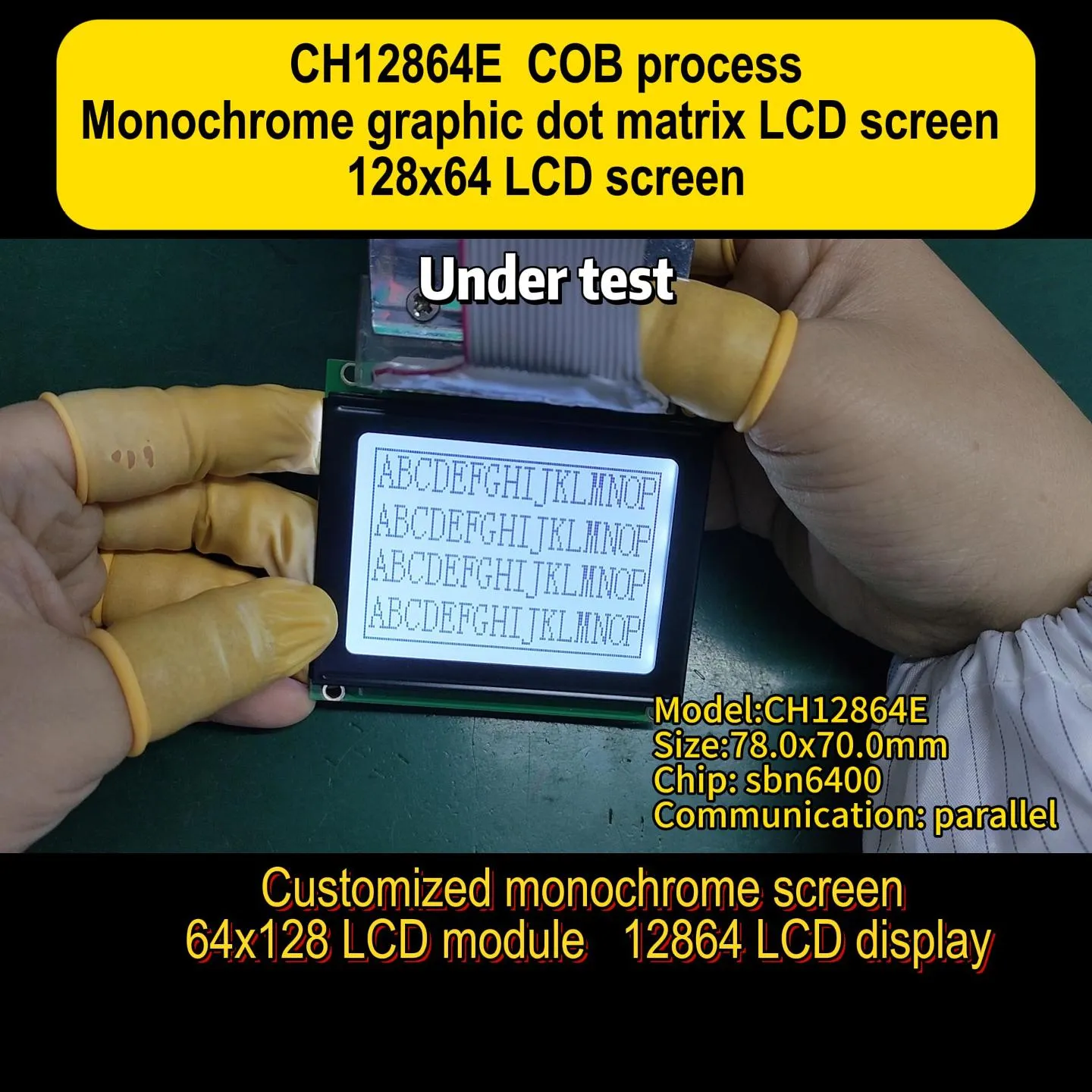
1. What is a COG LCD Module? Understanding Chip-on-Glass Construction
A COG LCD Module integrates the LCD controller/driver IC directly onto the glass panel using anisotropic conductive film (ACF) bonding. This contrasts with traditional COB (Chip-on-Board) where the IC is mounted on a PCB and connected via elastomeric connectors or flexible circuits. The COG approach minimizes the module's footprint and thickness, making it ideal for compact devices.
1.1. Key Components of a COG LCD Module
Glass substrate: Contains the ITO (Indium Tin Oxide) electrodes and alignment layers.
Driver IC: Mounted directly on the glass, typically with gold bumps bonded via ACF.
FPC (Flexible Printed Circuit): Connects the glass to the main system board, often with a minimalist design.
Backlight: Usually edge-lit LED, attached to the FPC or glass edge.
1.2. COG vs. COB: Technical Comparison
Thickness: COG modules can be as thin as 1.5mm, compared to 3-5mm for COB.
Reliability: Fewer mechanical connections reduce failure points; ACF bonding is highly durable under vibration.
Viewing area: COG allows a narrower bezel and larger active area relative to module size.
Cost: At high volumes, COG eliminates PCB and connector costs, offering significant savings.
Engineers often select a COG LCD Module when space is at a premium, such as in wearables, smart meters, and medical handhelds.
2. Why COG LCD Modules Dominate in Space-Constrained Applications
The shift toward miniaturization across industries has accelerated adoption of COG technology. Here are the quantifiable benefits of using a COG LCD Module in your next design.
Ultra-thin profile: Typical thickness ≤2.0 mm, enabling sleek product designs.
High pixel density: COG supports finer electrode pitches, allowing more segments or dots in a small area—ideal for icon-rich displays.
Low power consumption: The direct chip connection reduces parasitic capacitance, lowering drive voltages and overall power draw.
Enhanced optical performance: Fewer layers between glass and viewer improve brightness and contrast.
3. Critical Applications of COG LCD Modules Across Industries
From medical infusion pumps to automotive climate control panels, the COG LCD Module has become the backbone of human-machine interfaces. Below we analyze real-world use cases.
3.1. Medical Devices: Portable and Wearable Monitors
Blood glucose meters, pulse oximeters, and wearable ECG patches require displays that are lightweight and low-power. COG modules with transflective polarizers provide excellent sunlight readability while maintaining a slim profile. Chuanhang Display offers medical-grade COG displays with biocompatible materials and extended temperature ranges for sterilization processes.
3.2. Smart Meters and Industrial Instrumentation
Utility meters (water, gas, electricity) often operate for decades on battery power. COG LCD modules with low-duty drive and wide operating temperature (-30°C to +80°C) ensure reliable readout in outdoor environments. Their inherent ruggedness withstands humidity and thermal cycling.
3.3. Automotive Aftermarket and Telematics
Compact displays for tire pressure monitoring systems (TPMS), hands-free calling units, and dash cams leverage COG technology for vibration resistance and minimal weight. AEC-Q qualified driver ICs are available for automotive-grade modules.
4. Design Challenges When Integrating COG LCD Modules and How to Overcome Them
Despite its advantages, designing with a COG LCD Module requires attention to specific pitfalls. Here are expert solutions from Chuanhang Display's engineering team.
4.1. Mechanical Stress on Glass
Because the IC is bonded directly to glass, mechanical shock can crack the die or glass. Solution: Use a protective epoxy glob top or a metal frame that distributes stress. Additionally, specify thicker glass (0.7mm instead of 0.55mm) for high-vibration environments.
4.2. Signal Integrity and Noise
The fine pitch traces on glass can pick up noise, causing display flicker. Solution: Keep FPC lengths short and use shielded FPC designs. Incorporate decoupling capacitors near the glass interface. Our COG LCD Module portfolio includes optional EMI shielding layers.
4.3. Bonding Reliability Over Temperature
ACF connections can degrade under extreme temperature cycles. Solution: Choose modules with high-Tg ACF materials and perform accelerated life testing. Chuanhang Display validates all COG modules with thermal shock tests (-40°C to +85°C, 100 cycles).
4.4. Custom Segment Design
Creating custom icons or segment arrangements requires precise layout. Solution: Partner with a manufacturer that offers in-house CAD and mask design. We provide complete design-for-manufacturing (DFM) reviews to ensure first-pass success.
5. How to Select the Right COG LCD Module for Your Project
Choosing a COG LCD Module involves evaluating both technical specifications and supply chain factors. Use this checklist to make an informed decision.
Display type: Segmented (numeric/icons) or dot-matrix (character/graphic). COG supports both, with resolutions up to 128×64 common.
Viewing angle and polarizer: TN for cost, STN for better contrast, FSTN for true black-on-white; choose transmissive, reflective, or transflective based on ambient light.
Interface: Parallel, I²C, SPI, or custom serial. Ensure compatibility with your MCU voltage (1.8V to 5V).
Operating temperature: Commercial (0~50°C) vs. industrial (-20~70°C) vs. automotive (-40~85°C).
Backlight: LED edge-lit with various colors; consider brightness (cd/m²) and lifetime (≥50,000 hours).
Mechanical outline: Glass size, active area, FPC length and connector type (ZIF, solder pads, etc.).
Chuanhang Display offers a wide range of standard COG modules and rapid customization—from glass tooling to firmware modifications—ensuring a perfect fit for your enclosure and electrical interface.

6. Chuanhang Display: Excellence in COG LCD Module Engineering
With two decades of experience in liquid crystal display manufacturing, Chuanhang Display has become a trusted partner for global OEMs requiring high-reliability COG LCD Module solutions. Our state-of-the-art COG production lines feature class 1000 cleanrooms, automated ACF bonding, and in-house IC programming. Every module undergoes rigorous electrical and optical inspection, backed by ISO9001 and IATF16949 certifications. Whether you need a standard 128×64 graphic COG or a custom segmented display with specific icons, our team provides end-to-end support—from design concept to volume delivery.
7. The Future of COG LCD Modules: Innovations and Market Outlook
The COG LCD Module continues to evolve alongside advancements in materials and driver technology. Emerging trends include:
Embedded color filters: COG color LCDs are becoming feasible for low-cost, low-power color applications (e.g., wearable fitness trackers).
Integration with touch: Capacitive touch sensors can be fabricated directly on the COG glass, creating a touch display without a separate layer.
Ultra-low power modes: New driver ICs feature deep sleep modes drawing
<1µa, extending="" battery="" life="" in="" iot="" sensors.="">
Flexible COG: Research into flexible glass and thin-film encapsulation may lead to bendable COG modules for novel form factors.
Despite competition from OLED and e-paper, COG LCD remains the cost-performance leader for high-volume applications that require durability and sunlight readability.
Frequently Asked Questions (FAQ) about COG LCD Modules
Q1: What exactly does "Chip-on-Glass" mean?
A1: Chip-on-Glass (COG) refers to a mounting technology where the LCD driver IC is directly bonded onto the glass substrate of the display using anisotropic conductive film (ACF). This eliminates the need for a separate PCB, reducing thickness and improving reliability.
Q2: Are COG LCD modules more reliable than COB modules?
A2: In many aspects, yes. COG modules have fewer interconnects and no elastomeric connectors, making them more resistant to shock and vibration. However, proper mechanical protection (like a bezel) is necessary to prevent glass stress. High-quality manufacturers like Chuanhang Display design for long-term durability.
Q3: Can I use a COG LCD module in outdoor applications?
A3: Absolutely. By choosing a transflective polarizer and a high-brightness LED backlight (≥1000 cd/m²), COG displays perform exceptionally well in direct sunlight. FSTN positive mode further enhances contrast.
Q4: What is the typical lifespan of a COG LCD module?
A4: With proper design and quality components, COG modules can exceed 100,000 hours of operation. LED backlights typically have a half-life of 50,000–100,000 hours. The glass and IC themselves have virtually unlimited life under normal conditions.
Q5: How do I interface a COG LCD with a 3.3V microcontroller?
A5: Many COG modules are designed for 3.3V operation directly. If the module is 5V-only, you may need level shifters. It's best to specify a 3.3V-compatible driver IC during selection. Our COG LCD Module lineup includes 1.8V to 5V options with built-in charge pumps.
Q6: Can Chuanhang Display develop a custom COG LCD with my specific segment layout and icons?
A6: Yes, we offer full custom COG development—from glass pattern design, IC selection, to FPC layout. Our engineering team will guide you through the tooling process and provide samples within 4-6 weeks. Contact us via the contact page to start your project.
In conclusion, the COG LCD Module stands as a testament to engineering ingenuity—delivering slim, reliable, and cost-effective displays for the most demanding applications. By partnering with an experienced manufacturer like Chuanhang Display, you ensure your product benefits from cutting-edge COG technology backed by decades of expertise. For further technical inquiries or to request a quote, please reach out through our official channels.