The distinction between a display assembly operation and a fully integrated LCD factory is rarely visible on a datasheet, yet it determines every aspect of product reliability, supply stability, and total cost of ownership. For engineering teams and procurement professionals sourcing displays for medical devices, industrial control systems, or transportation infrastructure, understanding what happens inside the facility—from the TFT array deposition to the final optical bonding—is essential to risk mitigation.
A genuine LCD factory operates with semiconductor-grade discipline. The processes involved—photolithography, alignment layer curing, liquid crystal injection, and module assembly—require environmental controls that commodity assemblers simply cannot replicate. This article provides a technical framework for evaluating manufacturing partners, focusing on process validation, material traceability, and the engineering depth required to support long-lifecycle products.

Not every facility that produces display modules qualifies as a true LCD factory. The industry has a sharp divide between vertically integrated manufacturers that control TFT cell fabrication and assembly houses that purchase open-cell panels for backlight and touch integration.
The TFT array is the foundation of any active-matrix LCD. This process occurs in cleanrooms rated at Class 10 or better (ISO 4), where particle counts are rigorously controlled. Steps include:
A LCD factory with in-house TFT fabrication offers distinct advantages: custom glass sizes, tighter control over electrical characteristics, and the ability to maintain consistent production across batches. Facilities that outsource TFT cells have limited ability to modify key parameters such as aperture ratio or parasitic capacitance.
Following TFT fabrication, the alignment layer (polyimide) is applied and rubbed to create microscopic grooves that orient the liquid crystal molecules. The two glass substrates—TFT array and color filter—are then bonded together with precisely controlled cell gaps (typically 3 to 5 microns). Deviations in cell gap directly affect response time and optical uniformity.
After cell cutting and polarizer attachment, the module assembly stage includes backlight integration, driver IC bonding (COG or COF), and PCB assembly. This stage requires ESD-controlled environments, as the driver ICs and bonding areas are highly sensitive to electrostatic discharge.
When evaluating a potential LCD factory, procurement teams should request specific quality data that reflects process stability rather than simply reviewing ISO certificates.
A high-performance LCD factory maintains first-pass yield rates above 95% for standard products. More revealing than the yield percentage is the defect classification:
Manufacturers should provide detailed failure analysis reports, including optical inspection and electrical testing data from every stage of production. Suppliers that cannot trace defects to specific process steps often lack the process control infrastructure needed for high-reliability applications.
Accelerated lifecycle testing validates manufacturing robustness. A qualified LCD factory conducts:
These tests expose weak points such as adhesive failures, polarizer shrinkage, and driver IC bonding degradation. Requesting historical test data across multiple production lots reveals whether quality is consistent or varies batch to batch.
The quality of the final display is fundamentally constrained by the raw materials used. A reputable LCD factory maintains full traceability from incoming materials to finished goods.
Leading manufacturers source glass from Corning (Eagle XG, Lotus NXT) or AGC (AN100). These materials offer high strain points and dimensional stability during thermal processing. Inferior glass—often sourced from lower-tier suppliers—can warp during the alignment layer curing process, causing mura defects that only appear after the product is deployed.
Polarizer durability is critical for outdoor or high-humidity applications. High-grade polarizers from Nitto Denko or Sumitomo use TAC (triacetyl cellulose) or COP (cyclo-olefin polymer) substrates with UV-resistant adhesives. Lower-cost suppliers often use polarizers that yellow or delaminate within 12 to 24 months under UV exposure.
Driver ICs from Texas Instruments, Renesas, or Novatek offer predictable supply and long-term availability. Similarly, backlight LEDs from Nichia, Samsung, or Lumileds provide consistent color temperature and luminous decay curves. A LCD factory that maintains relationships with these tier-one component suppliers demonstrates supply chain discipline.
Industrial and medical applications increasingly require displays that do not conform to standard consumer sizes or interfaces. A flexible LCD factory offers customization across several dimensions.
A LCD factory with in-house optical bonding and CNC glass processing can significantly reduce lead times compared to suppliers that outsource these steps to separate subcontractors.
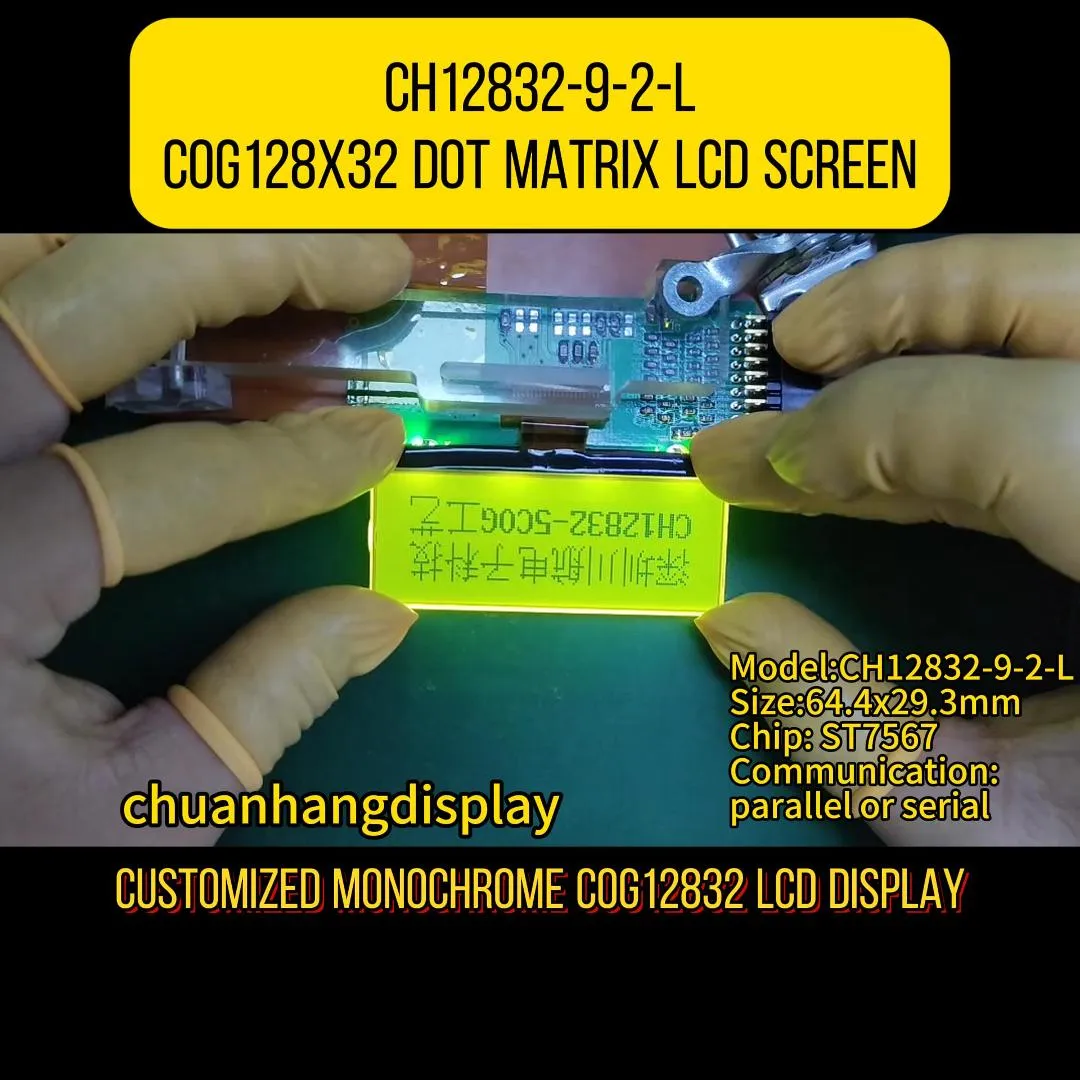
Chuanhang Display exemplifies this integrated approach, combining in-house TFT module assembly with precision optical bonding and rigorous environmental validation, enabling clients to move from concept to production with consistent quality across high-volume orders.
For equipment with expected lifecycles of 10 to 15 years, supply continuity is as important as initial quality. Consumer-oriented LCD factories frequently discontinue panels with minimal notice, forcing OEMs into costly redesigns.
A reliable LCD factory should provide:
Component changes—whether in backlight LEDs, driver ICs, or polarizer materials—can alter electrical timing, optical performance, or reliability characteristics. A professional LCD factory provides advance notice of such changes and offers qualification samples before production transition.
Initial unit price remains a factor, but experienced procurement organizations evaluate total cost of ownership (TCO) across the product lifecycle.
Selecting a LCD factory solely on unit price introduces risks including:
A TCO analysis typically reveals that a moderately higher initial price from a process-controlled manufacturer yields lower lifecycle costs than repeated qualification cycles and field returns.
The choice of a manufacturing partner extends far beyond comparing brightness and resolution specifications. A true LCD factory with semiconductor-grade process controls, comprehensive material traceability, and robust lifecycle management delivers consistent quality across production runs and over years of field operation.
For applications where reliability is not optional—medical diagnostics, industrial automation, transportation systems—the engineering team must evaluate the factory itself, not just the product sample. Process data, cleanroom standards, material sourcing, and supply continuity policies provide far more insight into long-term performance than a marketing brochure.
By prioritizing manufacturers with vertically integrated capabilities and transparent quality systems, procurement organizations can secure display solutions that maintain performance integrity across the entire product lifecycle.
Q1: What key indicators should I look for when auditing an LCD factory?
A1: Focus on cleanroom classification (minimum Class 100 / ISO 5 for module assembly; Class 10 / ISO 4 for TFT fabrication), ESD control measures, and in-process inspection points. Request yield data and failure analysis reports. A professional LCD factory will provide access to quality records and demonstrate traceability from raw materials to finished modules. Additionally, verify the presence of in-house environmental testing chambers rather than reliance on third-party labs.
Q2: How does a factory's choice of polarizer material affect long-term reliability?
A2: Polarizers are among the most vulnerable components in outdoor or high-humidity environments. Premium polarizers use TAC or COP substrates with UV-stable adhesives, offering 5+ years of outdoor durability. Lower-quality polarizers—often used by cost-focused factories—yellow, shrink, or delaminate after 12–24 months under sunlight or elevated temperature conditions, leading to irreversible contrast degradation.
Q3: What is the typical lead time for custom LCDs from a manufacturing perspective?
A3: Lead times vary based on customization depth. Semi-custom modifications (cover glass shape, touch integration, brightness adjustments) typically require 8 to 12 weeks after design finalization. Full custom TFT development—requiring new mask sets—requires 6 to 12 months, including mask fabrication, pilot runs, and reliability validation. A responsive LCD factory provides clear timelines and maintains open communication throughout the engineering sample phase.
Q4: How can I verify that a factory can support long-term supply for a 10-year product lifecycle?
A4: Request written lifecycle management policies, including minimum active period guarantees and last-time-buy notification terms. Review the factory's component sourcing strategy—facilities that use multiple qualified sources for driver ICs, LEDs, and other critical components can better manage supply continuity. Additionally, evaluate whether the LCD factory maintains engineering resources to develop form-fit-function replacements if original components become obsolete.
Q5: What is the significance of mother glass generation in LCD manufacturing?
A5: Mother glass generation refers to the size of the glass substrate used in TFT fabrication. Larger generations (G6, G8.5) enable higher output and lower per-unit costs for high-volume standard sizes. However, for industrial and medical applications with moderate volumes and custom sizes, a LCD factory using smaller mother glass generations (G3.5, G4.5, G5) may offer more flexible scheduling, faster tooling changeovers, and lower engineering NRE costs. The optimal choice depends on volume, customization requirements, and desired supply flexibility.