In the modern landscape of industrial design and electronic instrumentation, the demand for miniaturization without compromising visual clarity has led to the widespread adoption of specific packaging technologies. Among these, the [cog lcd display] (Chip-on-Glass) stands as a primary solution for engineers seeking to minimize the footprint of the display system while maintaining high reliability. Unlike traditional Chip-on-Board (COB) methods, where the driver integrated circuit (IC) is mounted on a separate PCB, COG technology involves the direct mounting of the driver IC onto the glass substrate of the liquid crystal display.

The fundamental shift in a [cog lcd display] is the elimination of the secondary PCB for IC mounting. This is achieved by utilizing the unused "periphery" or "ledge" of the LCD's bottom glass. The driver IC is flipped and bonded directly to the Indium Tin Oxide (ITO) traces on the glass.
The electrical connection between the IC and the glass substrate is facilitated through Anisotropic Conductive Film (ACF). This material consists of a thermosetting resin impregnated with conductive particles, typically gold-plated plastic spheres or nickel particles.
Alignment: The driver IC, which features gold bumps on its active side, is precision-aligned with the ITO patterns on the glass.Thermosonic/Thermocompression Bonding: Heat and pressure are applied simultaneously. This causes the ACF resin to flow while the conductive particles are trapped between the IC’s gold bumps and the ITO traces.Conductivity: Electrical conduction occurs only in the Z-axis (vertical), while the insulation remains intact in the X and Y axes, preventing short circuits between adjacent fine-pitch pads.
Chuanhang Display utilizes high-precision automated bonding lines to ensure that the alignment tolerance is kept within microns, which is a prerequisite for high-density dot matrix modules.
The performance of a [cog lcd display] is heavily dependent on the quality of its constituent materials. When sourcing these modules, understanding the technical specifications of each layer is vital for long-term field performance.
The glass substrate must have high planarity and thermal stability. For COG applications, the sheet resistance of the ITO (measured in Ohms per square) is a major factor. Lower resistance is preferred for larger displays or those with high multiplex rates to prevent ghosting and ensure uniform contrast across the panel.
The IC is the "brain" of the display. Leading manufacturers often source ICs from specialized foundries such as Sitronix, Ilitek, or Solomon Systech. For a [cog lcd display], the IC must be specifically designed for flip-chip mounting. The choice of IC determines the supported duty cycles, bias voltages, and the availability of internal temperature compensation—a feature necessary for outdoor applications where liquid crystal viscosity changes with ambient heat.
While the IC is on the glass, a connection to the host microcontroller is still required. This is handled by an FPC. The FPC is bonded to the glass using a similar ACF process. The durability of this bond determines the module's resistance to vibration and mechanical stress.
When evaluating display architectures, COG offers several distinct advantages over COB and COF (Chip-on-Film) configurations:
Significant Volume Reduction: By removing the bulky PCB behind the display, the total thickness of the module can be reduced to as little as 2mm (excluding the backlight).Weight Efficiency: The reduction in components leads to a lighter overall device, which is a major requirement for handheld medical devices and portable gas detectors.Cost-Effectiveness at Scale: While the initial tooling and NRE (Non-Recurring Engineering) for COG can be higher, the unit cost in mass production is lower due to the reduction in raw materials (no PCB, fewer pins, and simplified assembly).Improved Signal Integrity: Shorter paths between the driver IC and the liquid crystal cells reduce parasitic capacitance and improve the response time of the display.
Chuanhang Display focuses on optimizing these advantages by offering semi-custom COG solutions that allow for tailored FPC lengths and backlight brightness levels, meeting the specific mechanical constraints of specialized enclosures.
The [cog lcd display] has become the standard for sectors where space is at a premium and reliability is non-negotiable.
Handheld pulse oximeters, blood glucose monitors, and portable ultrasound units require high-resolution monochrome or small-scale color displays. The COG architecture allows these devices to remain ergonomic while providing clear, high-contrast data readouts.
In power meters and flow controllers, the display must function for decades. COG modules are preferred here because they have fewer points of failure than COB modules, which rely on elastomeric connectors (zebra strips) or through-hole soldering that can degrade over time due to oxidation or thermal expansion.
White-on-black VA (Vertical Alignment) type LCDs in COG packaging are frequently used in automotive clocks and climate control panels. They offer wide viewing angles and a premium aesthetic without requiring the complex cooling or high power consumption of full-TFT systems.
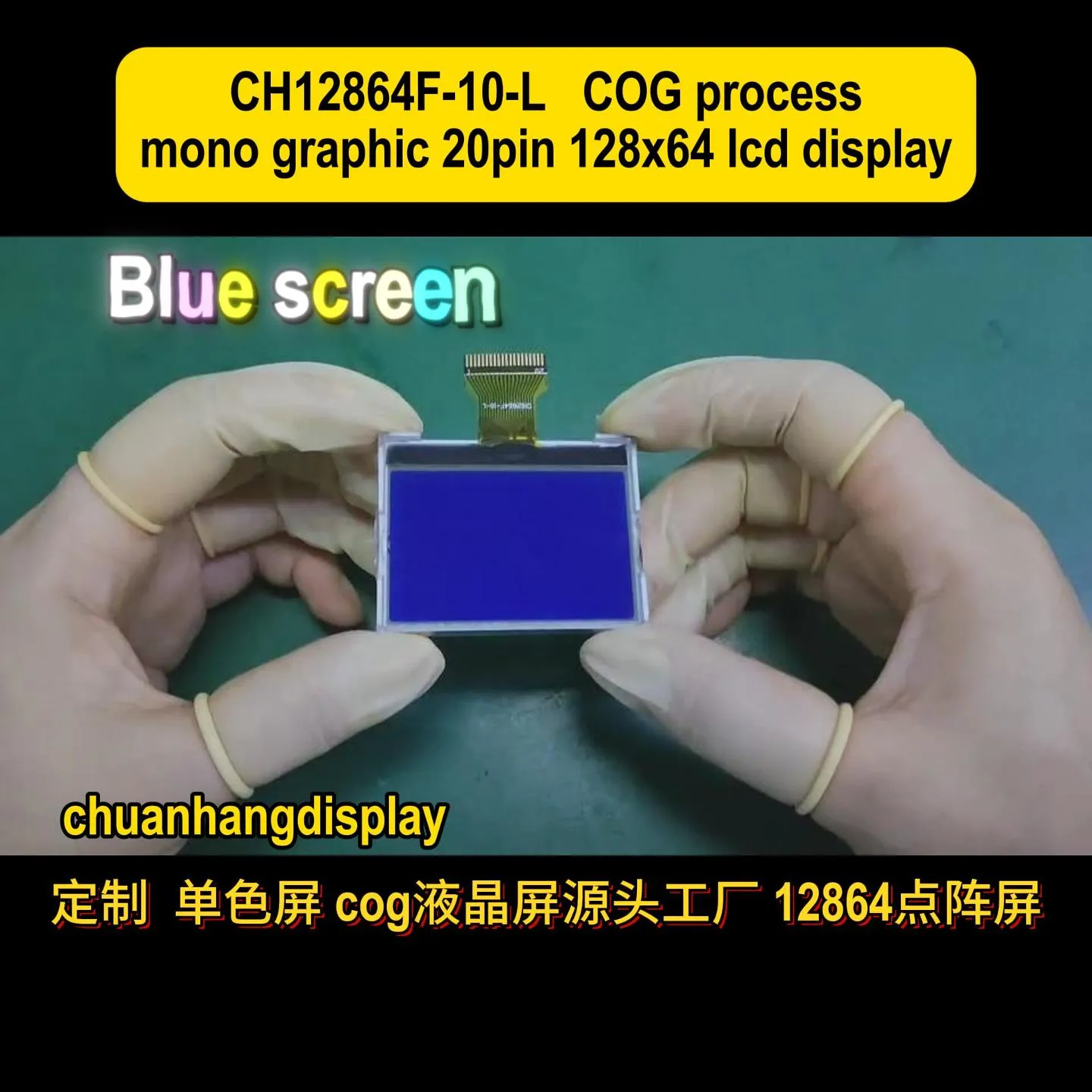
Despite the benefits, there are technical challenges that [cog lcd display] manufacturers must address to ensure a high-quality end product.
Because the driver IC is exposed on the glass ledge, it is vulnerable to physical damage and "chipping." High-end manufacturers apply a protective epoxy "chip-coat" or "silicone cover" over the IC and the ACF bond area. This seal protects the delicate gold-bump connections from moisture ingress and mechanical impact.
Glass and silicon have different coefficients of thermal expansion (CTE). In environments with extreme temperature fluctuations, this mismatch can put stress on the ACF bond. Advanced testing protocols, including thermal cycling from -40°C to +85°C, are required to validate the integrity of the electrical path.
In the B2B world, the discontinuation of a specific driver IC can jeopardize a multi-year project. Reliable partners provide longevity support, ensuring that if a specific IC reaches its end-of-life, a pin-compatible or software-compatible alternative is prepared.
When procurement teams look for a [cog lcd display], the focus should shift from "lowest unit cost" to "Total Cost of Ownership."
Tooling and NRE: Expect to pay for the custom ITO mask and FPC design. This is a one-time fee but ensures the display fits your enclosure perfectly.Minimum Order Quantities (MOQ): COG production is highly automated. Therefore, manufacturers often require MOQs ranging from 500 to 5,000 units, depending on the panel size.Grade A vs. Commercial Grade: Specify the pixel defect policy. For medical or aerospace applications, a "Zero Bright Pixel" policy may be required, which will influence the final yield and price.
By engaging with a specialist like Chuanhang Display early in the design phase, engineers can receive "design-for-manufacturing" (DFM) feedback that can reduce the complexity of the FPC and lower the overall assembly cost.
The industry is currently seeing a move toward COG integration with OLED and specialized reflective displays for E-Paper applications. Furthermore, as IC fabrication moves to smaller nodes, we can expect even smaller "ledge" requirements, allowing for nearly borderless monochrome displays. The integration of touch-panel controllers directly onto the COG driver is another area of active development, further consolidating the component count.
The [cog lcd display] remains a cornerstone of efficient electronic design. Its ability to provide a high-density interface in a slim, lightweight, and cost-effective package makes it the preferred choice for industrial and medical OEMs. As the technology matures, the focus remains on enhancing the robustness of the ACF bond and expanding the functional temperature range to meet the needs of the most demanding environments. Choosing the right manufacturer involves a deep dive into their bonding precision, material quality, and commitment to long-term lifecycle support.
Q1: What is the main difference between COB and COG LCD displays?
A1: In a COB (Chip-on-Board) display, the driver IC is mounted on a PCB attached to the back of the LCD. In a [cog lcd display], the driver IC is mounted directly onto the LCD's glass substrate. COG is much thinner, lighter, and generally more reliable for high-vibration applications.
Q2: Can a COG LCD display be repaired if the driver IC fails?
A2: No, COG displays are generally not repairable at the component level. The IC is permanently bonded to the glass using heat-cured ACF. If the IC or the bond fails, the entire display module must be replaced. However, the high degree of automation in COG manufacturing makes such failures very rare compared to manual soldering processes.
Q3: How do you handle the "glass ledge" fragility in a product design?
A3: The glass ledge where the IC is mounted is the most fragile part of the module. Product designers should ensure that the display mounting frame or bezel protects this area from direct pressure. Many manufacturers also apply a drop of hardened epoxy over the IC to provide additional mechanical and environmental protection.
Q4: Is COG technology available for both Monochrome and TFT displays?
A4: Yes. While very common in monochrome (TN, STN, FSTN, VA) displays, COG is also the standard for most small-to-medium-sized TFT LCDs. For larger TFTs or high-speed interfaces, Chip-on-Film (COF) might be used, but COG remains the dominant choice for handheld and industrial screens.
Q5: What information is needed to request a quote for a custom COG display?
A5: You should provide the desired display dimensions (Active Area), resolution (pixels or segments), preferred liquid crystal mode (e.g., FSTN positive or VA negative), interface type (I2C, SPI, or Parallel), operating temperature range, and estimated annual volume. This allows Chuanhang Display or other manufacturers to provide an accurate NRE and unit price estimate.
Q6: Does the COG structure affect the backlight design?
A6: The COG structure actually allows for more flexible backlight designs. Since there is no PCB behind the glass, the backlight can be thinner, or the display can be used in a purely reflective mode without a backlight at all, which is ideal for ultra-low-power outdoor devices.