In the specialized sector of display engineering, the transition from bulky, legacy modules to streamlined architectures has been largely driven by the adoption of Chip-on-Glass technology. A COG LCD Screen represents a sophisticated packaging method where the liquid crystal display driver controller is directly mounted onto the surface of the LCD glass. This departure from the traditional Chip-on-Board (COB) method—where the IC is housed on a separate PCB—has redefined the design parameters for modern handheld devices, industrial meters, and medical diagnostic equipment.
For B2B procurement managers and hardware engineers, understanding the nuance of this technology is not merely about aesthetics. It involves a deep dive into manufacturing precision, signal integrity, and long-term mechanical stability.

The fundamental brilliance of the COG LCD Screen lies in its structural simplicity. In a standard monochrome or low-resolution graphic display, the driver IC must communicate with hundreds of individual segments or pixels. In older configurations, this required a dense network of wires or pins connecting the glass to a secondary circuit board.
With COG architecture, the silicon die (the driver IC) is bonded directly to the Indium Tin Oxide (ITO) conductive traces on the glass substrate. This bonding is achieved through a process known as Flip-Chip mounting. The electrical connection is secured using Anisotropic Conductive Film (ACF), which contains microscopic conductive particles. When heat and pressure are applied during the assembly process, these particles create a vertical electrical path between the IC’s gold bumps and the glass’s ITO traces, while maintaining insulation between adjacent traces.
ACF is the silent hero of the COG assembly. The choice of ACF material determines the reliability of the module in fluctuating temperatures. Higher-quality ACF ensures that the contact resistance remains low even when the glass expands or contracts. This level of precision is a hallmark of the manufacturing standards upheld by Chuanhang Display, where bond-line thickness and particle density are monitored to prevent intermittent connection failures.
The shift toward the COG LCD Screen is motivated by several objective engineering benefits:
Extreme Space Efficiency: By removing the need for a separate PCB to house the driver, the overall thickness of the display module is reduced by up to 60%. This allows for sleeker product enclosures and more room for batteries or other internal components.Reduced Component Count: Fewer interconnections mean fewer points of failure. In a COB module, the connection between the PCB and the glass (often a zebra strip or heat-seal connector) is a common failure point under high vibration. COG eliminates this intermediate step.Enhanced Signal Integrity: Because the driver IC is millimeters away from the pixels it controls, the trace length is minimized. This reduces parasitic capacitance and electromagnetic interference (EMI), which is vital for passing stringent industrial certification tests.Cost-Effectiveness in Mass Production: While the initial setup for COG bonding requires expensive precision machinery, the per-unit cost in high-volume production is lower due to reduced material requirements (no extra PCB or bulky connectors).
Selecting a COG LCD Screen requires a thorough evaluation of the liquid crystal fluid and polarizer configuration. The optical performance must match the environment where the end-user will interact with the machine.
TN (Twisted Nematic): The most cost-effective option, suitable for simple numeric displays with limited viewing angles.STN (Super-Twisted Nematic): Provides a higher twist angle (typically 180° to 270°), which allows for higher multiplex rates and better contrast in dot-matrix configurations.FSTN (Film-compensated STN): Incorporates a compensation film to neutralize the yellow-green or blue tint of STN, resulting in a sharp black-and-white display. This is the preferred choice for medical instruments where clarity is a non-negotiable requirement.VA (Vertical Alignment): Offers an exceptionally high contrast ratio and deep black backgrounds, making it ideal for high-end automotive dashboards and premium consumer appliances.
The choice between Reflective, Transmissive, and Transflective polarizers dictates the power budget of the device. For outdoor utility meters, a transflective COG LCD Screen is the industry standard, as it utilizes ambient sunlight to illuminate the display during the day while relying on a low-power LED backlight at night.
Integrating a COG module into a system architecture requires a clear strategy for the physical and logical interface. Most COG drivers, such as the Sitronix ST7565 or Solomon Systech SSD1306, support multiple communication modes.
I2C (Inter-Integrated Circuit): Uses only two wires (SDA and SCL). It is ideal for saving microcontroller pins but is limited in speed.SPI (Serial Peripheral Interface): A four-wire interface that offers much higher data throughput than I2C, making it suitable for graphic-heavy menus and real-time data plotting.Parallel (8-bit or 4-bit): Offers the highest speed but requires a high pin count. This is increasingly rare in COG designs unless the application requires extremely high refresh rates.
A pivotal detail often overlooked is the driving voltage (Vop). COG modules typically require a higher voltage for the liquid crystals than the logic voltage (VDD) provided by the MCU. Quality COG modules feature integrated charge pumps (voltage boosters) within the driver IC, allowing the entire screen to operate from a single 3.3V or 5V supply. Chuanhang Display ensures that these internal components are rated for high-duty cycles to prevent premature dimming of the display.
In the B2B world, the "cheapest" component often becomes the most expensive after accounting for field failures and shipping delays.
Industrial environments can swing from -30°C to +80°C. Standard liquid crystal fluids become "sluggish" or freeze at low temperatures, while the contrast washes out at high temperatures. High-reliability COG screens utilize wide-temperature fluids and temperature-compensated driver ICs that adjust the driving voltage dynamically to maintain consistent contrast.
In high-humidity environments, the exposed ITO traces on the glass of a COG LCD Screen can undergo electrochemical corrosion if not properly protected. Professional manufacturers apply a protective coating (silicon or UV-cured resin) over the bonded IC and the exposed traces to seal them from atmospheric moisture.
Because the IC is bonded to the glass, the glass itself must be protected from torsion. If the product housing flexes, it can put stress on the ACF bond, leading to line failures (missing rows or columns). Engineers must design the mounting bezel to "float" the LCD or use specialized gaskets to absorb mechanical energy.
Finding a reliable partner for a COG LCD Screen is a strategic decision that affects the product lifecycle.
Most off-the-shelf COG modules may not perfectly fit your enclosure or pinout requirements. It is often necessary to customize the Flexible Printed Circuit (FPC) length, the backlight brightness (Nits), or the polarizer type. A reputable supplier like Chuanhang Display provides comprehensive design support, ensuring that the FPC layout minimizes EMI and fits the mechanical constraints of your PCB.
The global semiconductor supply chain remains volatile. The driver ICs used in COG displays are often produced on legacy nodes, which can be subject to sudden EOL (End-of-Life) notices. A professional supplier manages these risks by maintaining safety stocks of silicon dies and offering pin-compatible alternatives before a shortage disrupts your production line.
A robust QC process should include:
100% Electrical Testing: Checking every pixel and segment.High-Temperature Soak: Operating the display at its maximum rated temperature for 48–72 hours.Peel Strength Tests: Ensuring the ACF bond between the FPC/IC and the glass exceeds industry standards (typically >5N/cm).
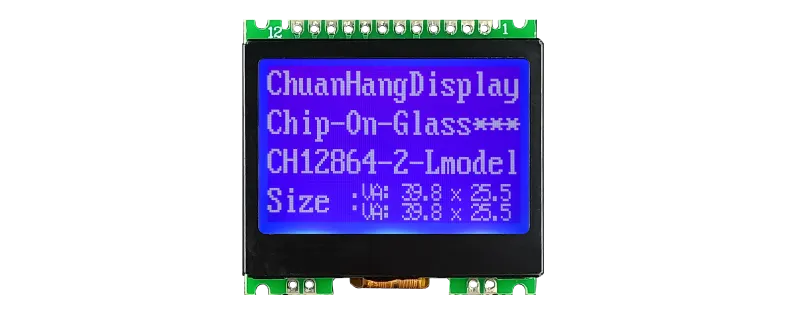
The COG LCD Screen has evolved from a niche solution for calculators to the backbone of industrial HMI. Its ability to deliver high-resolution data in a compact, vibration-resistant package makes it an indispensable tool for engineers worldwide. By focusing on the material science of the liquid crystal, the precision of the ACF bonding, and the stability of the driver IC, manufacturers like Chuanhang Display continue to push the boundaries of what is possible in monochrome visualization.
When selecting a display for your next B2B project, remember that the glass is only as good as the engineering that supports it. Prioritizing thermal resilience, interface compatibility, and supplier transparency will ensure that your product remains functional and legible for years to come.
Q1: What is the main difference between COG and COB LCDs?
A1: The primary difference lies in the placement of the driver IC. In a COB (Chip-on-Board) module, the IC is on a PCB connected to the glass via a bridge. In a COG LCD Screen, the IC is bonded directly onto the glass substrate. This makes COG modules significantly thinner, lighter, and more reliable in high-vibration environments.
Q2: Can I customize the FPC (ribbon cable) of a COG LCD?
A2: Yes. One of the major advantages of working with a manufacturer like Chuanhang Display is the ability to customize the FPC's length, width, and pinout. This allows the display to be integrated into complex mechanical housings without requiring an intermediate adapter board.
Q3: Does a COG LCD require a special backlight?
A3: Not necessarily. COG modules can use standard LED backlights (side-lit or bottom-lit). However, because COG screens are often used in slim devices, they frequently utilize high-efficiency side-lit LED arrays with specialized light guide plates (LGP) to maintain a thin profile while ensuring uniform brightness.
Q4: How do I handle the fragile edges of a COG glass?
A4: COG glass edges can be prone to chipping if handled incorrectly. During assembly, it is recommended to use a plastic or rubberized bezel that grips the glass securely without applying point pressure. Silicon gaskets are often used to provide a cushion between the glass and the product's front housing.
Q5: What is the typical lifespan of a monochrome COG LCD?
A5: The LCD glass and the driver IC themselves can last for decades. The limiting factor is usually the LED backlight, which typically has a half-life of 30,000 to 50,000 hours. If the backlight is replaceable or used with a timer, the functional life of the display can be significantly extended.
Q6: Why is my COG display showing "ghosting" or slow refresh at low temperatures?
A6: This is a characteristic of liquid crystal viscosity. At low temperatures, the liquid becomes more solid, slowing the rotation of the molecules. To solve this, you should use a "wide-temperature" liquid crystal fluid or implement a software-based temperature compensation algorithm that increases the driving voltage as the temperature drops.