In an era dominated by high-resolution color displays, the monochrome lcd display continues to dominate mission-critical applications—from semiconductor fabrication equipment to aerospace instrumentation. This persistence is not due to technological stagnation, but because monochrome technology offers unparalleled reliability, optical performance in extreme environments, and deterministic response times that color displays cannot guarantee. Drawing on semiconductor wafer fabrication parallels and extensive field data, this article provides a technical roadmap for engineers specifying display modules in high-reliability systems.
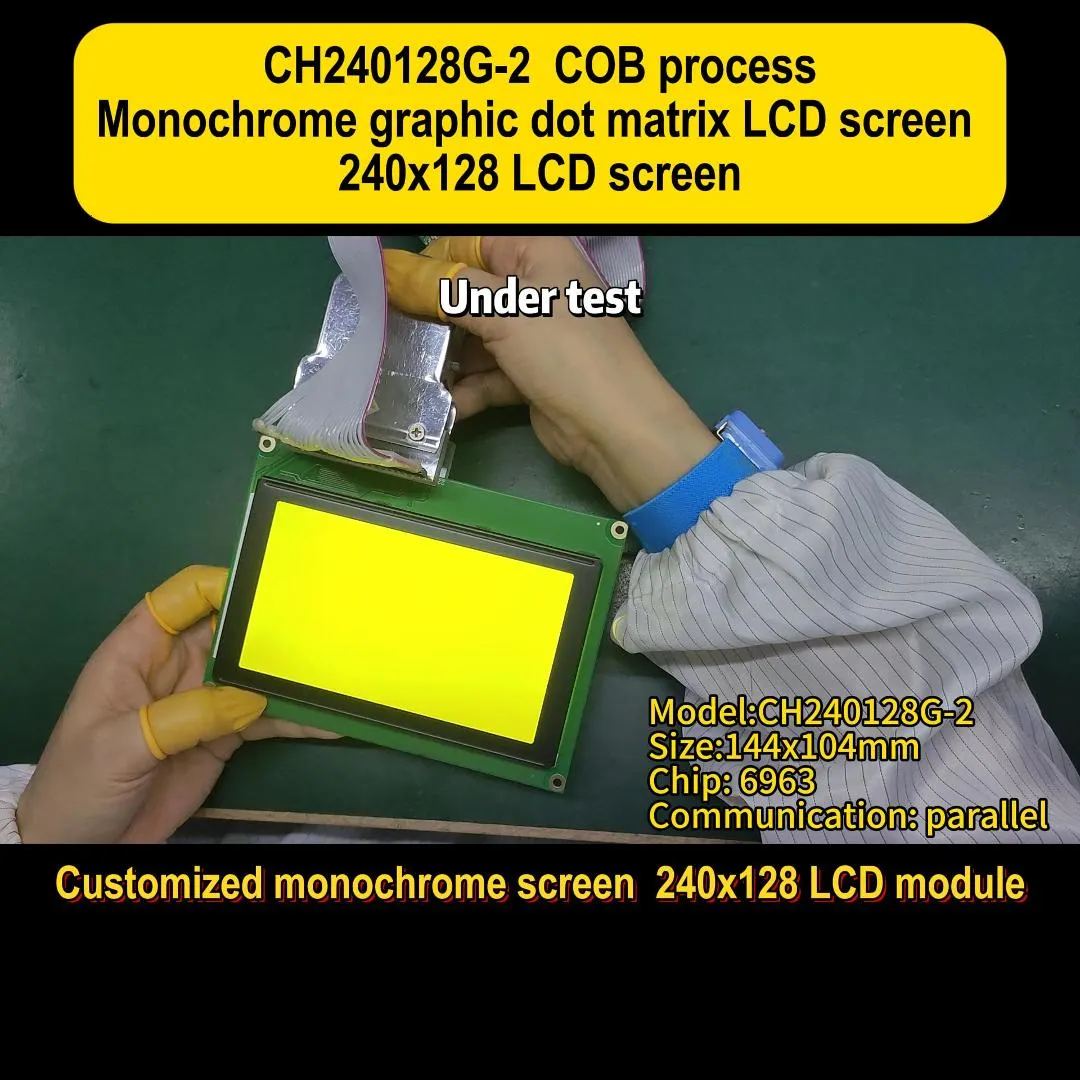
The fabrication of a high-quality monochrome lcd display shares fundamental processes with integrated circuit manufacturing. Both rely on photolithography, thin-film deposition, and precision etching. In LCD production, indium tin oxide (ITO) is sputtered onto glass substrates—similar to metal deposition in wafer fabs—and patterned to form transparent electrodes. The critical difference lies in the liquid crystal material itself: a birefringent fluid with dielectric anisotropy, aligned by polyimide layers rubbed to create uniform pretilt angles.
For industrial-grade modules, the driver IC (commonly fabricated on 200mm or 300mm wafers using high-voltage CMOS processes) is bonded via chip-on-glass (COG) or chip-on-board (COB) techniques. This semiconductor backbone ensures precise voltage control (typically 3V to 5V) across each segment or pixel. Companies like Chuanhang Display leverage this semiconductor heritage to achieve contrast ratios exceeding 8:1 even after 50,000 hours of operation.
Industrial systems demand functionality across extreme temperatures. A standard twisted nematic (TN) monochrome lcd display has a clear point (the temperature at which liquid crystal becomes isotropic) typically between +80°C and +100°C. Below -20°C, response times can exceed 500ms due to increased viscosity. For wide-temperature applications, engineers specify materials with lower rotational viscosity (γ1) and higher clearing points.
Commercial grade: Operating -10°C to +60°C, storage -20°C to +70°C.
Industrial grade: Operating -30°C to +80°C, storage -40°C to +90°C (achieved via specialized LC mixtures and heater films).
Military grade: Operating -40°C to +85°C, often with integrated thermostats.
Data from Chuanhang Display indicates that their industrial monochrome lcd display modules maintain 80% contrast from -20°C to +70°C without external heating, thanks to optimized LC formulations and polarizer stacks.
One of the most misunderstood parameters is the polarizer mode. For outdoor equipment (e.g., oil rig panels, toll booths), a transflective monochrome lcd display incorporates a semi-reflective layer that uses ambient light to illuminate the display, drastically reducing backlight power. Reflectivity values typically range from 5% to 15% for transflective stacks, while transmissive-only designs require continuous backlighting.
Film-compensated super-twisted nematic (FSTN) adds optical retardation films to neutralize the blue/yellow tint inherent in STN displays. This yields a near-black-on-white appearance with viewing cone angles up to 60° in all directions—critical for operator panels viewed from multiple angles. Contrast retention under direct sunlight (>10,000 lux) is achieved by combining high-aperture designs with circular polarizers that reduce glare.
While CCFL backlights are nearly obsolete in new designs, high-reliability sectors still require them for specific UV-curing applications. Modern monochrome lcd display modules predominantly use LED edge-lighting. Key parameters include:
Luminous intensity: Typically 80–150 cd/m² for indoor use; >400 cd/m² for sunlight-readable versions.
LED lifetime: L70 (time to 70% initial brightness) >50,000 hours for industrial LEDs vs. 20,000 hours for commodity types.
Color options: Yellow-green (peak 570nm) offers highest human eye sensitivity, while white (RGB LED) enables color filters if needed.
Power consumption in sleep mode can be as low as 5 µA for the LCD controller, with backlight adding 10–50 mA depending on size. For battery-operated field devices, a reflective mode (no backlight) is preferred; Chuanhang Display offers modules with 1/8 bias drive to minimize power draw.
The selection of the driver IC determines not only the resolution but also the MCU interface complexity. Common driver families (Sitronix, Novatek, Epson) support:
6800/8080 parallel: High-speed data transfer for large graphic arrays (e.g., 240x128 pixels).
Serial SPI / I²C: Reduced pin count, ideal for segment-type displays or small character modules.
Embedded charge pumps: Generate negative voltages (VEE) for LCD bias without external components.
For harsh electrical environments, differential signaling (LVDS) is rarely used in monochrome panels; instead, robust 3.3V or 5V tolerant I/O with Schmitt triggers prevent glitches. When specifying a monochrome lcd display for high-EMI applications, ensure the interface includes filtering capacitors and the controller supports partial refresh to reduce radiated emissions.
Industrial display modules must withstand vibration (up to 4G), shock (50G), and high humidity (95% RH). The weakest points are the zebra (elastomeric) connectors and the polarizer edges. Modern designs use pin-type connectors or FPC with heat-seal bonding. Accelerated life tests (85°C/85% RH for 1000 hours) reveal moisture ingress paths. A quality monochrome lcd display should exhibit less than 5% contrast degradation after such tests.
Based on field returns from 2020–2024, Chuanhang Display reports a FIT rate (failures in time) of < 50 for their COB modules, primarily due to open circuits in ITO traces—a failure mechanism mitigated by using double-layer ITO coatings and protective silicon dioxide overcoats, similar to passivation in semiconductor devices.

No single monochrome lcd display fits all scenarios. Below is a decision matrix for common industrial domains:
Medical ventilators: Require FSTN positive mode with white backlight and anti-microbial coatings. Contrast ratio >6:1, viewing angle >45°.
Smart meters (outdoor): Reflective TN or VA technology, no backlight, operating range -25°C to +70°C, with UV-stable polarizers.
Semiconductor wafer handlers: Need ESD protection (IEC 61000-4-2 level 4), and fast response (
<150ms 0="" at="">Marine navigation: Transflective blue mode with red dimmable backlight to preserve night vision.
Chuanhang Display provides custom solutions including heater films for arctic environments and optical bonding to eliminate condensation, ensuring the monochrome lcd display remains functional under the harshest conditions.
A1: When operated within specified voltage and temperature limits, the liquid crystal material itself does not degrade. The limiting factors are the backlight LED (L70 >50,000 hours) and the polarizer (UV degradation). With proper sealing, a monochrome lcd display can function for 10+ years continuously.
A2: Modern graphic monochrome LCDs offer pixel resolutions from 96x32 to 320x240 and beyond. They can display any pattern, including charts, barcodes, and Chinese characters, using built-in controllers with character generator ROM or custom CGRAM.
A3: TN is lowest cost and fastest response but limited viewing angle. STN offers wider viewing but has yellow/blue tint. FSTN adds a compensation film to make the background neutral (white/grey), ideal for applications requiring good aesthetics and readability from various angles.
A4: Liquid crystal viscosity increases exponentially as temperature drops, slowing molecular realignment. For cold environments, specify a wide-temperature LC fluid (e.g., -30°C operation) or add a transparent heater film. Response time at -20°C can be 5–10 times slower than at +25°C.
A5: No, LCDs use liquid crystals that switch electric fields and do not emit light. They are immune to burn-in. However, DC bias across a pixel for extremely long periods can cause electrochemical degradation; therefore, controllers invert the drive waveform periodically (frame inversion) to ensure net-zero DC.
A6: For character modules (16x2, 20x4), the parallel HD44780 interface is the de facto standard. For graphic modules, 8-bit parallel (with or without READ/WRITE) and SPI are most common. Many modules now also support I²C via bridge ICs.
A7: Yes, if you choose a reflective or transflective mode with a mirror-like reflector. Reflective displays appear dark on light background using ambient light; they become unreadable in darkness but excel under bright sun. For dual use, transflective with a controlled backlight is recommended.
The continued dominance of monochrome LCD technology in industrial and semiconductor equipment is underpinned by its deterministic behavior, wide operating margins, and manufacturing synergy with semiconductor processes. By understanding the interplay of liquid crystal materials, driver ICs, and optical enhancements, engineers can select a monochrome lcd display that delivers decades of reliable service. For custom requirements, consult with specialists like Chuanhang Display to leverage their semiconductor-grade design and testing expertise.