In the specialized world of Human-Machine Interfaces (HMI), the character LCD remains a cornerstone technology for industrial, medical, and telecommunications equipment. While high-resolution graphical displays dominate the consumer market, the alphanumeric character module provides an unmatched balance of cost-efficiency, low power consumption, and extreme reliability. For engineers and procurement specialists, selecting the right module involves navigating a complex array of technical specifications, from liquid crystal fluid types to interface protocols. This analysis examines the technical architecture of these displays and the strategic considerations necessary for long-term industrial deployment.

The functionality of a character LCD is centered around its internal controller, most commonly the industry-standard HD44780 or its modern equivalents like the ST7066 or SPLC780D. These controllers manage the complexity of driving the liquid crystal pixels by providing a pre-defined Character Generator ROM (CGROM).
CGROM and Font Tables: Most modules come with a standard English/Japanese or English/European font table stored in the ROM. This allows the host microcontroller to send simple ASCII codes to display characters, significantly reducing the computational overhead on the system’s main processor.CGRAM (Character Generator RAM): For specialized applications requiring custom symbols, such as battery icons or proprietary logos, these controllers offer a small amount of RAM (usually 64 bytes). This enables the definition of up to eight custom 5x8 pixel characters.Instruction Set Efficiency: The instruction set for these modules is designed for simplicity. By utilizing 4-bit or 8-bit parallel data buses, engineers can achieve rapid screen updates. In modern contexts where PCB real estate is limited, many manufacturers, including Chuanhang Display, now offer character modules with integrated I2C or SPI bridge chips to reduce the required pin count from 14-16 pins down to just 2-4 pins.
The visual performance of a character LCD is primarily dictated by the liquid crystal mode and the polarizer configuration. Unlike simple consumer gadgets, industrial displays must maintain contrast across wide temperature ranges and varied lighting conditions.
TN (Twisted Nematic): The baseline technology. It offers the fastest response times but the narrowest viewing angles. It is best suited for direct-view applications like handheld multimeters.STN (Super-Twisted Nematic): By increasing the twist angle of the liquid crystal molecules, STN provides a much higher contrast ratio and wider viewing angles (typically 60-120 degrees). It is available in Yellow-Green, Blue, and Grey modes.FSTN (Film-compensated STN): This involves adding a compensation film to the STN layer to cancel out the color tint, resulting in a true black-on-white or white-on-black display. FSTN is the preferred choice for medical devices and high-end industrial panels where legibility is critical.FFSTN (Double Film STN): For even more demanding environments, FFSTN provides a superior black background and nearly 180-degree viewing angles, rivaling the appearance of vacuum fluorescent displays (VFD) but at a fraction of the power consumption.
One of the most significant advantages of using a character LCD is its minimal power footprint. A standard 16x2 module typically consumes less than 2mA at 5V when the backlight is inactive. However, managing voltage becomes complex in modern 3.3V systems.
Many legacy controllers require a 5V supply to maintain logic levels and sufficient contrast. When integrating these into 3.3V architectures, engineers must use a logic level shifter or select a module with a built-in voltage booster. Furthermore, the contrast pin (V0) often requires a negative voltage bias if the display is intended for use in sub-zero temperatures. Without this negative voltage, the liquid crystal fluid becomes too viscous, and the display appears faint or blank.
Chuanhang Display addresses these challenges by offering "Wide Temperature" modules that incorporate internal temperature compensation circuits, ensuring the contrast remains stable from -20°C to +70°C without manual adjustment.
The physical construction of the display module impacts both its durability and its assembly cost. There are two primary manufacturing methods used in the industry:
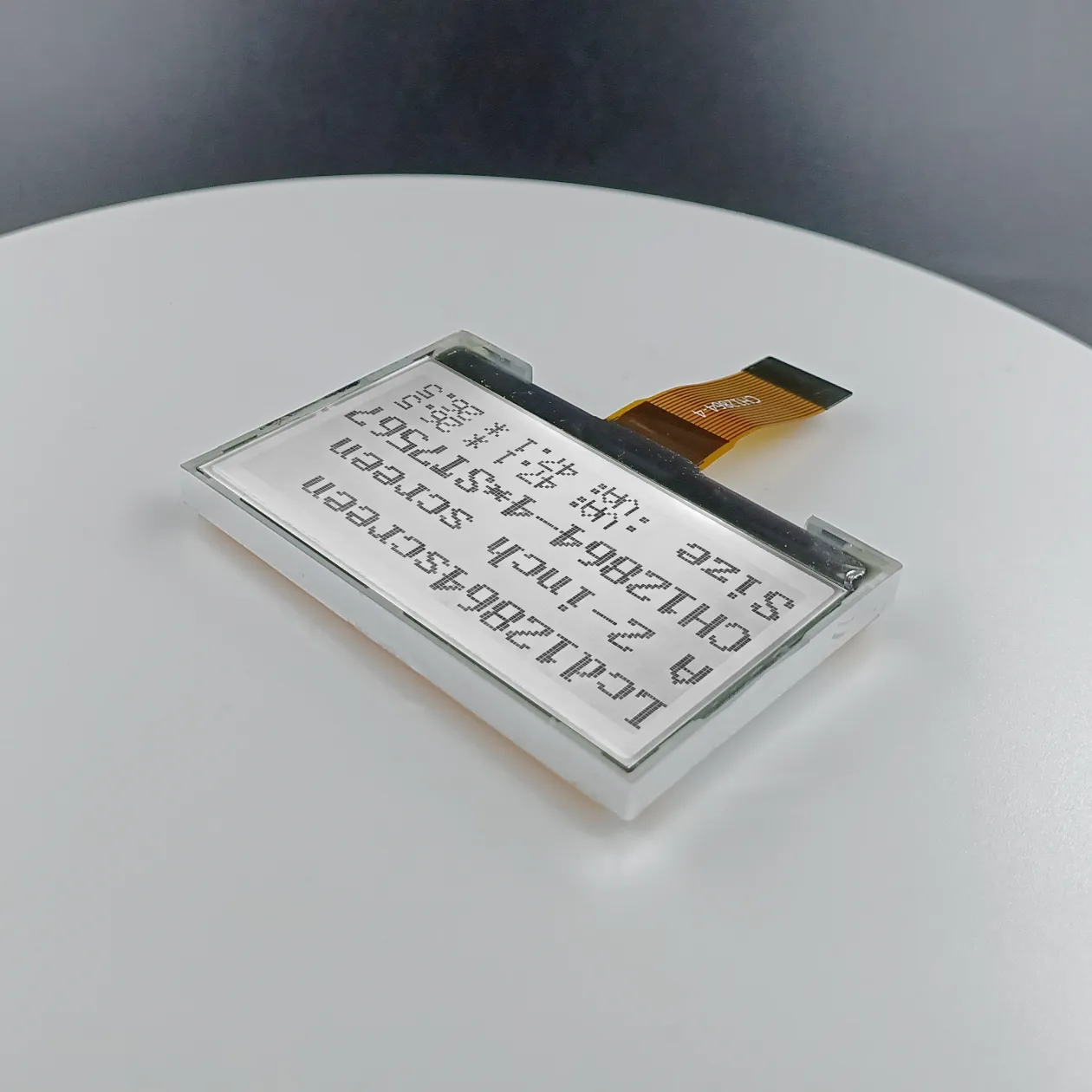
COB (Chip-on-Board): This is the most common form factor for a character LCD. The controller IC is mounted directly onto the PCB of the display module and covered with an epoxy "blob." This design is physically robust, provides easy mounting holes, and uses standard 2.54mm pitch headers for connectivity. It is ideal for heavy industrial machinery where vibration resistance is necessary.COG (Chip-on-Glass): In this configuration, the controller IC is bonded directly to the LCD glass. This results in a much thinner and lighter display. COG modules are frequently used in portable instruments where space is at a premium. However, they require more careful handling during assembly and usually utilize a flexible printed circuit (FPC) tail for connection.
While the liquid crystal itself is passive, the backlight determines the module's usability in dark or high-glare environments.
LED Backlighting: The current industry standard due to its long lifespan (up to 50,000 hours) and ease of dimming. For industrial applications, side-lit LEDs are preferred for thinness, while bottom-lit (array) LEDs are used for maximum brightness and uniformity.Color Uniformity: Achieving a consistent "Industrial White" or "Safety Amber" across multiple production batches requires strict LED binning. High-tier suppliers ensure that the chromaticity coordinates of the LEDs remain within a tight tolerance, preventing the "rainbow effect" often seen when multiple machines are lined up in a control room.Thermal Considerations: Driving a backlight at maximum brightness generates heat, which can affect the liquid crystal's clearing point. Professional designs include current-limiting resistors calculated specifically for the forward voltage of the LED array to prevent thermal runaway.
In the B2B sector, the cost of the display is often secondary to the cost of re-qualifying a new component. A significant pain point for manufacturers is the "End of Life" (EOL) cycle of display controllers.
When sourcing a character LCD, it is vital to evaluate the supplier's track record regarding product longevity. Industrial projects often have lifespans of 10 to 15 years. Working with established manufacturers like Chuanhang Display provides an assurance of supply chain stability. They maintain buffer stocks of critical ICs and offer pin-compatible replacements if a specific glass substrate or controller is discontinued.
Pricing Factors:
Volume Breaks: The price difference between 100 units and 5,000 units can be as much as 40% due to the efficiencies of automated SMT and bonding lines.Customization NRE: If a standard 16x2 or 20x4 module does not fit, custom glass shapes or specialized icons require a Non-Recurring Engineering (NRE) fee. For character-based displays, these fees are relatively low, making customization accessible for mid-volume projects.
The enduring relevance of the character LCD in a world of high-definition touchscreens is a testament to its functional efficiency. By providing clear, high-contrast alphanumeric data with minimal power and processing requirements, these modules remain the optimal choice for ruggedized industrial interfaces. Success in implementation depends on a deep understanding of the interplay between controller logic, fluid chemistry, and mechanical mounting. By partnering with technical experts and focusing on long-term reliability rather than just the lowest initial price, engineers can ensure their products perform consistently in the field for decades.
Q1: What is the difference between a 1602 and a 2004 character LCD?
A1: These numbers refer to the display capacity. A 1602 module displays 16 characters per line across 2 lines (32 characters total). A 2004 module displays 20 characters per line across 4 lines (80 characters total). Both typically use the same HD44780-compatible command set, though the memory addresses for the start of each line will differ.
Q2: Can I use a 5V character LCD with an Arduino or ESP32 running at 3.3V?
A2: Yes, but with precautions. While the 3.3V logic high may trigger a 5V LCD's inputs, it is safer to use a level shifter. Additionally, you must ensure the LCD has a separate 5V supply for the power pin (VDD) and the backlight, or the contrast will be insufficient.
Q3: Why does my display screen turn completely black or completely blank when I turn it on?
A3: This is almost always related to the contrast adjustment pin (V0). If the voltage on V0 is too low (relative to VDD), all pixels will activate (black blocks). If it is too high, no pixels will show. A 10k ohm potentiometer connected between VDD and Ground, with the wiper connected to V0, is the standard method for manual adjustment.
Q4: What are the advantages of an I2C interface over a parallel interface for these displays?
A4: The primary advantage is pin conservation. A parallel interface requires at least 6 to 10 GPIO pins. An I2C interface requires only 2 pins (SDA and SCL). This is especially useful for small microcontrollers with limited I/O. However, parallel interfaces are slightly faster for high-speed data refresh.
Q5: How do I choose between a Yellow-Green and a Blue STN display?
A5: Yellow-Green STN displays are typically reflective or transflective, meaning they are very easy to read in direct sunlight even without a backlight. Blue STN displays are transmissive and rely on the backlight; they look modern and high-contrast in indoor settings but can wash out in bright outdoor environments.
Q6: What is the lifespan of the LED backlight in a professional character LCD?
A6: Most industrial-grade LED backlights are rated for 30,000 to 50,000 hours of continuous use before the brightness drops to 50% of its original value. To extend this lifespan, it is recommended to use PWM (Pulse Width Modulation) to dim the backlight or turn it off entirely during periods of inactivity.