The global market for integrated human-machine interfaces (HMIs) continues to expand, driven by the need for intuitive control in industrial automation, medical devices, and smart appliances. According to recent industry data, the broader display module market is projected to grow at a compound annual rate exceeding 6% through the decade, with tft display touch screen modules representing the fastest-growing segment due to their combination of vivid graphics and interactive capability. However, selecting the right tft display touch screen involves far more than comparing resolution and size. Engineers and procurement specialists must evaluate optical bonding techniques, touch controller compatibility, environmental sealing, and long-term supply stability. This article provides a data-backed framework for making an informed decision, referencing real-world applications and standards.
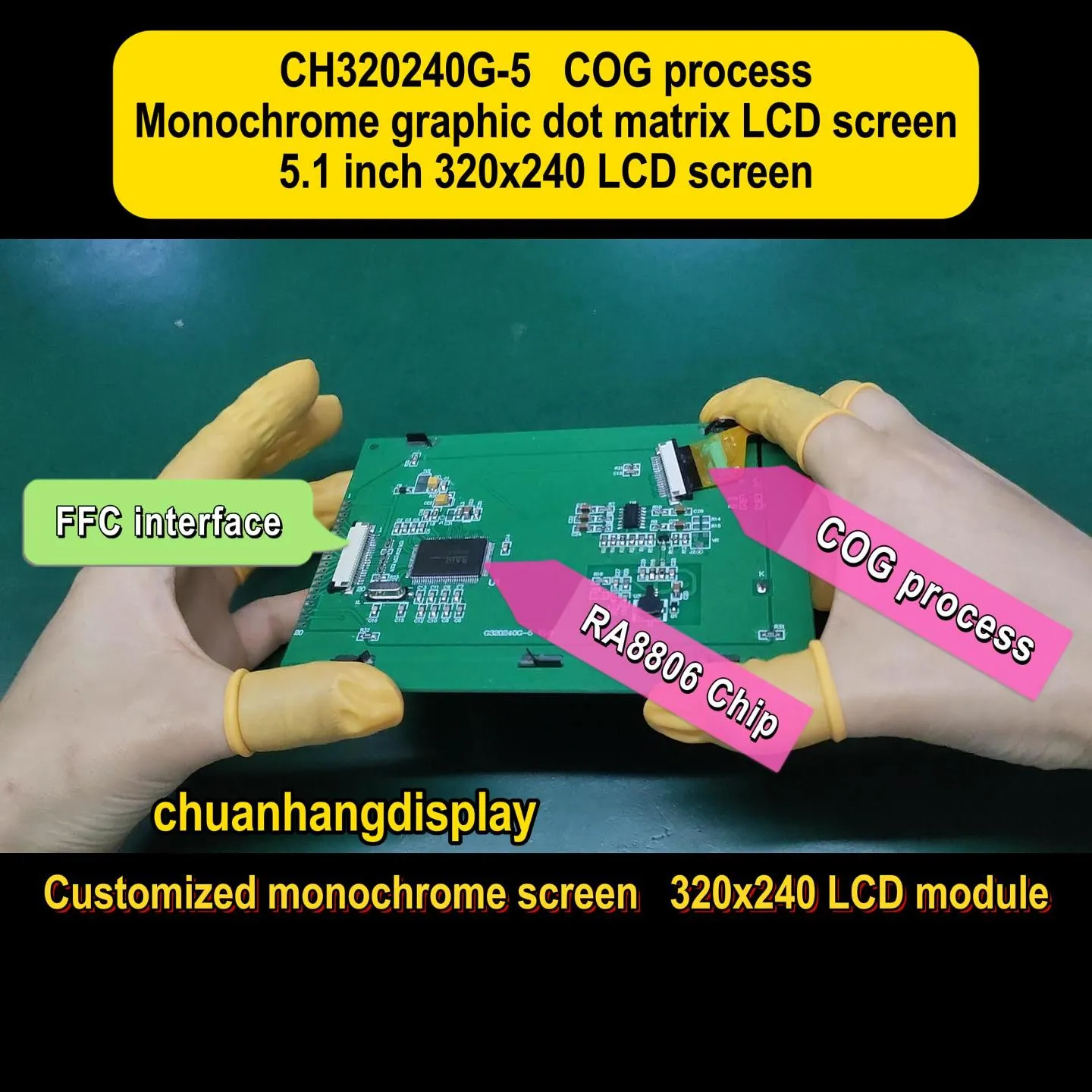
A standard tft display touch screen module consists of a TFT LCD and a separate touch sensor (e.g., glass or film). Without optical bonding, an air gap exists between the two layers, causing approximately 8–10% loss in brightness due to Fresnel reflections at each interface. More critically, this gap allows condensation and dust ingress, degrading visibility in outdoor or high-humidity environments.
Optical bonding fills the gap with a transparent adhesive (OCA or OCR) that matches the refractive index of glass (~1.5). Benefits include:
Enhanced transmittance: up to 10% higher effective brightness without increasing backlight power.
Durability: bonded modules withstand shock and vibration better, as the touch sensor is mechanically coupled to the LCD.
Condensation prevention: eliminates the internal air volume where fogging occurs.
For applications requiring direct sunlight readability—such as marine navigation or outdoor kiosks—optical bonding is mandatory. Manufacturers like Chuanhang Display offer full optical bonding services with anti-reflective coatings, achieving<800 nits="" brightness="" and="">tft display touch screen for high-ambient-light conditions, always request bonded samples and measure contrast ratio under 10,000 lux illumination.
PCAP technology has become dominant in consumer and industrial tft display touch screen designs. It supports true multi-touch, gestures (pinch, zoom), and high clarity due to minimal layer stack. Modern PCAP controllers can also handle thick gloves (up to 5mm) and wet surfaces through advanced signal processing, but this requires careful sensor pattern design and firmware tuning. For example, mutual-capacitance scanning with automatic tuning can adapt to changing environmental conditions.
Resistive touch remains relevant in extreme industrial environments—oil & gas, food processing, or logistics—where users may wear thick, dirty gloves and operate with stylus or any object. A 5-wire resistive analog tft display touch screen offers proven durability (>1 million touches) and operates at temperatures from -30°C to +80°C. The trade-off is lower light transmission (≈80%) and no multi-touch. Engineers should evaluate whether the application requires bare-finger interaction or absolute reliability with any actuator. A hybrid approach, such as using a resistive overlay on a high-brightness TFT, is sometimes the optimal choice for heavy industrial terminals.
The electrical interface of the tft display touch screen dictates processor compatibility and signal integrity over cable lengths. For small to medium sizes (up to 7-inch), parallel RGB or MIPI DSI are common, offering high bandwidth for resolutions up to 1080p. Larger industrial panels often use LVDS (Low-Voltage Differential Signaling) due to its noise immunity and longer reach (up to 5 meters). When designing a distributed system—where the display is remote from the main board—consider converting to HDMI or using extender ICs.
The touch controller's interface must match the host's capabilities. I2C is typical for embedded systems with limited pins, while USB is preferred for PC-based HMIs. Advanced touch controllers now embed gestures and self-calibration routines, offloading the main processor. For instance, many PCAP controllers support up to 10 touches and report coordinates via I2C at 400 kHz. Verify that the tft display touch screen vendor provides Linux/Android drivers or a Windows HID-compliant driver. Chuanhang Display supplies comprehensive driver support and tuning tools for their modules, reducing integration time.
Industrial and outdoor tft display touch screen modules must endure extreme temperatures. Standard commercial TFTs are rated -20°C to +70°C, but for automotive or outdoor enclosures, wider ranges (-40°C to +85°C or +95°C) are necessary. The liquid crystal response time slows at low temperatures; heating elements or quick-response LC modes (like OCB) can mitigate this. Additionally, the touch sensor adhesive and cover glass must have matched coefficients of thermal expansion to prevent delamination.
For washdown environments (food, pharmaceutical), the entire front panel should meet IP65 or IP68. This requires a gasketed design between the tft display touch screen and enclosure. The cover glass can be treated with oleophobic and chemical-resistant coatings to withstand repeated cleaning with aggressive agents (e.g., bleach, alcohol). Always request test reports for chemical resistance if the display will be used in medical or laboratory settings.
Industrial products often have lifecycles of 5–10 years, while consumer-grade TFT panels may be discontinued within 2 years. It is essential to partner with a supplier that offers long-term availability or alternate sourcing. Chuanhang Display specializes in industrial-grade modules with guaranteed supply and revision control. Ask about the panel's driver IC status and whether the manufacturer has a product continuity program.
Standard off-the-shelf tft display touch screen modules rarely fit perfectly into a unique enclosure. Look for a vendor capable of custom cover glass shapes, optical bonding with anti-reflective or anti-glare textures, and EMI shielding. Some projects require integrated mounting brackets or heat spreaders. Early engagement with the display manufacturer's engineering team can resolve mechanical conflicts before tooling begins.

Medical Devices (patient monitors, infusion pumps): require antimicrobial coatings, optical bonding to reduce parallax, and PCAP for gloved operation. The tft display touch screen must comply with IEC 60601-1 for electrical safety.
Industrial Automation (PLC HMIs, CNC controls): demand resistive or high-noise-immune PCAP, wide viewing angles (IPS technology), and extended temperature ranges. Often need to withstand cutting fluids and metal chips.
Marine and Navigation: mandatory sunlight readability, optical bonding, and NVIS compatibility for night vision. Bonded tft display touch screen modules prevent fogging in high-humidity environments.
Smart Retail / Kiosks: require vandal-resistant glass, high brightness (1000+ nits), and PCAP with palm rejection.
One frequent issue is ESD (electrostatic discharge) damaging the touch controller through the cover glass edges. Mitigation includes using grounded conductive gaskets and selecting controllers with robust ESD protection (≥15kV air discharge). Another challenge is optical interference from backlight PWM (pulse-width modulation) causing flicker on camera sensors; choose displays with high-frequency PWM (>20kHz) or DC dimming. Finally, ensure the tft display touch screen module's FPC (flexible printed circuit) bending radius is not violated during assembly—a leading cause of intermittent failures. Work with your supplier to define mechanical tolerances.
A1: A TFT LCD is the display component that generates the image. A tft display touch screen integrates a touch sensor (resistive or capacitive) onto the TFT LCD, either as an add-on film or optically bonded cover glass. The latter includes a touch controller IC and firmware to translate touches into coordinates, making it a complete HMI subsystem.
A2: Yes, but the touch technology matters. Projected capacitive (PCAP) can be tuned for glove sensitivity up to 5mm thickness, but performance may degrade with heavy water droplets. Resistive touch remains the most reliable choice for wet environments and any glove material because it responds to physical pressure. Some specialized tft display touch screen modules combine PCAP with glove/wet modes selectable via firmware.
A3: Optical bonding fills the air gap between the TFT and the touch sensor with a transparent adhesive. It is necessary for outdoor applications, high-vibration environments, or when maximum contrast and readability are required. It improves durability and eliminates condensation. If your tft display touch screen will be used in direct sunlight or extreme humidity, bonding is highly recommended.
A4: Partner with manufacturers that focus on industrial and medical markets, such as Chuanhang Display. Request a product lifecycle statement and confirm the panel driver IC is not nearing end-of-life. Consider designing in a standard mechanical footprint so that if the panel changes, the mounting remains compatible. Also, maintain a buffer stock for critical programs.
A5: LVDS or differential signaling interfaces offer the best noise immunity for distances over 0.5 meters. For the touch controller, I2C with shielded cables or USB with ferrite beads can help. Ensure the tft display touch screen module's PCB layout includes proper grounding and ESD protection. Your vendor can provide layout guidelines.
A6: Sunlight readability requires high luminance (≥800 nits) and low reflectance. Optical bonding with AR coating reduces reflections from 10% to below 1%. Additionally, selecting a TFT with a normally black mode (like VA or IPS with high contrast) helps maintain legibility. A bonded tft display touch screen is the standard solution for outdoor kiosks and automotive dashboards.