Selecting an lcd screen for industrial, medical, or outdoor applications involves considerations far beyond consumer-grade specifications. Factors such as wide operating temperature, high brightness for sunlight readability, and extended product life cycles dominate the decision matrix. According to a 2026 report by Interact Analysis, the industrial display market is projected to grow at 6.8% CAGR, driven by human-machine interface (HMI) upgrades in manufacturing and smart infrastructure. This article provides a technical deep dive into lcd screen engineering—from backlight technology to optical bonding—and references implementations by Chuanhang Display, a manufacturer with over 15 years of experience supplying rugged displays to automation, medical, and transportation sectors.

The backlight unit determines the brightness, uniformity, and lifespan of an lcd screen. While CCFL (cold cathode fluorescent) backlights are now obsolete in consumer products, some industrial replacements still require them for legacy equipment. Modern industrial lcd screen designs exclusively use LED backlights, which offer lower power consumption, longer life (50,000‑100,000 hours), and dimming capabilities. For outdoor applications, luminance must exceed 1000 cd/m² (nits) to overcome ambient sunlight. Chuanhang Display's sunlight‑readable models achieve 1500 nits using high‑efficiency LED arrays and optical films that minimize power draw.
Industrial lcd screen installations often face ambient temperatures from -20°C to +70°C or more. Standard commercial LCDs (0°C to 50°C) will exhibit slow response times or permanent damage outside this range. Wide‑temperature LCDs use heated backlight units or specialized liquid crystal mixtures (e.g., with lower viscosity) to maintain switching speed at sub‑zero temperatures. Chuanhang Display offers displays with integral heaters that automatically activate below 5°C, ensuring startup in cold storage or outdoor kiosks. Thermal management also includes aluminum chassis that act as heat sinks, preventing hot spots when operating at high brightness.
A common complaint with lcd screen use outdoors is washout due to ambient light. Two techniques mitigate this:
Chuanhang Display's outdoor terminals combine both techniques, achieving a contrast ratio of 800:1 in 40,000 lux ambient light (simulated sunlight).
Industrial lcd screen systems frequently incorporate touch input. The choice depends on the operating environment:
For both types, surface hardness (pencil hardness ≥ 7H) and chemical resistance (against cleaning agents) are specified.
While resolution (XGA, WXGA, Full HD, 4K) is often driven by application, viewing angle is critical for industrial HMIs where operators stand off‑axis. IPS (in‑plane switching) or MVA (multi‑domain vertical alignment) panels provide 178° viewing angles with minimal color shift. For medical or aviation, color accuracy (ΔE < 2) is required. Chuanhang Display's medical‑grade monitors are calibrated per DICOM Part 14 standards, ensuring consistent grayscale rendering for diagnostic imaging.
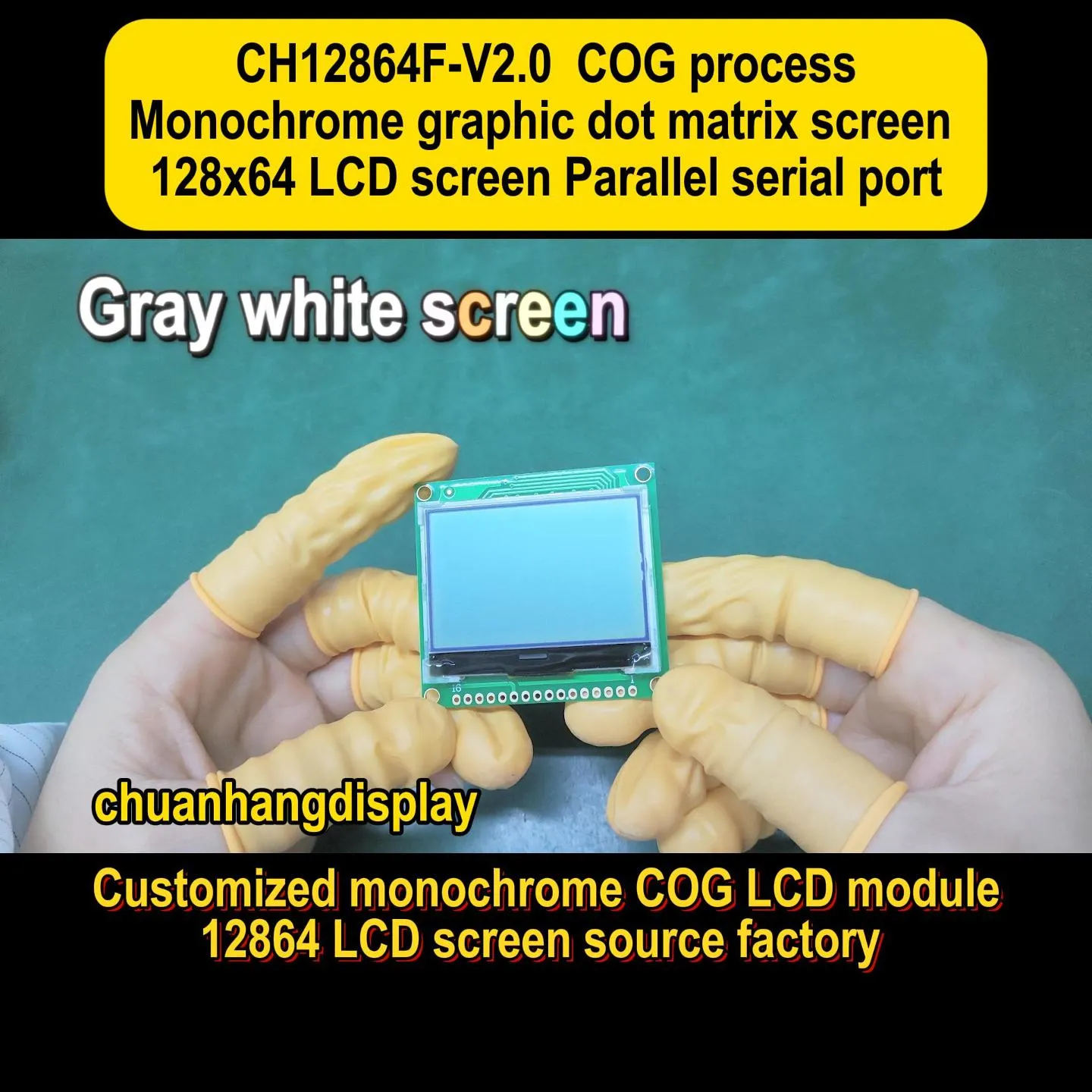
Industrial equipment often has a lifespan of 10‑15 years, far exceeding consumer product cycles. A major risk is obsolescence of the lcd screen. Reputable suppliers like Chuanhang Display guarantee product availability for 5‑7 years after launch and offer last‑time buy options. They also maintain cross‑reference databases to match legacy displays (e.g., Sharp, NEC, Optrex) with form‑fit‑function compatible replacements, including adapter boards for interface conversion.
The lcd screen must match the host system's video interface. Industrial displays commonly support:
Chuanhang Display provides interface boards that convert HDMI or VGA to the panel's native protocol, simplifying integration with standard single‑board computers.
Transportation and heavy machinery applications expose lcd screen to continuous vibration. Specifications should reference IEC 60068‑2‑6 (vibration) and 60068‑2‑27 (shock). Ruggedized displays feature reinforced bezels, secured PCB mounting, and sometimes conformal coating on the control board to prevent short circuits from conductive dust. Chuanhang Display's railway‑certified displays meet EN 50155 for shock and vibration, with MTBF exceeding 100,000 hours.
For night vision imaging systems (NVIS) in military or aviation, displays must not emit near‑IR light that interferes with goggles. This requires NVIS‑compliant filters and backlight units. In non‑military settings, circular polarizers can be added to reduce glare from curved surfaces. Chuanhang Display offers custom optical stacks tailored to specific spectral requirements.
Industrial lcd screen must comply with regional regulations: UL/cUL, CE, FCC Class A (industrial) or Class B (residential). For medical, IEC 60601‑1 (safety) and 60601‑1‑2 (EMC) are mandatory. Chuanhang Display provides a full declaration of conformity with each shipment, including test reports from accredited labs.
Q1: What is the difference between an industrial LCD and a commercial LCD?
A1: Industrial lcd screen are designed for wider operating temperatures (-20°C to +70°C or wider), longer product lifecycles (5‑7 years availability), higher brightness options, and often include features like optical bonding. Commercial displays are optimized for indoor consumer use with limited temperature range and shorter production cycles.
Q2: How do I make an LCD screen readable in direct sunlight?
A2: Increase brightness to at least 1000‑1500 nits and use optical bonding to eliminate the air gap, reducing internal reflections. An anti‑reflective coating on the cover glass further improves readability. Chuanhang Display's sunlight‑readable kits combine these techniques.
Q3: Can I use a standard LCD in an outdoor kiosk?
A3: Not recommended. Standard LCDs will overheat in direct sun, and the liquid crystal may darken or become permanently damaged above 50°C. Additionally, humidity and condensation can penetrate non‑sealed units. Always specify an industrial‑grade LCD with proper thermal management.
Q4: What is the typical lifespan of an industrial LCD backlight?
A4: LED backlights in industrial lcd screen are rated for 50,000‑100,000 hours to half‑brightness (L50). This equates to 5‑11 years of continuous 24/7 operation. Actual lifespan depends on operating temperature and drive current.
Q5: How do I match a replacement LCD to an existing system?
A5: Document the original part number, resolution, interface (LVDS, eDP, etc.), and physical dimensions. Suppliers like Chuanhang Display maintain cross‑reference databases to suggest form‑fit‑function replacements, often including adapter cables for interface changes.
Q6: What is optical bonding, and is it worth the cost?
A6: Optical bonding fills the air gap between the LCD and cover glass with a transparent adhesive. It improves contrast in bright light, prevents fogging, and adds impact resistance. For outdoor or high‑vibration environments, the added cost is justified by improved reliability and readability.